Department of Sport Science, Faculty of Medicine and Health Sciences, Stellenbosch University, Stellenbosch, South Africa.
Institute of Sport and Exercise Medicine, Department of Surgical Sciences, Faculty of Medicine and Health Sciences, Stellenbosch University, South Africa.
Prosthet Orthot Int. 2022 Jun 1;46(3):258-266. doi: 10.1097/PXR.0000000000000079. Epub 2022 Jan 10.
Individuals with unilateral transtibial amputation are at risk of abnormal mechanical joint loading and development of osteoarthritis on sound side joint structures.
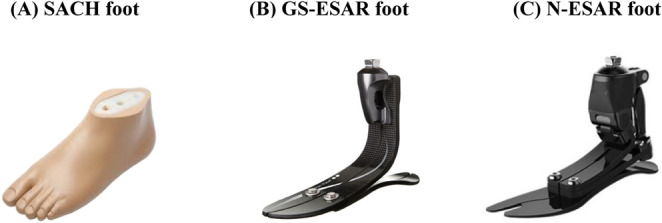
This study describes the spatiotemporal and kinetic and kinematic parameters related to osteoarthritis in participants while using (A) a solid-ankle cushioned-heel prosthesis (SACH), (B) a conventional energy storage and return (ESAR) foot prosthesis, and (C) a novel ESAR (N-ESAR) foot prosthesis.
A pragmatic randomized controlled trial.
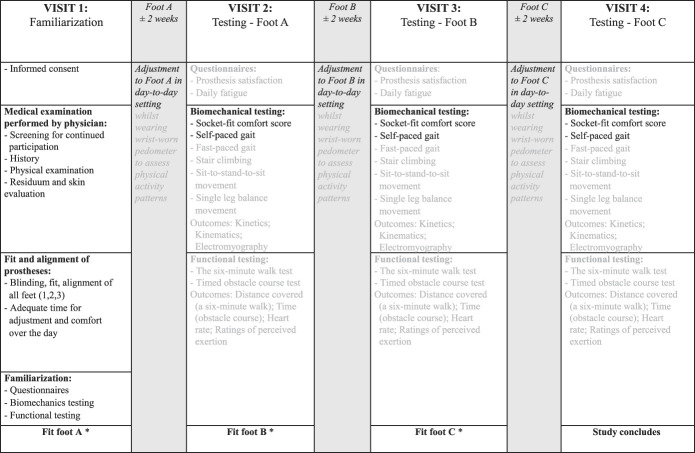
K3-K4 ambulators used three feet in a 2-week randomized cross-over order. Kinetics of vertical ground reaction forces (vGRFs) and 3D kinematics of joint angles were integrated to provide normalized parameters. Data were analyzed using one way and mixed model Analysis of variance (ANOVAs) (p < 0.05) and Cohen d statistic.
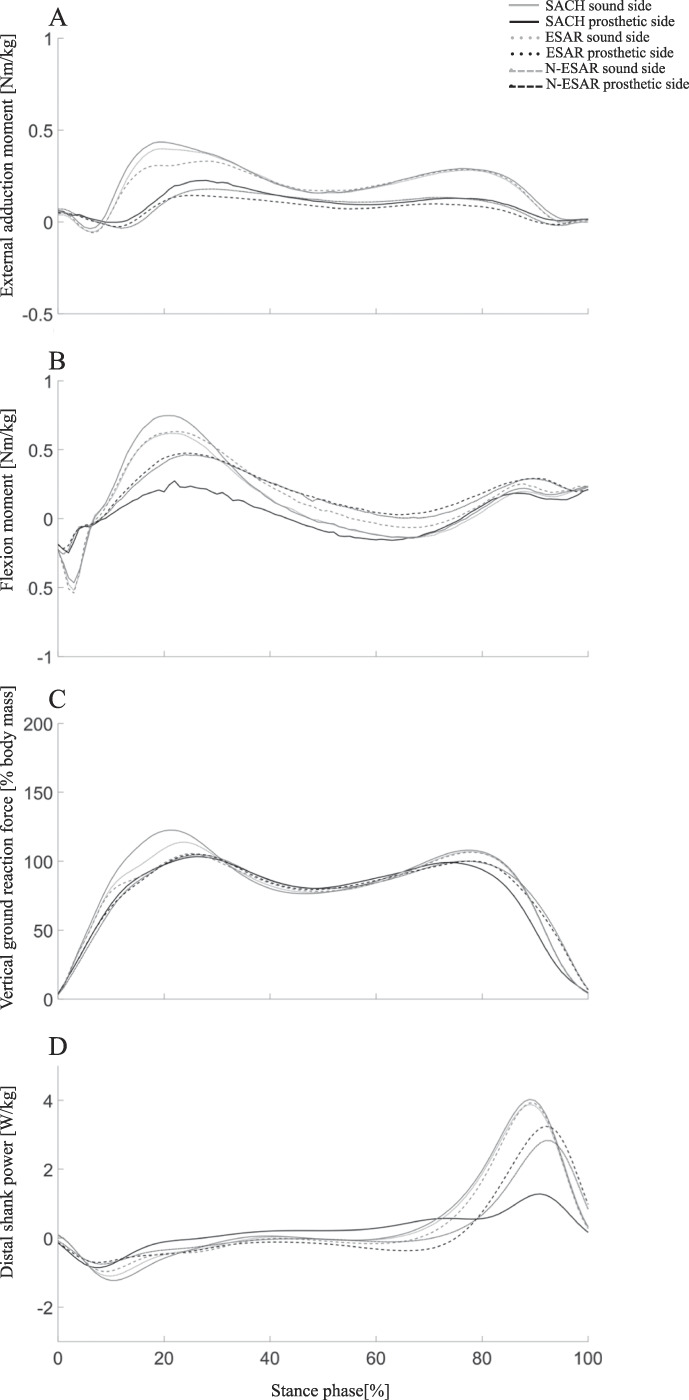
Twenty participants, aged 40 ± 16 years with body mass index of 24.7 ± 3.6 kg/m2, experienced minimal change in the spatiotemporal parameters between feet. Participants using the N-ESAR foot prosthesis experienced reduced peak knee external adduction moment (p = 0.030), peak vGRFs (p < 0.001), and peak loading rate of vGRFs (p = 0.030). Peak knee flexion moments only changed when using the solid-ankle cushioned-heel prosthesis, in a positive direction (p = 0.014). Using the N-ESAR prosthesis also increased peak distal shank power during late stance phase (p < 0.001).
A novel ankle/foot ESAR prosthesis reduces loading on the sound side. With extended use of the N-ESAR foot prosthesis, these findings may provide the prosthesis user with improved outcomes related to sound side loading and development of osteoarthritis.
单侧小腿截肢者存在异常机械关节负荷和健侧关节结构骨关节炎发展的风险。
本研究描述了使用(A)实心踝垫后跟假肢(SACH)、(B)传统储能和回弹(ESAR)脚假肢和(C)新型 ESAR(N-ESAR)脚假肢的参与者中与骨关节炎相关的时空和运动学及运动学参数。
实用随机对照试验。
K3-K4 步行者在 2 周的随机交叉顺序中使用三种脚。垂直地面反作用力(vGRFs)的动力学和关节角度的 3D 运动学被整合以提供归一化参数。使用单向和混合模型方差分析(ANOVA)(p<0.05)和 Cohen d 统计分析数据。
20 名参与者,年龄 40±16 岁,体重指数为 24.7±3.6 kg/m2,双脚的时空参数变化最小。使用 N-ESAR 脚假肢的参与者经历了降低的峰值膝关节外展力矩(p=0.030)、峰值 vGRFs(p<0.001)和 vGRFs 峰值加载率(p=0.030)。只有在使用实心踝垫后跟假肢时,峰值膝关节屈曲力矩才会发生变化,呈正方向(p=0.014)。使用 N-ESAR 假肢还增加了晚期站立阶段的峰值远端小腿功率(p<0.001)。
一种新型踝关节/脚 ESAR 假肢可减少健侧的负荷。随着 N-ESAR 脚假肢的广泛使用,这些发现可能为假肢使用者提供与健侧负荷和骨关节炎发展相关的改善结果。