Department of Neuroscience, Harvard University, Boston, MA, 02138, USA.
Division of Developmental Medicine, Boston Children's Hospital, Harvard Medical School, Boston, MA, 02115, USA.
J Neurodev Disord. 2022 Jan 12;14(1):6. doi: 10.1186/s11689-021-09413-x.
Differences in face processing in individuals with ASD is hypothesized to impact the development of social communication skills. This study aimed to characterize the neural correlates of face processing in 12-month-old infants at familial risk of developing ASD by (1) comparing face-sensitive event-related potentials (ERP) (Nc, N290, P400) between high-familial-risk infants who develop ASD (HR-ASD), high-familial-risk infants without ASD (HR-NoASD), and low-familial-risk infants (LR), and (2) evaluating how face-sensitive ERP components are associated with development of social communication skills.
12-month-old infants participated in a study in which they were presented with alternating images of their mother's face and the face of a stranger (LR = 45, HR-NoASD = 41, HR-ASD = 24) as EEG data were collected. Parent-reported and laboratory-observed social communication measures were obtained at 12 and 18 months. Group differences in ERP responses were evaluated using ANOVA, and multiple linear regressions were conducted with maternal education and outcome groups as covariates to assess relationships between ERP and behavioral measures.
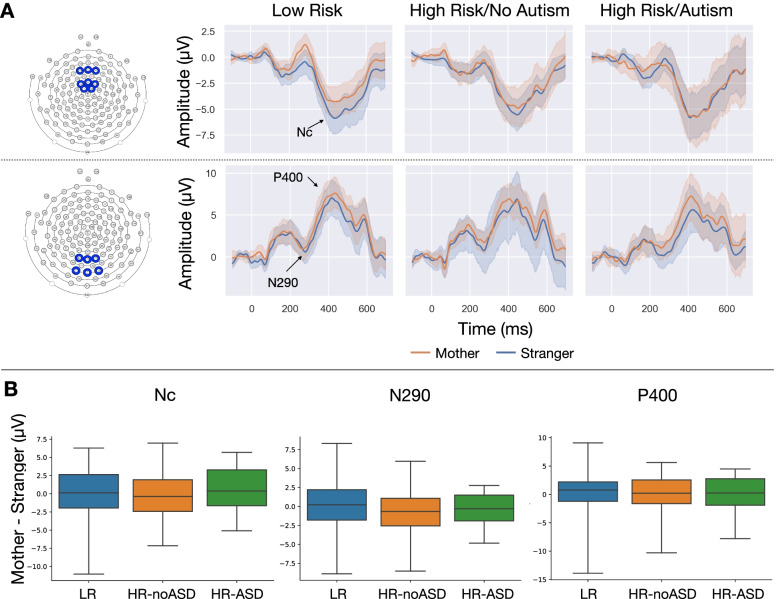
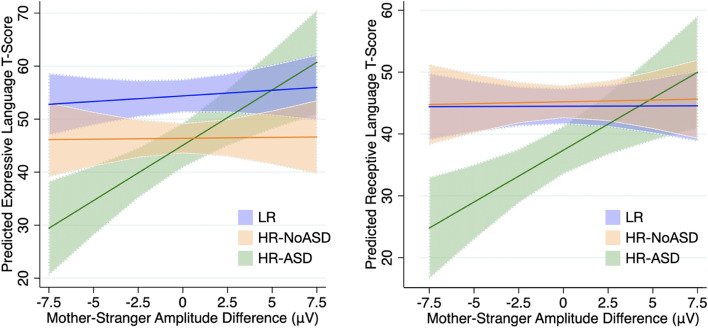
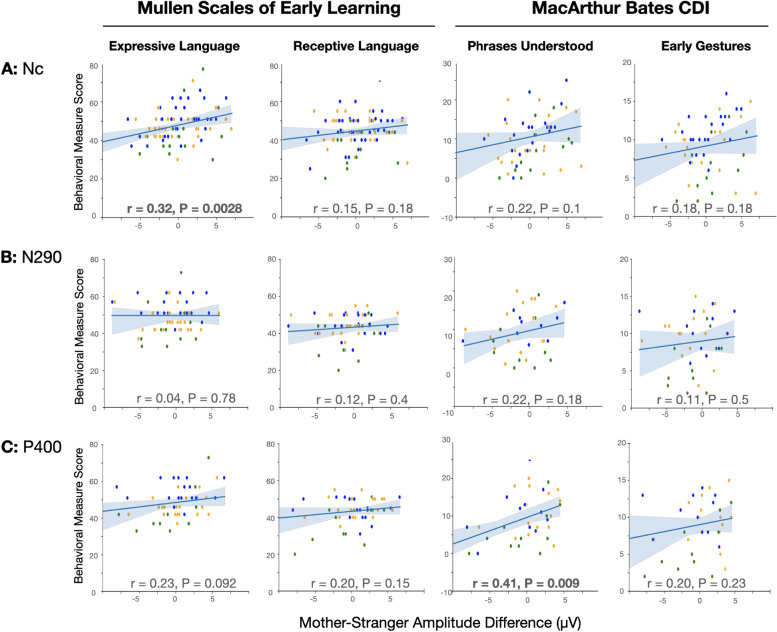
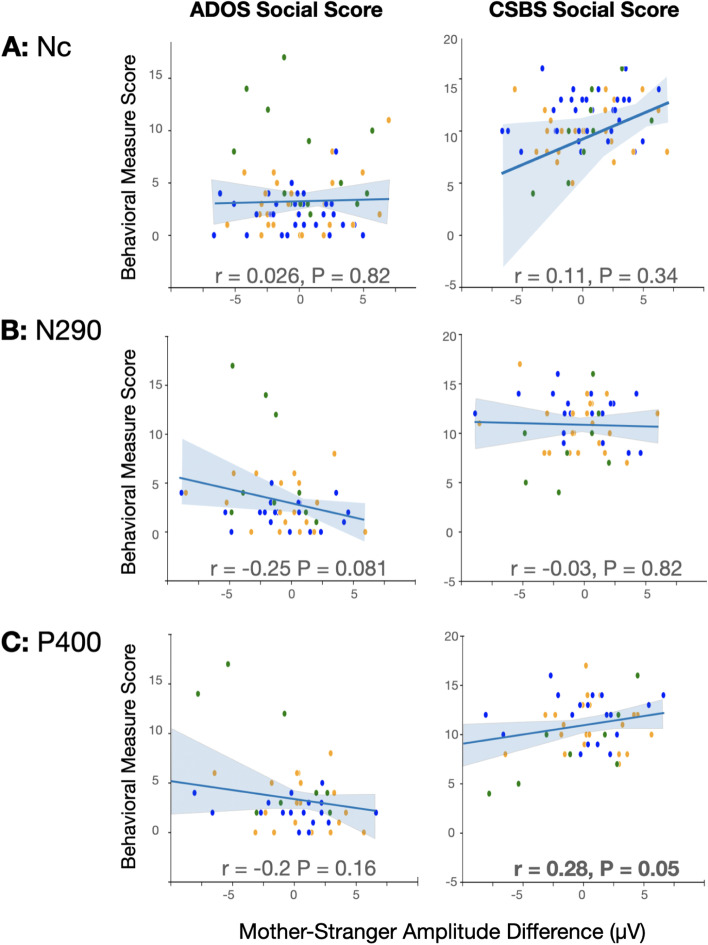
For each of the ERP components (Nc [negative-central], N290, and P400), the amplitude difference between mother and stranger (Mother-Stranger) trials was not statistically different between the three outcome groups (Nc p = 0.72, N290 p = 0.88, P400 p = 0.91). Marginal effects analyses found that within the LR group, a greater Nc Mother-Stranger response was associated with better expressive language skills on the Mullen Scales of Early Learning, controlling for maternal education and outcome group effects (marginal effects dy/dx = 1.15; p < 0.01). No significant associations were observed between the Nc and language or social measures in HR-NoASD or HR-ASD groups. In contrast, specific to the HR-ASD group, amplitude difference between the Mother versus Stranger P400 response was positively associated with expressive (dy/dx = 2.1, p < 0.001) and receptive language skills at 12 months (dy/dx = 1.68, p < 0.005), and negatively associated with social affect scores on the Autism Diagnostic Observation Schedule (dy/dx = - 1.22, p < 0.001) at 18 months.
In 12-month-old infant siblings with subsequent ASD, increased P400 response to Mother over Stranger faces is positively associated with concurrent language and future social skills.
自闭症谱系障碍(ASD)个体在面部处理方面的差异被假设会影响社交沟通技能的发展。本研究旨在通过(1)比较有发展 ASD 高家族风险的婴儿(HR-ASD)、无 ASD 的高家族风险婴儿(HR-NoASD)和低家族风险婴儿(LR)的面孔敏感事件相关电位(ERP)(Nc、N290、P400),以及(2)评估面孔敏感 ERP 成分与社交沟通技能发展的关系,来描述 12 个月大的具有 ASD 家族风险的婴儿的面部处理的神经相关性。
12 个月大的婴儿参加了一项研究,研究中他们被呈现母亲的面孔和陌生人的面孔交替出现(LR=45,HR-NoASD=41,HR-ASD=24),同时记录脑电图数据。在 12 个月和 18 个月时,获得了父母报告和实验室观察的社交沟通测量结果。使用方差分析评估 ERP 反应的组间差异,并进行多元线性回归,以母亲教育和结果组为协变量,评估 ERP 与行为测量之间的关系。
对于每个 ERP 成分(Nc[负中央]、N290 和 P400),母亲和陌生人(Mother-Stranger)试验之间的振幅差异在三个结果组之间没有统计学差异(Nc p=0.72,N290 p=0.88,P400 p=0.91)。边际效应分析发现,在 LR 组中,Nc 母亲-陌生人反应的幅度越大,与 Mullen 早期学习量表的表达性语言技能越好相关,控制了母亲教育和结果组的影响(边际效应 dy/dx=1.15;p<0.01)。在 HR-NoASD 或 HR-ASD 组中,Nc 与语言或社交测量之间均未观察到显著关联。相比之下,特定于 HR-ASD 组,母亲与陌生人 P400 反应的振幅差异与表达性(dy/dx=2.1,p<0.001)和接受性语言技能在 12 个月时呈正相关(dy/dx=1.68,p<0.005),与 18 个月时自闭症诊断观察量表(ADOS)的社交情感评分呈负相关(dy/dx=-1.22,p<0.001)。
在具有后续 ASD 的 12 个月大的婴儿兄弟姐妹中,对母亲的 P400 反应增加与当前的语言和未来的社交技能呈正相关。