Vilca Lindsey W, Chávez Blanca V, Fernández Yoselin Shara, Caycho-Rodríguez Tomás, White Michael
Departamento de Psicología, Universidad Peruana Unión, Lima, Perú.
Facultad de Ciencias de la Salud, Universidad Privada del Norte, Lima, Perú.
Curr Psychol. 2022 Jan 13:1-8. doi: 10.1007/s12144-021-02542-5.
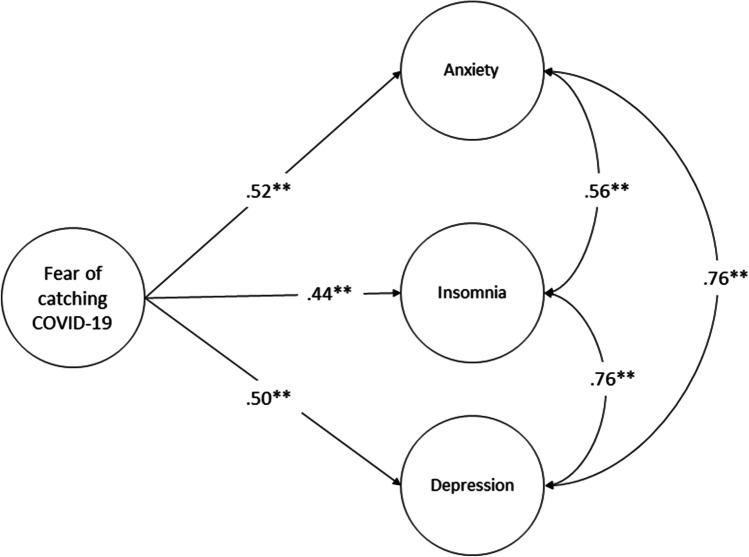
Most studies only describe mental health indicators (anxiety, depression, insomnia, and stress) and the risk factors associated with these indicators during the pandemic (sex, student status, and specific physical symptoms). However, no explanatory studies have been found that assess the impact of variables associated with COVID-19. Against this background, the objective of the study was to evaluate the impact of the fear of catching COVID-19 on the level of anxiety, depression, and insomnia in 947 university students of both sexes (41.6% males and 58.4% females) between the ages of 18 and 35 ( = 6; = 4). The Fear of catching COVID-19 Scale, the Generalized Anxiety Disorder Scale (GAD-7), the Patient Health Questionnaire (PHQ-9), and the Insomnia Severity Index (ISI) were used to measure the variables. The results of the study show that the fear of catching COVID-19 significantly influences the level of anxiety (β = .52; p < .01), insomnia (β = .44; p<.01), and depression (β = .50; p < .01) experienced by university students (χ2 = 2075.93; df = 371; p = .000; RMSEA = .070 [CI 90% .067-.073]; SRMR = .055; CFI = .95; TLI = .94). The descriptive results show that a notable percentage of university students present significant symptoms of anxiety (23%), depression (24%), and insomnia (32.9%). It is concluded that the fear of catching COVID-19 is a serious health problem since it influences the appearance of anxiety, depression and insomnia symptoms.
大多数研究仅描述了心理健康指标(焦虑、抑郁、失眠和压力)以及疫情期间与这些指标相关的风险因素(性别、学生身份和特定身体症状)。然而,尚未发现有解释性研究评估与新冠病毒相关变量的影响。在此背景下,本研究的目的是评估对感染新冠病毒的恐惧对947名年龄在18至35岁之间的男女大学生(男性占41.6%,女性占58.4%)焦虑、抑郁和失眠水平的影响(均值 = 6;标准差 = 4)。使用对感染新冠病毒的恐惧量表、广泛性焦虑障碍量表(GAD - 7)、患者健康问卷(PHQ - 9)和失眠严重程度指数(ISI)来测量这些变量。研究结果表明,对感染新冠病毒的恐惧显著影响大学生所经历的焦虑水平(β = 0.52;p < 0.01)、失眠水平(β = 0.44;p < 0.01)和抑郁水平(β = 0.50;p < 0.01)(χ2 = 2075.93;df = 371;p = 0.000;RMSEA = 0.070 [90%置信区间0.067 - 0.073];SRMR = 0.055;CFI = 0.95;TLI = 0.94)。描述性结果显示,相当比例的大学生存在显著的焦虑症状(23%)、抑郁症状(24%)和失眠症状(32.9%)。研究得出结论,对感染新冠病毒的恐惧是一个严重的健康问题,因为它会影响焦虑、抑郁和失眠症状的出现。