Ge Fenfen, Zhang Di, Wu Lianhai, Mu Hongwei
Clinical Psychology Department, Qingdao Municipal Hospital, Qingdao 266000, Shandong, People's Republic of China.
Mental Health Education and Counseling Center, Ocean University of China, Qingdao 266100, Shandong, People's Republic of China.
Neuropsychiatr Dis Treat. 2020 Sep 17;16:2111-2118. doi: 10.2147/NDT.S262004. eCollection 2020.
The outbreak of the 2019 novel coronavirus disease (COVID-19) not only caused physical abnormalities, but also caused psychological distress, especially for undergraduate students who are facing the pressure of academic study and work. We aimed to explore the prevalence rate of probable anxiety and probable insomnia and to find the risk factors among a longitudinal study of undergraduate students using the approach of machine learning.
The baseline data (T1) were collected from freshmen who underwent psychological evaluation at two months after entering the university. At T2 stage (February 10th to 13th, 2020), we used a convenience cluster sampling to assess psychological state (probable anxiety was assessed by general anxiety disorder-7 and probable insomnia was assessed by insomnia severity index-7) based on a web survey. We integrated information attained at T1 stage to predict probable anxiety and probable insomnia at T2 stage using a machine learning algorithm (XGBoost).
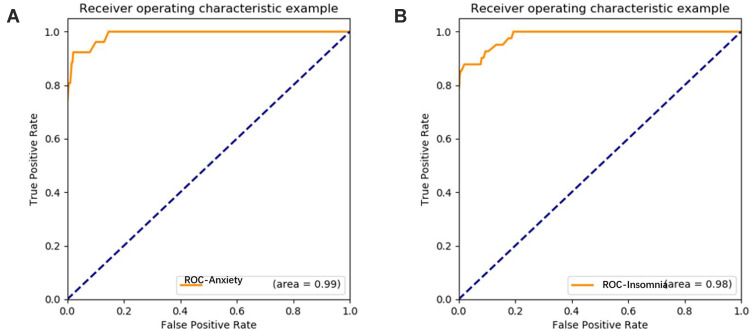
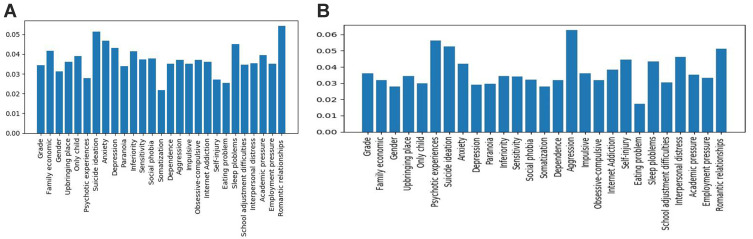
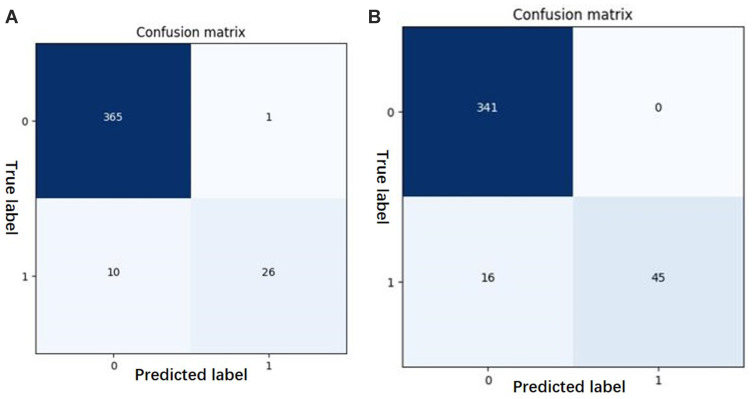
Finally, we included 2009 students (response rate: 80.36%). The prevalence rate of probable anxiety and probable insomnia was 12.49% and 16.87%, respectively. The XGBoost algorithm predicted 1954 out of 2009 students (translated into 97.3% accuracy) and 1932 out of 2009 students (translated into 96.2% accuracy) who suffered anxiety and insomnia symptoms, respectively. The most relevant variables in predicting probable anxiety included romantic relationship, suicidal ideation, sleep symptoms, and a history of anxiety symptoms. The most relevant variables in predicting probable insomnia included aggression, psychotic experiences, suicidal ideation, and romantic relationship.
Risks for probable anxiety and probable insomnia among undergraduate students can be identified at an individual level by baseline data. Thus, timely psychological intervention for anxiety and insomnia symptoms among undergraduate students is needed considering the above factors.
2019年新型冠状病毒病(COVID-19)的爆发不仅导致身体异常,还造成心理困扰,尤其是对于面临学业和工作压力的大学生而言。我们旨在通过机器学习方法,在一项针对大学生的纵向研究中,探索可能的焦虑和可能的失眠的患病率,并找出风险因素。
基线数据(T1)收集自入学两个月后接受心理评估的大一新生。在T2阶段(2020年2月10日至13日),我们采用便利整群抽样法,通过网络调查评估心理状态(用广泛性焦虑障碍量表-7评估可能的焦虑,用失眠严重程度指数-7评估可能的失眠)。我们整合在T1阶段获得的信息,使用机器学习算法(XGBoost)预测T2阶段可能的焦虑和可能的失眠。
最终,我们纳入了2009名学生(应答率:80.36%)。可能的焦虑和可能的失眠的患病率分别为12.49%和16.87%。XGBoost算法分别预测出2009名学生中1954名(准确率为97.3%)和1932名(准确率为96.2%)有焦虑和失眠症状。预测可能的焦虑最相关的变量包括恋爱关系、自杀意念、睡眠症状和焦虑症状史。预测可能的失眠最相关的变量包括攻击性、精神病体验、自杀意念和恋爱关系。
通过基线数据可以在个体层面识别大学生可能的焦虑和可能的失眠风险。因此,考虑到上述因素,需要对大学生的焦虑和失眠症状及时进行心理干预。