Malamas Nikolaos, Papangelou Konstantinos, Symeonidis Andreas L
Gnomon Informatics S.A., 570 01 Thessaloniki, Greece.
School of Electrical and Computer Engineering, Aristotle University of Thessaloniki, 541 24 Thessaloniki, Greece.
Healthcare (Basel). 2022 Jan 4;10(1):99. doi: 10.3390/healthcare10010099.
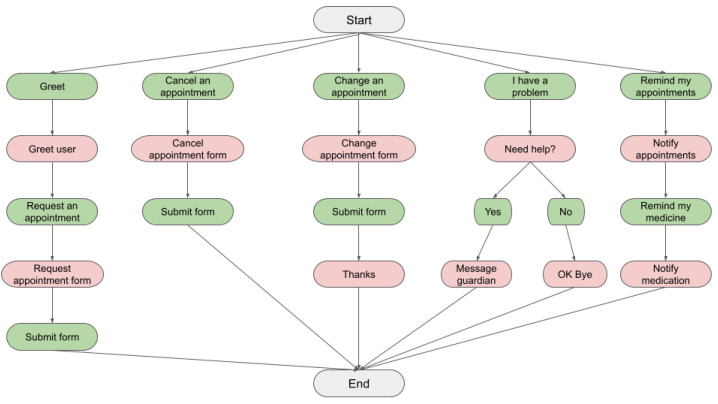
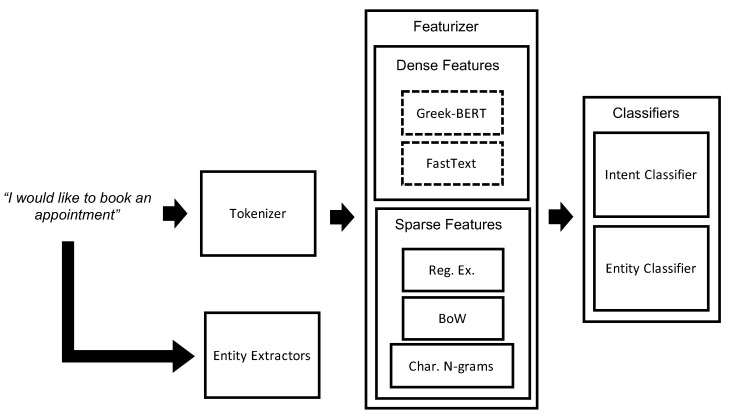
Virtual assistants are becoming popular in a variety of domains, responsible for automating repetitive tasks or allowing users to seamlessly access useful information. With the advances in Machine Learning and Natural Language Processing, there has been an increasing interest in applying such assistants in new areas and with new capabilities. In particular, their application in e-healthcare is becoming attractive and is driven by the need to access medically-related knowledge, as well as providing first-level assistance in an efficient manner. In such types of virtual assistants, localization is of utmost importance, since the general population (especially the aging population) is not familiar with the needed "healthcare vocabulary" to communicate facts properly; and state-of-practice proves relatively poor in performance when it comes to specialized virtual assistants for less frequently spoken languages. In this context, we present a Greek ML-based virtual assistant specifically designed to address some commonly occurring tasks in the healthcare domain, such as doctor's appointments or distress (panic situations) management. We build on top of an existing open-source framework, discuss the necessary modifications needed to address the language-specific characteristics and evaluate various combinations of word embeddings and machine learning models to enhance the assistant's behaviour. Results show that we are able to build an efficient Greek-speaking virtual assistant to support e-healthcare, while the NLP pipeline proposed can be applied in other (less frequently spoken) languages, without loss of generality.
虚拟助手在各个领域越来越受欢迎,负责自动化重复任务或让用户无缝获取有用信息。随着机器学习和自然语言处理的进步,人们对在新领域应用此类助手并赋予其新功能的兴趣与日俱增。特别是,它们在电子医疗保健领域的应用正变得具有吸引力,其驱动力在于获取医学相关知识的需求,以及高效提供一级援助的需求。在这类虚拟助手中,本地化至关重要,因为普通人群(尤其是老年人群体)并不熟悉正确传达事实所需的“医疗保健词汇”;而且在涉及使用不太常用语言的专业虚拟助手时,目前的实践水平在性能方面相对较差。在此背景下,我们展示了一个基于机器学习的希腊语虚拟助手,它专门设计用于处理医疗保健领域一些常见任务,如预约医生或管理紧急情况(恐慌情况)。我们基于现有的开源框架进行构建,讨论为解决特定语言特征所需的必要修改,并评估词嵌入和机器学习模型的各种组合以增强助手的性能。结果表明,我们能够构建一个高效的希腊语虚拟助手来支持电子医疗保健,同时所提出的自然语言处理管道可应用于其他(不太常用的)语言,且不失一般性。