
抑制 RIPK1 介导的神经元坏死性凋亡对体外和体内缺氧缺血具有神经保护作用。
Inhibition of Neuronal Necroptosis Mediated by RIPK1 Provides Neuroprotective Effects on Hypoxia and Ischemia In Vitro and In Vivo.
机构信息
Institute of Biology and Biomedicine, Lobachevsky State University of Nizhni Novgorod, 23 Prospekt Gagarina, 603950 Nizhny Novgorod, Russia.
Institute of Information Technology, Mathematics and Mechanics, Lobachevsky State University of Nizhni Novgorod, 23 Prospekt Gagarina, 603950 Nizhny Novgorod, Russia.
出版信息
Int J Mol Sci. 2022 Jan 10;23(2):735. doi: 10.3390/ijms23020735.
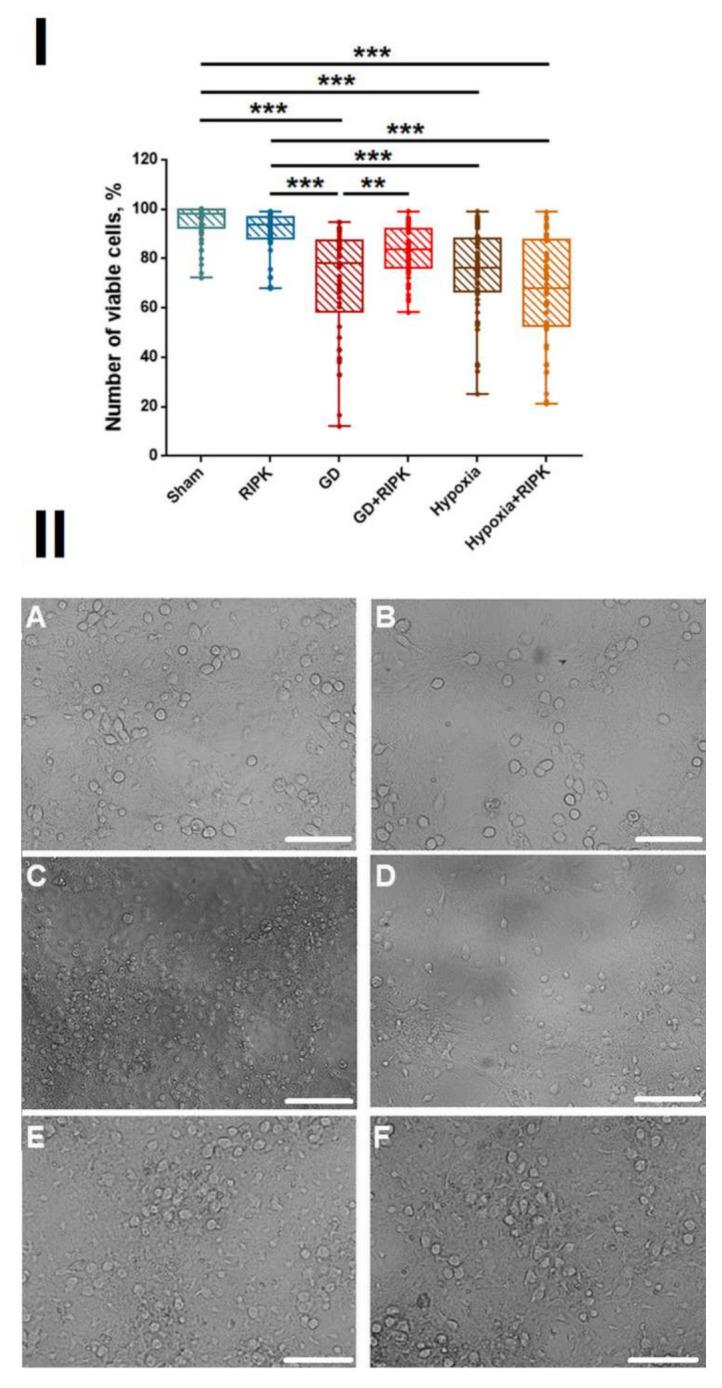
Ischemic brain injury is a widespread pathological condition, the main components of which are a deficiency of oxygen and energy substrates. In recent years, a number of new forms of cell death, including necroptosis, have been described. In necroptosis, a cascade of interactions between the kinases RIPK1 and RIPK3 and the MLKL protein leads to the formation of a specialized death complex called the necrosome, which triggers MLKL-mediated destruction of the cell membrane and necroptotic cell death. Necroptosis probably plays an important role in the development of ischemia/reperfusion injury and can be considered as a potential target for finding methods to correct the disruption of neural networks in ischemic damage. In the present study, we demonstrated that blockade of RIPK1 kinase by Necrostatin-1 preserved the viability of cells in primary hippocampal cultures in an in vitro model of glucose deprivation. The effect of RIPK1 blockade on the bioelectrical and metabolic calcium activity of neuron-glial networks in vitro using calcium imaging and multi-electrode arrays was assessed for the first time. RIPK1 blockade was shown to partially preserve both calcium and bioelectric activity of neuron-glial networks under ischemic factors. However, it should be noted that RIPK1 blockade does not preserve the network parameters of the collective calcium dynamics of neuron-glial networks, despite the maintenance of network bioelectrical activity (the number of bursts and the number of spikes in the bursts). To confirm the data obtained in vitro, we studied the effect of RIPK1 blockade on the resistance of small laboratory animals to in vivo modeling of hypoxia and cerebral ischemia. The use of Necrostatin-1 increases the survival rate of C57BL mice in modeling both acute hypobaric hypoxia and ischemic brain damage.
缺血性脑损伤是一种广泛存在的病理状态,其主要成分是缺氧和能量底物的缺乏。近年来,已经描述了几种新的细胞死亡形式,包括坏死性凋亡。在坏死性凋亡中,激酶 RIPK1 和 RIPK3 与 MLKL 蛋白之间的一系列相互作用导致形成一种称为坏死小体的专门死亡复合物,该复合物触发 MLKL 介导的细胞膜破坏和坏死性细胞死亡。坏死性凋亡可能在缺血/再灌注损伤的发展中发挥重要作用,并且可以被认为是寻找方法来纠正缺血损伤中神经网络破坏的潜在靶点。在本研究中,我们证明了 Necrostatin-1 阻断 RIPK1 激酶可以在体外葡萄糖剥夺模型中维持原代海马培养物中的细胞活力。首次使用钙成像和多电极阵列评估了 RIPK1 阻断对体外神经元-神经胶质网络的生物电和代谢钙活性的影响。结果表明,RIPK1 阻断在缺血因子下部分保留了神经元-神经胶质网络的钙和生物电活性。然而,应该注意的是,尽管维持了网络生物电活性(爆发中的爆发次数和爆发中的尖峰数),但 RIPK1 阻断并不能保留神经元-神经胶质网络的集体钙动力学的网络参数。为了证实体外获得的数据,我们研究了 RIPK1 阻断对小型实验动物对体内缺氧和脑缺血模型的抗性的影响。使用 Necrostatin-1 可提高 C57BL 小鼠在急性低压缺氧和缺血性脑损伤模型中的存活率。



 Zotero 插件