Department of Community Health Studies, Faculty of Health Sciences, Durban University of Technology, PO Box 1334, Durban, 4000, South Africa.
Institute for Water and Wastewater Technology (IWWT), Durban University of Technology, PO Box 1334, Durban, 4000, South Africa.
BMC Public Health. 2022 Jan 20;22(1):145. doi: 10.1186/s12889-022-12527-z.
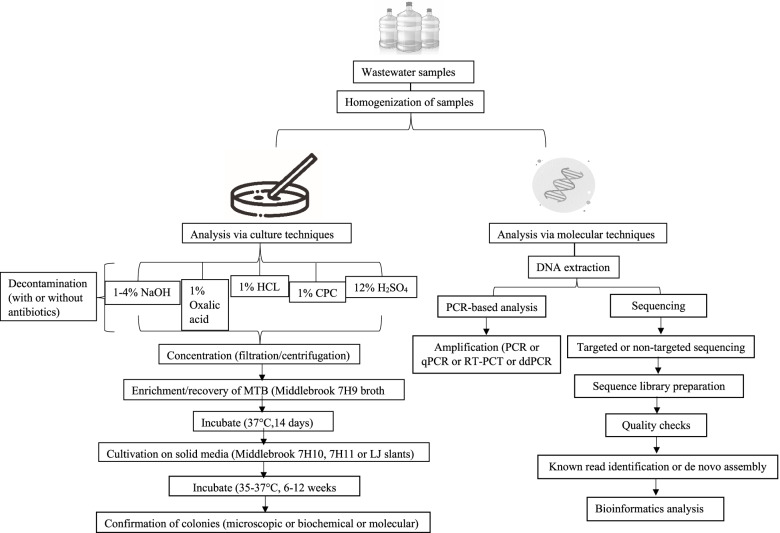
The Mycobacterium tuberculosis complex (MTBC) consists of causative agents of both human and animal tuberculosis and is responsible for over 10 million annual infections globally. Infections occur mainly through airborne transmission, however, there are possible indirect transmissions through a faecal-oral route which is poorly reported. This faecal-oral transmission could be through the occurrence of the microbe in environments such as wastewater. This manuscript, therefore, reviews the source and fate of MTBC in the wastewater environment, including the current methods in use and the possible risks of infections.
The reviewed literature indicates that about 20% of patients with pulmonary TB may have extra-pulmonary manifestations such as GITB, resulting in shedding in feaces and urine. This could potentially be the reason for the detection of MTBC in wastewater. MTBC concentrations of up to 5.5 × 10 (±3.9 × 10) copies/L of untreated wastewater have been reported. Studies have indicated that wastewater may provide these bacteria with the required nutrients for their growth and could potentially result in environmental transmission. However, 98.6 (± 2.7) %, removal during wastewater treatment, through physical-chemical decantation (primary treatment) and biofiltration (secondary treatment) has been reported. Despite these reports, several studies observed the presence of MTBC in treated wastewater via both culture-dependent and molecular techniques.
The detection of viable MTBC cells in either treated or untreated wastewater, highlights the potential risks of infection for wastewater workers and communities close to these wastewater treatment plants. The generation of aerosols during wastewater treatment could be the main route of transmission. Additionally, direct exposure to the wastewater containing MTBC could potentially contribute to indirect transmissions which may lead to pulmonary or extra-pulmonary infections. This calls for the implementation of risk reduction measures aimed at protecting the exposed populations.
结核分枝杆菌复合群(MTBC)由人类和动物结核病的病原体组成,占全球每年 1000 多万例感染。感染主要通过空气传播,但也可能通过粪便-口腔途径发生间接传播,而后者报道甚少。这种粪-口传播可能是由于微生物在废水等环境中存在。因此,本文综述了 MTBC 在废水环境中的来源和归宿,包括目前使用的方法和感染的可能风险。
综述文献表明,约 20%的肺结核患者可能有肺外表现,如 GITB,导致粪便和尿液中排出。这可能是在废水中检测到 MTBC 的原因。未经处理的废水中 MTBC 浓度高达 5.5×10(±3.9×10)拷贝/L。研究表明,废水可能为这些细菌提供生长所需的营养物质,并可能导致环境传播。然而,通过物理化学沉降(一级处理)和生物过滤(二级处理),废水处理过程中可去除 98.6(±2.7)%的 MTBC。尽管有这些报告,但一些研究仍通过培养依赖和分子技术观察到处理过和未处理过的废水中存在 MTBC。
无论是在处理过的还是未经处理的废水中都检测到有活力的 MTBC 细胞,这突出了废水处理厂工人和附近社区感染的潜在风险。废水处理过程中气溶胶的产生可能是主要的传播途径。此外,直接接触含有 MTBC 的废水可能会导致间接传播,从而导致肺外或肺内感染。这需要实施旨在保护暴露人群的减少风险措施。