Chukwu Emelda E, Okwuraiwe Azuka, Kunle-Ope Chioma N, Igbasi Uche T, Onyejepu Nneka, Osuolale Kazeem, Shaibu Joseph O, Ojogbede Adewale, Abuh Dennis, Afocha Ebelechukwu, Awoderu Oluwatoyin, Obiozor Kelechi, Mustapha Adetoun, Audu Rosemary
Center for Infectious Diseases Research, Nigerian Institute of Medical Research, Yaba, Lagos State, Nigeria.
Department of Medical Laboratory Sciences, Faculty of Sciences, Trinity University, Sabo, Yaba, Lagos State, Nigeria.
BMC Public Health. 2024 Dec 26;24(1):3590. doi: 10.1186/s12889-024-21157-6.
Wastewater-based epidemiology (WBE) is already being adopted for the surveillance of health conditions of communities and shows great potential for the monitoring of infectious pathogens of public health importance. There is however paucity of robust data to support extensive WBE in Nigeria. This study evaluated the prevalence of clinically relevant infectious pathogens and provided antimicrobial resistance profiles of bacteria pathogens in wastewater canals in Lagos State at a single point in time.
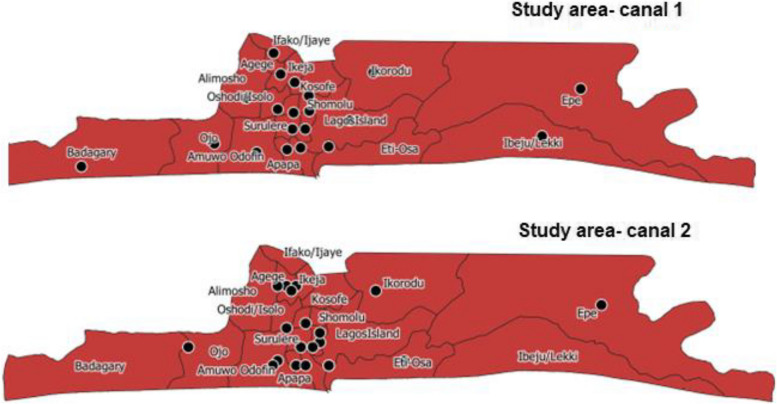
This is a cross-sectional survey of wastewater canals in 20 Local Government Areas (LGAs) in Lagos State for detection of bacteria pathogens of public health importance including non-tuberculous mycobacteria and SARS-Cov-2 virus using cultural analysis and conventional Polymerase Chain Reaction (PCR) techniques. Descriptive epidemiological survey of communities around the canals was done using questionnaires to assess exposure pathways. Statistical analysis was done using SPSS version 27 while P value of < 0.05 was considered as significant.
Three thousand and fifty-four (3054) questionnaires were administered to 1215 (39.8%) females and 1658 (54.3%) males in communities situated around 40 canals in 20 LGAs. Although majority (81.8%) reported using water closet toilet system and pit latrine (12.5%), a few of them admitted to open defaecation [101 (3.3%)] while 299 (9.8%) engaged in open field waste disposal. SARS-CoV-2 was not detected from wastewater in this study. Two mycobacterial species that included Mycobacterium fortitium group (13, 32.5%) and Mycobacterium kansasii (11, 27.5%) were identified in 15 out of 20 LGAs sampled. A total of 123 bacteria pathogens were isolated across the 40 canals. Prominent enteropathogens isolated included Escheriachia coli (28.5%), Salmonella spp (16.3%), Vibro cholerae (10.6%) and Shigella spp (5.7%). Extended spectrum beta-lactamase genes were prominent (87.5%) in the wastewater samples with almost a half (42.5%) of the canals containing both SHV and CTX-M.
This study highlights the presence of pathogens with potential to cause epidemic in wastewater canals in Lagos State and provides evidence to inform policy and strategies for wastewater monitoring and treatment. Further studies involving longitudinal monitoring of time-based variations is needed to identify trends in pathogen loads and AMR patterns over time.
基于废水的流行病学(WBE)已被用于社区健康状况监测,并在监测具有公共卫生重要性的传染病原体方面显示出巨大潜力。然而,在尼日利亚,缺乏有力数据支持广泛开展WBE。本研究评估了临床相关传染病原体的流行情况,并在某一时刻提供了拉各斯州废水渠中细菌病原体的抗菌药物耐药性概况。
这是一项对拉各斯州20个地方政府辖区(LGA)的废水渠进行的横断面调查,采用培养分析和传统聚合酶链反应(PCR)技术检测包括非结核分枝杆菌和SARS-CoV-2病毒在内的具有公共卫生重要性的细菌病原体。使用问卷对渠周围社区进行描述性流行病学调查,以评估接触途径。使用SPSS 27版进行统计分析,P值<0.05被视为具有统计学意义。
在20个LGA中40条渠周围的社区,共向1215名(39.8%)女性和1658名(54.3%)男性发放了3054份问卷。虽然大多数人(81.8%)报告使用抽水马桶系统和坑式厕所(12.5%),但有少数人承认有露天排便[101人(3.3%)],而299人(9.8%)进行露天垃圾处理。本研究未从废水中检测到SARS-CoV-2。在抽样的20个LGA中的15个中,鉴定出两种分枝杆菌,包括偶然分枝杆菌群(13株,32.5%)和堪萨斯分枝杆菌(11株,27.5%)。在40条渠中共分离出123种细菌病原体。分离出的主要肠道病原体包括大肠杆菌(28.5%)、沙门氏菌属(16.3%)、霍乱弧菌(10.6%)和志贺氏菌属(5.7%)。超广谱β-内酰胺酶基因在废水样本中占主导地位(87.5%),近一半(42.5%)的渠同时含有SHV和CTX-M。
本研究突出了拉各斯州废水渠中存在有引发疫情潜力的病原体,并为制定废水监测和处理的政策及策略提供了依据。需要进一步开展涉及基于时间变化的纵向监测的研究,以确定病原体负荷和抗菌药物耐药模式随时间的变化趋势。