Penning Amber, Tosoni Giorgia, Abiega Oihane, Bielefeld Pascal, Gasperini Caterina, De Pietri Tonelli Davide, Fitzsimons Carlos P, Salta Evgenia
Laboratory of Neurogenesis and Neurodegeneration, Netherlands Institute for Neuroscience, Amsterdam, Netherlands.
Swammerdam Institute for Life Sciences, Faculty of Science, University of Amsterdam, Amsterdam, Netherlands.
Front Cell Neurosci. 2022 Jan 4;15:781434. doi: 10.3389/fncel.2021.781434. eCollection 2021.
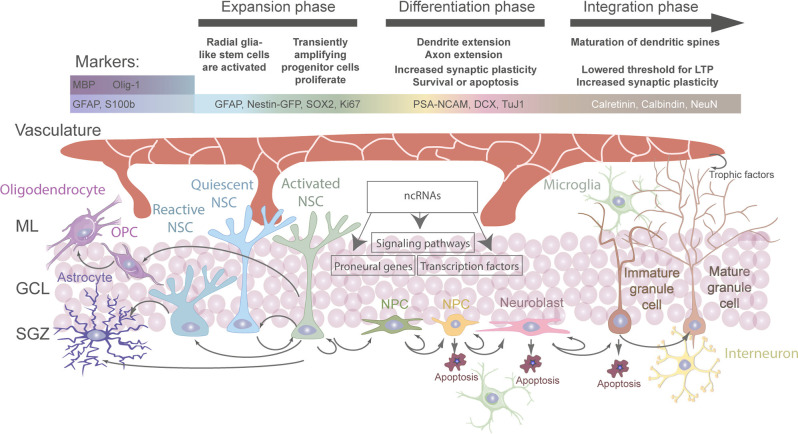
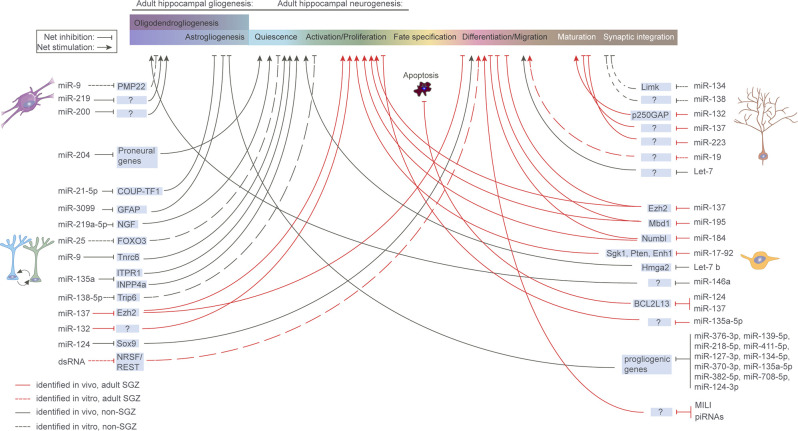
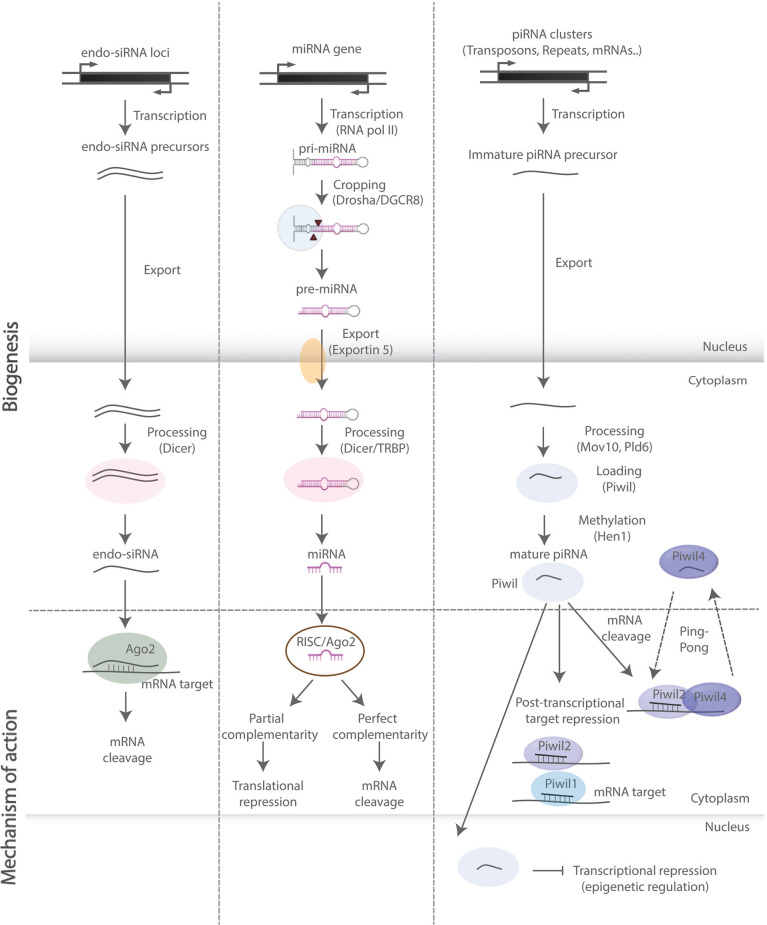
The adult neurogenic niches are complex multicellular systems, receiving regulatory input from a multitude of intracellular, juxtacrine, and paracrine signals and biological pathways. Within the niches, adult neural stem cells (aNSCs) generate astrocytic and neuronal progeny, with the latter predominating in physiological conditions. The new neurons generated from this neurogenic process are functionally linked to memory, cognition, and mood regulation, while much less is known about the functional contribution of aNSC-derived newborn astrocytes and adult-born oligodendrocytes. Accumulating evidence suggests that the deregulation of aNSCs and their progeny can impact, or can be impacted by, aging and several brain pathologies, including neurodevelopmental and mood disorders, neurodegenerative diseases, and also by insults, such as epileptic seizures, stroke, or traumatic brain injury. Hence, understanding the regulatory underpinnings of aNSC activation, differentiation, and fate commitment could help identify novel therapeutic avenues for a series of pathological conditions. Over the last two decades, small non-coding RNAs (sncRNAs) have emerged as key regulators of NSC fate determination in the adult neurogenic niches. In this review, we synthesize prior knowledge on how sncRNAs, such as microRNAs (miRNAs) and piwi-interacting RNAs (piRNAs), may impact NSC fate determination in the adult brain and we critically assess the functional significance of these events. We discuss the concepts that emerge from these examples and how they could be used to provide a framework for considering aNSC (de)regulation in the pathogenesis and treatment of neurological diseases.
成体神经发生微环境是复杂的多细胞系统,接收来自众多细胞内、旁分泌和自分泌信号以及生物学途径的调节输入。在这些微环境中,成体神经干细胞(aNSC)产生星形胶质细胞和神经元后代,在生理条件下后者占主导。由这个神经发生过程产生的新神经元在功能上与记忆、认知和情绪调节相关联,而关于aNSC衍生的新生星形胶质细胞和成年新生少突胶质细胞的功能贡献却知之甚少。越来越多的证据表明,aNSC及其后代的失调会影响衰老和几种脑部疾病,或者受到它们的影响,这些疾病包括神经发育和情绪障碍、神经退行性疾病,以及诸如癫痫发作、中风或创伤性脑损伤等损伤。因此,了解aNSC激活、分化和命运决定的调控基础,有助于为一系列病理状况确定新的治疗途径。在过去二十年中,小非编码RNA(sncRNA)已成为成体神经发生微环境中NSC命运决定的关键调节因子。在这篇综述中,我们综合了关于sncRNA(如微小RNA(miRNA)和Piwi相互作用RNA(piRNA))如何影响成体脑中NSC命运决定的先前知识,并批判性地评估了这些事件的功能意义。我们讨论了从这些例子中得出的概念,以及它们如何能够被用于为在神经疾病的发病机制和治疗中考虑aNSC的(去)调节提供一个框架。