Center of Excellence in Hepatitis and Liver Cancer, Department of Biochemistry, Faculty of Medicine, Chulalongkorn University, Bangkok, 10330, Thailand.
Division of Gastroenterology, Department of Medicine, Faculty of Medicine, Chulalongkorn University, Bangkok, Thailand.
BMC Infect Dis. 2022 Jan 22;22(1):79. doi: 10.1186/s12879-022-07074-2.
Individuals with end-stage renal disease have a higher risk of hepatitis C virus (HCV) acquisition during long-term hemodialysis (HD). Our report was designed to investigate HCV prevalence and genotype, in addition to the clinical use of HCV core antigen (HCVcAg), within multiple HD facilities in Thailand.
This cross-sectional report was investigated between January and June 2019. HCV infection was assessed by anti-HCV and confirmed active infection by measuring HCV RNA and HCVcAg. HCV genotype was determined by phylogenetic analysis using nucleotide sequences of NS5B region.
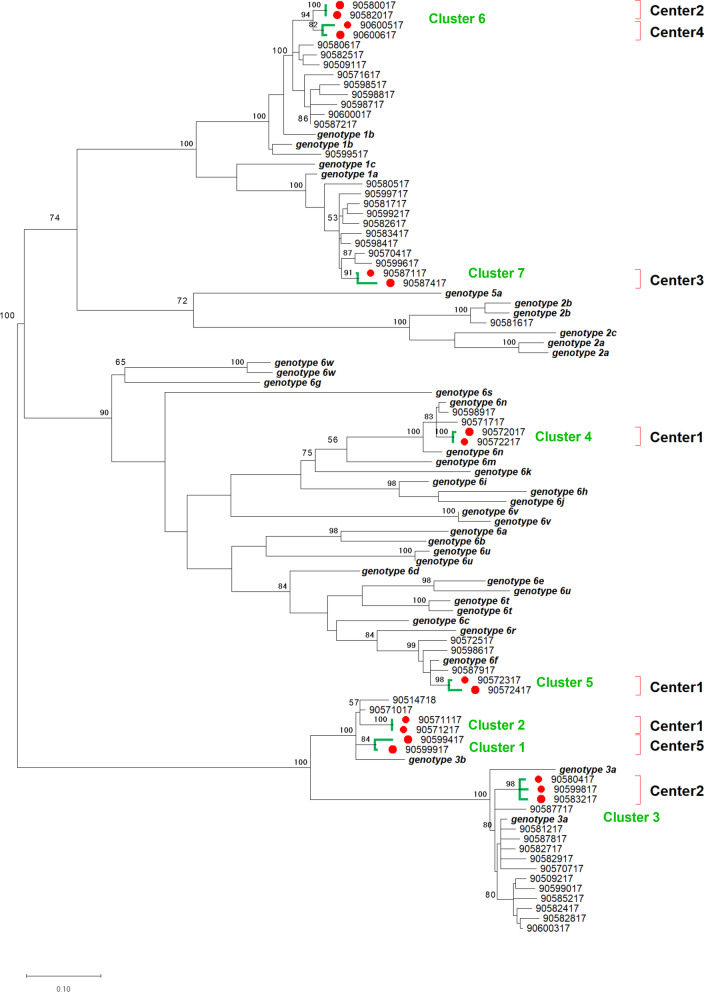
Overall, 140 of 3,305 (4.2%) patients in 15 dialysis centers had anti-HCV positive. Among them, HCV RNA was further assessed in 93 patients and was detectable in 59 (63.4%) persons. Considering HCV viremia, HCVcAg measurement exhibited high accuracy (96.8%), sensitivity (94.9%) and specificity (100%) in comparison with HCV RNA testing. Moreover, individuals infected with HCV received a longer duration of dialysis vintage when compared to anti-HCV negative controls. The major sub-genotypes were 1a, 1b, 3a, 3b, 6f and 6n. Regarding phylogenetic analysis, there were 7 clusters of isolates with high sequence homology affecting 17 individuals, indicating possible HCV transmission within the same HD centers.
HCV frequency and common sub-genotypes in HD centers were different from those found in the Thai general population. HCVcAg might be an alternate testing for viremia within resource-limited countries. Enhanced preventive practices, dialyzer reuse policy and better access to antiviral therapy are crucial for HCV micro-elimination within HD facilities.
在长期血液透析(HD)期间,终末期肾病患者感染丙型肝炎病毒(HCV)的风险更高。我们的报告旨在调查泰国多个 HD 中心 HCV 的流行率和基因型,以及 HCV 核心抗原(HCVcAg)的临床应用。
本横断面报告于 2019 年 1 月至 6 月进行。通过抗-HCV 检测评估 HCV 感染,并通过测量 HCV RNA 和 HCVcAg 来确认活跃感染。通过 NS5B 区核苷酸序列的系统发育分析确定 HCV 基因型。
总体而言,在 15 个透析中心的 3305 名患者中,有 140 名(4.2%)抗-HCV 阳性。其中,进一步评估了 93 名患者的 HCV RNA,其中 59 名(63.4%)可检测到 HCV RNA。与 HCV RNA 检测相比,考虑到 HCV 病毒血症,HCVcAg 测量显示出较高的准确性(96.8%)、灵敏度(94.9%)和特异性(100%)。此外,与抗-HCV 阴性对照组相比,感染 HCV 的个体接受 HD 治疗的时间更长。主要亚基因型为 1a、1b、3a、3b、6f 和 6n。关于系统发育分析,有 7 个具有高序列同源性的分离株簇影响了 17 个人,表明在同一 HD 中心可能存在 HCV 传播。
HD 中心的 HCV 频率和常见亚基因型与泰国普通人群不同。HCVcAg 可能是资源有限国家检测病毒血症的替代方法。加强预防措施、透析器重复使用政策以及更好地获得抗病毒治疗对于 HCV 在 HD 设施中的微消除至关重要。