Department of Endocrinology, Mymensingh Medical College, Mymensingh, 2207, Bangladesh.
Department of Endocrinology, North East Medical College, Sylhet, Bangladesh.
BMC Endocr Disord. 2022 Jan 23;22(1):28. doi: 10.1186/s12902-022-00938-3.
Diabetes distress (DD) is common and has considerable impacts on diabetes management. Unfortunately, DD is less discussed and frequently underestimated. This study evaluated the prevalence and predictors of DD in adults with type 2 diabetes mellitus (T2DM).
A cross-sectional study was conducted at several specialized endocrinology outpatient clinics in Bangladesh from July 2019 to June 2020; 259 adults with T2DM participated. Participants' DD and depression were measured using the 17-item Diabetes Distress Scale (DDS-17) and 9-item Patient Health Questionnaire (PHQ-9), respectively. DDS-17 scores ≥2 and PHQ-9 scores ≥10 were the cutoffs for DD and significant depression, respectively.
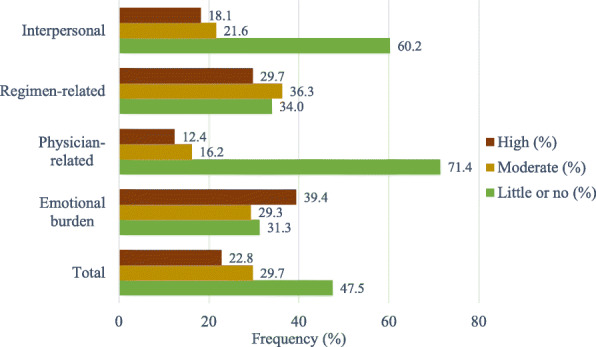
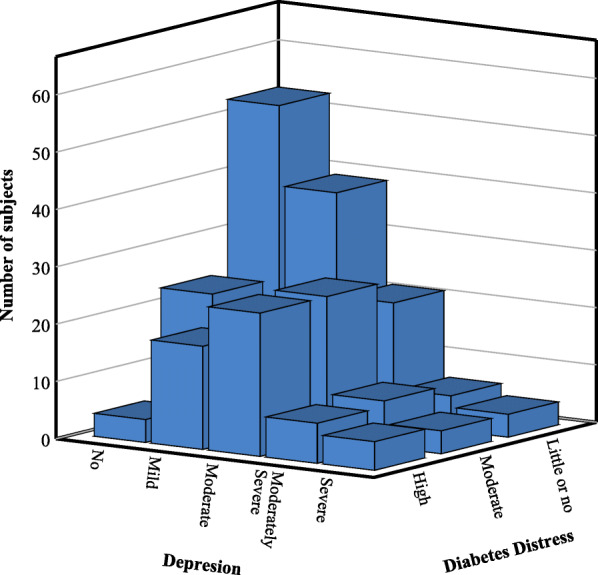
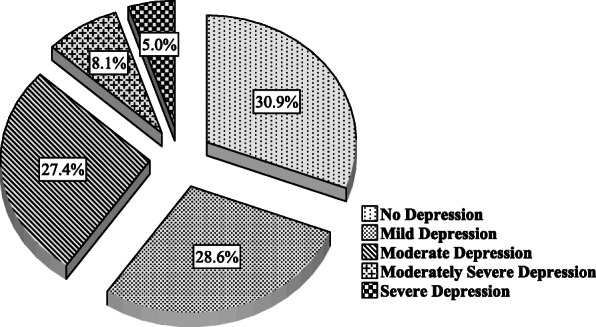
The mean (±SD) age of the participants was 50.36 (±12.7) years, with the majority (54.8%) being male; their median (IQR) duration of diabetes was 6 (3-11) years. Among the study participants, 52.5% had DD (29.7% moderate and 22.8% high DD). The prevalence of emotional burden, physician-related distress, regimen-related distress, and interpersonal distress was 68.7, 28.6, 66, and 37.7%, respectively. Depression was present in 40.5%; 28.6% of the participants had DD and depression. The total DDS-17 score was positively correlated with the PHQ-9 score (r = 0.325, p < 0.001). Rural residence (OR 1.94), presence of any diabetic complication (OR 3.125), insulin use (OR 2.687), and presence of major depression (OR 4.753) were positive predictors of DD. In contrast, age ≥ 40 years at diabetes diagnosis (OR 0.047) and diabetes duration of > 10 years (OR 0.240) were negative predictors of DD (p < 0.05 in all instances).
The prevalence of DD in our setting is notably high; DD and depression frequently overlap. Screening for diabetes distress may be considered, especially in high-risk patients.
糖尿病困扰(DD)很常见,对糖尿病管理有很大影响。不幸的是,DD 讨论较少,且经常被低估。本研究评估了孟加拉国几家内分泌专科门诊的 259 名 2 型糖尿病(T2DM)成年患者的 DD 患病率及其预测因素。
2019 年 7 月至 2020 年 6 月,在孟加拉国的几家内分泌专科门诊进行了一项横断面研究,共 259 名 T2DM 成人参与。使用 17 项糖尿病困扰量表(DDS-17)和 9 项患者健康问卷(PHQ-9)分别评估参与者的 DD 和抑郁情况。DDS-17 评分≥2 分和 PHQ-9 评分≥10 分分别为 DD 和显著抑郁的截断值。
参与者的平均(±SD)年龄为 50.36(±12.7)岁,其中大多数(54.8%)为男性;他们的糖尿病中位(IQR)病程为 6(3-11)年。在研究参与者中,52.5%有 DD(29.7%为中度 DD,22.8%为高度 DD)。情感负担、与医生相关的困扰、治疗方案相关的困扰和人际困扰的患病率分别为 68.7%、28.6%、66%和 37.7%。存在抑郁的比例为 40.5%;28.6%的参与者同时患有 DD 和抑郁。DDS-17 总分与 PHQ-9 评分呈正相关(r=0.325,p<0.001)。农村居住(OR 1.94)、存在任何糖尿病并发症(OR 3.125)、使用胰岛素(OR 2.687)和存在重度抑郁症(OR 4.753)是 DD 的阳性预测因素。相比之下,糖尿病诊断时年龄≥40 岁(OR 0.047)和糖尿病病程>10 年(OR 0.240)是 DD 的负性预测因素(所有情况均为 p<0.05)。
我们研究环境中的 DD 患病率相当高;DD 和抑郁经常重叠。可能需要考虑筛查糖尿病困扰,特别是在高危患者中。