Ikeda Hiroki, Liu Xinxin, Oyama Fuyuki, Akama Takahide, Izawa Shuhei, Takahashi Masaya
National Institute of Occupational Safety and Health, Japan Organization of Occupational Health and Safety, Japan.
Department of Integrated Design Engineering, Maebashi Institute of Technology, Japan.
Ind Health. 2022 Dec 1;60(6):535-547. doi: 10.2486/indhealth.2021-0184. Epub 2022 Jan 21.
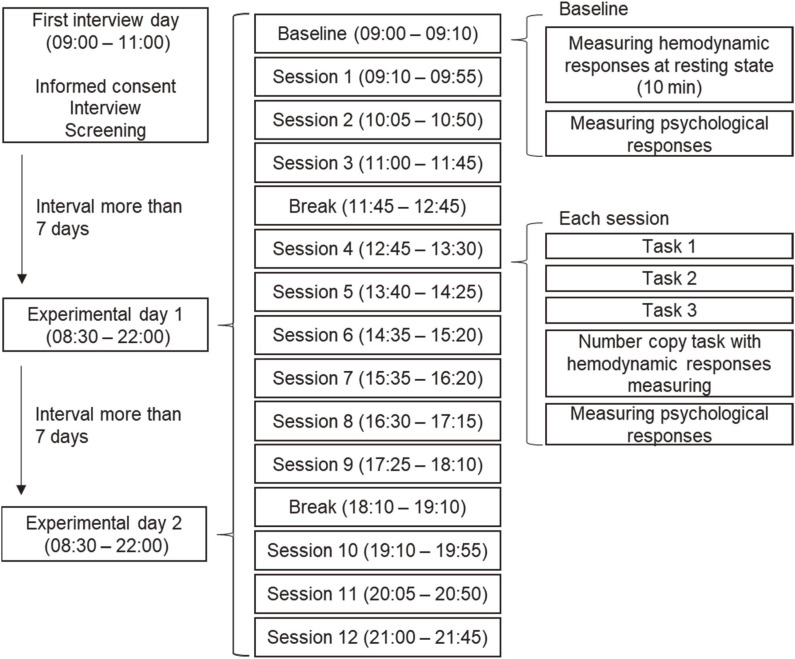
This study examined the effects of short sleep duration (SSD) on hemodynamic and psychological responses under long working hours (LWH) in a laboratory experiment. Sixteen subjects participated in a crossover design experiment consisting of two conditions: normal (7-hours) sleep and short (5-hours) sleep. In each condition, participants engaged in simulated LWH (13 hours a day), comprising 12 task sessions. Hemodynamic and psychological responses were measured in each session. Results showed that there were significant main effects of condition and session but no interaction for hemodynamic and psychological responses. Systolic blood pressure and fatigue were higher in the later sessions than the first one. Stroke volume, sleepiness, fatigue, and stress were higher in the 5-hour than the 7-hour sleep condition (all p<0.05). These results suggest that although the combined effect of LWH and SSD was not significant, both LWH and SSD caused a hemodynamic and psychological burden.
本研究在实验室实验中考察了短睡眠时间(SSD)对长时间工作(LWH)下血液动力学和心理反应的影响。16名受试者参与了一项交叉设计实验,该实验包括两种条件:正常(7小时)睡眠和短(5小时)睡眠。在每种条件下,参与者进行模拟的长时间工作(每天13小时),包括12个任务时段。在每个时段测量血液动力学和心理反应。结果表明,条件和时段对血液动力学和心理反应有显著的主效应,但没有交互作用。后期时段的收缩压和疲劳程度高于第一个时段。5小时睡眠条件下的每搏输出量、嗜睡、疲劳和压力高于7小时睡眠条件(所有p<0.05)。这些结果表明,尽管长时间工作和短睡眠时间的联合效应不显著,但长时间工作和短睡眠时间都会造成血液动力学和心理负担。