Maheu Emmanuel, Soriot-Thomas Sandrine, Noel Eric, Ganry Hervé, Lespessailles Eric, Cortet Bernard
Rheumatology Department, St-Antoine Hospital-APHP, 75011 Paris, FrancePrivate Office, 283, Bd Voltaire, Paris, France.
Clinical Research Centre and Orthopaedic and Traumatology Surgery Department, CHU Amiens Picardie, Amiens, France.
Ther Adv Musculoskelet Dis. 2022 Jan 18;14:1759720X211066233. doi: 10.1177/1759720X211066233. eCollection 2022.
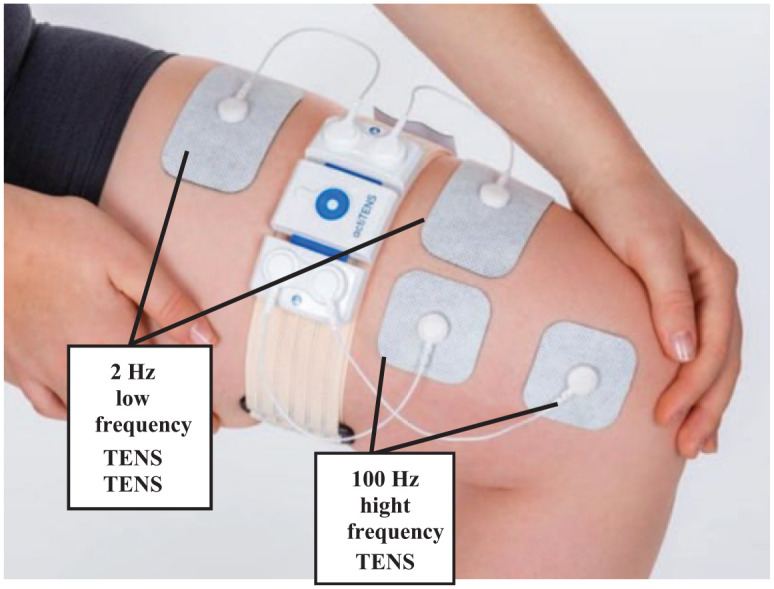
Despite their poor tolerance, especially in the elderly, weak opioids (WO) remain commonly prescribed for patients with knee osteoarthritis (KOA). We compared the efficacy and safety of a new wearable transcutaneous electrical nerve stimulation (W-TENS) device with WO for the treatment of moderate-to-severe, nociceptive KOA chronic pain.
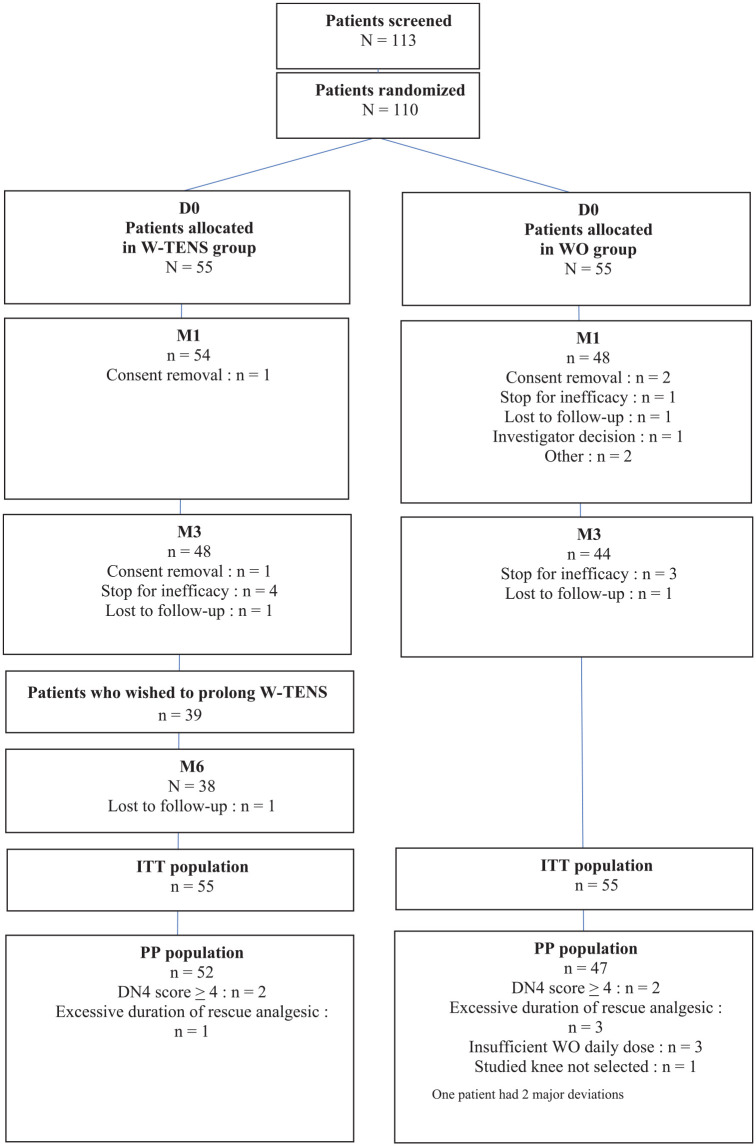
The study was a non-inferiority, multicentric, prospective, randomized, single-blind, controlled, 2-parallel groups Trial. A total of 110 patients with KOA were included (Kellgren-Lawrence radiographic grade ⩾2; American College of Rheumatology criteria), with chronic moderate-to-severe nociceptive pain (mean 8-day pain intensity (PI) ⩾ 4 on an 11-point numerical rating scale), in failure to non-opioid analgesics, including nonsteroidal anti-inflammatory drugs (NSAIDs). Patients with neuropathic pain were excluded. The co-primary endpoints were mean PI at 3 months (M3) and number of potentially treatment-related adverse events (TRAEs). Secondary outcomes included Western Ontario MAC Master University function subscale (range, 0-68), additional pain and quality of life measures, and responder rates.
The non-inferiority of W-TENS was demonstrated in both the per protocol (PP) and intent-to-treat (ITT) populations. At M3, PI in PP population was 3.87 (2.12) compared with 4.66 (2.37) [delta: -0.79 (0.44); 95% CI (-1.65, 0.08)] in W-TENS and WO groups, respectively. A planned superiority analysis showed a significant superiority of W-TENS over WO on PI at M3 ( = 0.0124). The number of TRAEs was significantly lower in the W-TENS group ( = 7) than in the WO group ( = 36) ( < 0.001). Other secondary outcomes also favored W-TENS.
W-TENS was more effective and better tolerated than WO in the treatment of chronic nociceptive KOA pain and offers an interesting non-pharmacological analgesic alternative in the management of KOA. ClinicalTrials.gov: NCT03902340.
尽管弱阿片类药物(WO)耐受性较差,尤其是在老年人中,但仍常用于膝关节骨关节炎(KOA)患者。我们比较了一种新型可穿戴式经皮电神经刺激(W-TENS)设备与弱阿片类药物治疗中度至重度伤害性KOA慢性疼痛的疗效和安全性。
本研究为非劣效性、多中心、前瞻性、随机、单盲、对照、两组平行试验。共纳入110例KOA患者(Kellgren-Lawrence放射学分级⩾2;美国风湿病学会标准),患有慢性中度至重度伤害性疼痛(在11点数字评分量表上平均8天疼痛强度(PI)⩾4),对包括非甾体抗炎药(NSAIDs)在内的非阿片类镇痛药治疗无效。排除患有神经性疼痛的患者。共同主要终点为3个月(M3)时的平均PI和潜在治疗相关不良事件(TRAEs)的数量。次要结局包括西安大略和麦克马斯特大学骨关节炎指数功能子量表(范围0 - 68)、额外的疼痛和生活质量指标以及缓解率。
在符合方案(PP)人群和意向性分析(ITT)人群中均证明了W-TENS的非劣效性。在M3时,PP人群中的PI为3.87(2.12),而W-TENS组和WO组分别为4.66(2.37)[差值:-0.79(0.44);95%置信区间(-1.65,0.08)]。一项计划的优效性分析显示,在M3时W-TENS在PI方面显著优于WO( = 0.0124)。W-TENS组的TRAEs数量( = 7)显著低于WO组( = 36)( < 0.001)。其他次要结局也有利于W-TENS。
在治疗慢性伤害性KOA疼痛方面,W-TENS比WO更有效且耐受性更好,为KOA的管理提供了一种有趣的非药物镇痛替代方案。ClinicalTrials.gov:NCT03902340。