Fu Mengdi, Jin Chengjuan, Feng Shuai, Jia Zongyang, Nie Lekai, Zhang Yang, Peng Jin, Wang Xia, Bu Hualei, Kong Beihua
Department of Gynecology and Obstetrics, Qilu Hospital, Cheeloo College of Medicine, Shandong University, Jinan, China.
Department of Obstetrics and Gynecology, Shanghai General Hospital, School of Medicine, Shanghai Jiao Tong University, Shanghai, China.
Front Oncol. 2022 Jan 6;11:810099. doi: 10.3389/fonc.2021.810099. eCollection 2021.
Whether neoadjuvant chemotherapy (NAC) followed by interval debulking surgery (IDS) against primary debulking surgery (PDS) has a differential effect on prognosis due to Breast Cancer Susceptibility Genes (BRCA)1/2 mutations has not been confirmed by current studies.
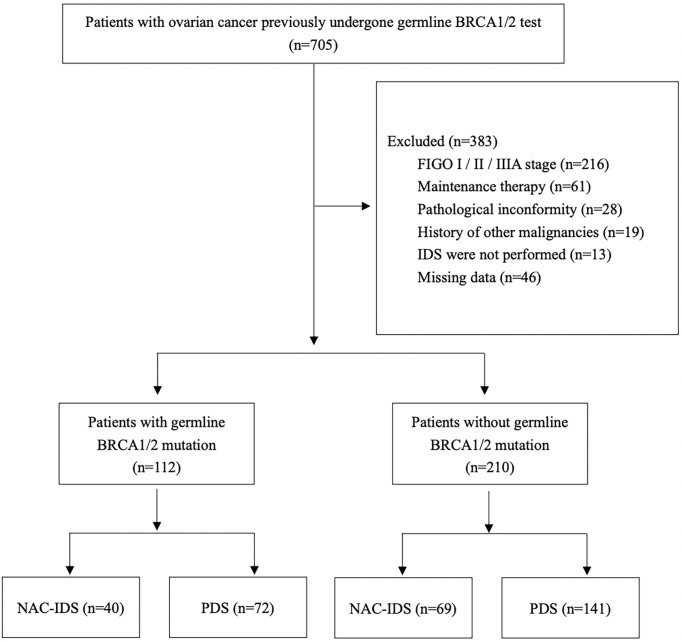
All patients included in this retrospective study were admitted to Qilu Hospital of Shandong University between January 2009 and June 2020, and germline BRCA1/2 mutation were tested. Patients in stage IIIB, IIIC, and IV, re-staged by International Federation of Gynecology and Obstetrics (FIGO) 2014, were selected for analysis. All patients with NAC received 1-5 cycles of platinum-containing (carboplatin, cisplatin, or nedaplatin) chemotherapy. Patients who received maintenance therapy after chemotherapy were not eligible for this study. All relevant medical records were collected.
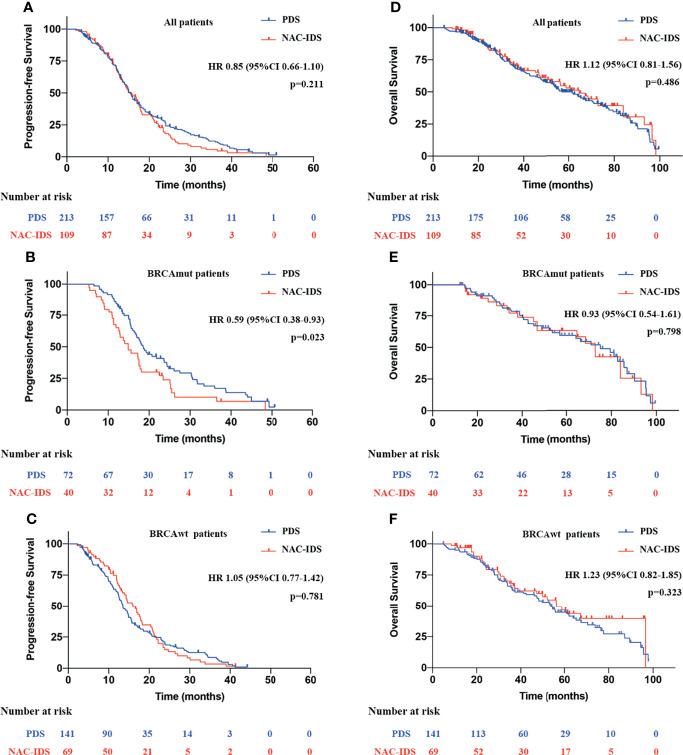
A total of 322 patients were enrolled, including 112 patients with BRCA1/2 mutations (BRCAmut), and 210 patients with BRCA1/2 wild-type (BRCAwt). In the two groups, 40 BRCAmut patients (35.7%) and 69 BRCAwt patients (32.9%) received NAC. The progression-free survival (PFS) of BRCAmut patients was significantly reduced after NAC (median: 14.9 vs. 18.5 months; p=0.023); however, there was no difference in overall survival (OS) (median: 75.1 vs. 72.8 months; p=0.798). Whether BRCAwt patients received NAC had no significant effect on PFS (median: 13.5 vs. 16.0 months; p=0.780) or OS (median: 54.0 vs. 56.4 months; p=0.323). Multivariate analyses in BRCAmut patients showed that the predictors of prolonged PFS were PDS (p=0.001), the absence of residual lesions (p=0.012), and FIGO III stage (p=0.020); Besides, PARP inhibitor was the independent predictor for prolonged OS in BRCAmut patients (p=0.000), for BRCAwt patients, the absence of residual lesions (p=0.041) and history of PARP inhibitors (p=0.000) were beneficial factors for OS prolongation.
For ovarian cancer patients with FIGO IIIB, IIIC, and IV, NAC-IDS did not adversely affect survival outcomes due to different BRCA1/2 germline mutational status.
新辅助化疗(NAC)后行间隔减瘤手术(IDS)对比初次减瘤手术(PDS),是否因乳腺癌易感基因(BRCA)1/2突变而对预后产生不同影响,目前研究尚未证实。
本回顾性研究纳入的所有患者于2009年1月至2020年6月期间入住山东大学齐鲁医院,并检测了胚系BRCA1/2突变。选取国际妇产科联盟(FIGO)2014年重新分期为IIIB、IIIC和IV期的患者进行分析。所有接受NAC的患者接受了1 - 5周期含铂(卡铂、顺铂或奈达铂)化疗。化疗后接受维持治疗的患者不符合本研究条件。收集了所有相关病历。
共纳入322例患者,其中112例为BRCA1/2突变(BRCAmut)患者,210例为BRCA1/2野生型(BRCAwt)患者。两组中,40例BRCAmut患者(35.7%)和69例BRCAwt患者(32.9%)接受了NAC。BRCAmut患者NAC后的无进展生存期(PFS)显著缩短(中位数:14.9个月对18.5个月;p = 0.023);然而,总生存期(OS)无差异(中位数:75.1个月对72.8个月;p = 0.798)。BRCAwt患者是否接受NAC对PFS(中位数:13.5个月对16.0个月;p = 0.780)或OS(中位数:54.0个月对56.4个月;p = 0.323)均无显著影响。BRCAmut患者的多因素分析显示,PFS延长的预测因素为PDS(p = 0.001)、无残留病灶(p = 0.01)和FIGO III期(p = 0.020);此外,PARP抑制剂是BRCAmut患者OS延长的独立预测因素(p = 0.000),对于BRCAwt患者,无残留病灶(p = 0.041)和PARP抑制剂使用史(p = 0.000)是OS延长的有利因素。
对于FIGO IIIB、IIIC和IV期的卵巢癌患者,NAC - IDS不会因不同的BRCA1/2胚系突变状态而对生存结局产生不利影响。