Department of Gynecological Oncology, Tongji Hospital, Tongji Medical College, Huazhong University of Science and Technology, Wuhan, China.
National Clinical Research Center for Obstetrics and Gynecology, Cancer Biology Research Center (Key Laboratory of the Ministry of Education), Tongji Hospital, Tongji Medical College, Huazhong University of Science and Technology, Wuhan, China.
J Ovarian Res. 2023 Jun 27;16(1):121. doi: 10.1186/s13048-023-01164-8.
To investigate the prognostic relevance of the time to interval debulking surgery (TTS) and the time to postoperative adjuvant chemotherapy (TTC) after the completion of neoadjuvant chemotherapy (NACT).
A retrospective real-word study included 658 patients with histologically confirmed advanced epithelial ovarian cancer who received NACT at seven tertiary hospitals in China from June 2008 to June 2020. TTS was defined as the time interval from the completion of NACT to the time of interval debulking surgery (IDS). TTC was defined as the time interval from the completion of NACT to the initiation of postoperative adjuvant chemotherapy (PACT).
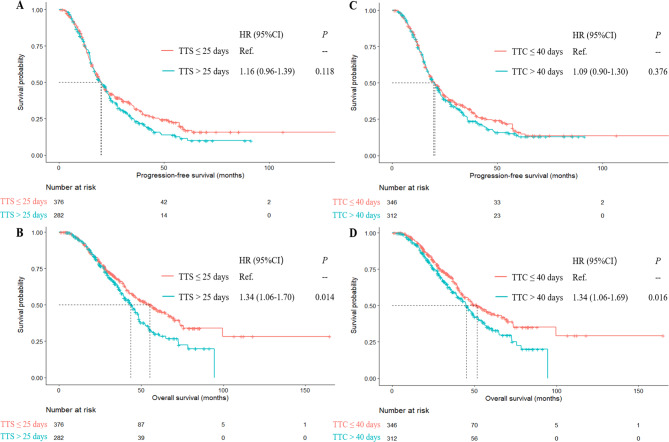
The median TTS and TTC were 25 (IQR, 20-29) and 40 (IQR, 33-49) days, respectively. Patients with TTS > 25 days were older (55 vs. 53 years, P = 0.012) and received more NACT cycles (median, 3 vs. 2, P = 0.002). Similar results were observed in patients with TTC > 40 days. In the multivariate analyses, TTS and TTC were not associated with PFS when stratified by median, quartile, or integrated as continuous variables (all P > 0.05). However, TTS and TTC were significantly associated with worse OS when stratified by median (P = 0.018 and 0.018, respectively), quartile (P = 0.169, 0.014, 0.027 and 0.012, 0.001, 0.033, respectively), or integrated as continuous variables (P = 0.018 and 0.011, respectively). Similarly, increasing TTS and TTC intervals were associated with a higher risk of death (P = 0.016 and 0.031, respectively) but not with recurrence (P = 0.103 and 0.381, respectively).
The delays of IDS and PACT after the completion of NACT have adverse impacts on OS but no impacts on PFS, which indicates that reducing delays of IDS and PACT might ameliorate the outcomes of ovarian cancer patients treated with NACT.
本研究旨在探讨新辅助化疗(NACT)完成后间隔肿瘤细胞减灭术(IDS)的时间(TTS)和术后辅助化疗(PACT)的时间(TTC)与预后的相关性。
本回顾性真实世界研究纳入了 2008 年 6 月至 2020 年 6 月在中国七家三级医院接受 NACT 治疗的 658 例组织学确诊的晚期上皮性卵巢癌患者。TTS 定义为 NACT 完成至 IDS 的时间间隔。TTC 定义为 NACT 完成至 PACT 开始的时间间隔。
中位 TTS 和 TTC 分别为 25(IQR,20-29)和 40(IQR,33-49)天。TTS>25 天的患者年龄更大(55 岁比 53 岁,P=0.012),且接受了更多的 NACT 周期(中位数 3 个周期比 2 个周期,P=0.002)。TTC>40 天的患者也有类似的结果。在多变量分析中,当按中位数、四分位数或连续变量综合分层时,TTS 和 TTC 与 PFS 均无相关性(均 P>0.05)。然而,当按中位数分层时,TTS 和 TTC 与 OS 显著相关(P=0.018 和 0.018),当按四分位数分层时,TTS 和 TTC 与 OS 也显著相关(P=0.169、0.014、0.027 和 0.012、0.001、0.033),当按连续变量综合分层时,TTS 和 TTC 与 OS 也显著相关(P=0.018 和 0.011)。同样,TTS 和 TTC 间隔的延长与死亡风险的增加相关(P=0.016 和 0.031),但与复发无关(P=0.103 和 0.381)。
NACT 完成后 IDS 和 PACT 的延迟对 OS 有不良影响,但对 PFS 没有影响,这表明减少 IDS 和 PACT 的延迟可能改善接受 NACT 治疗的卵巢癌患者的结局。