Jhang Jia-Fong, Jiang Yuan-Hong, Hsu Yung-Hsiang, Ho Han-Chen, Birder Lori A, Lin Teng-Yi, Kuo Hann-Chorng
Department of Urology, Hualien Tzu Chi Hospital, Tzu Chi Medical Foundation, and Tzu Chi University, Hualien, Taiwan.
Department of Pathology, Hualien Tzu Chi Hospital, Tzu Chi Medical Foundation, and Tzu Chi University, Hualien, Taiwan.
Int Neurourol J. 2022 Feb;26(Suppl 1):S57-67. doi: 10.5213/inj.2142100.050. Epub 2022 Jan 20.
To investigate urothelial cell proliferation, cytoskeleton, inflammation, and barrier function protein expressions in patients with interstitial cystitis/bladder pain syndrome (IC/BPS) after intravesical platelet-rich plasma (PRP) injections.
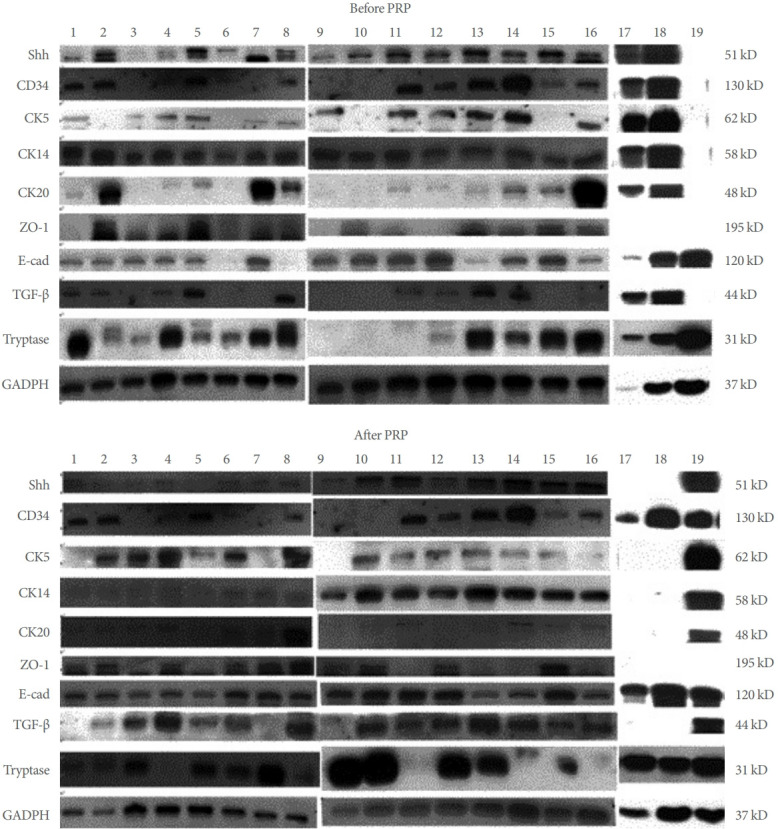
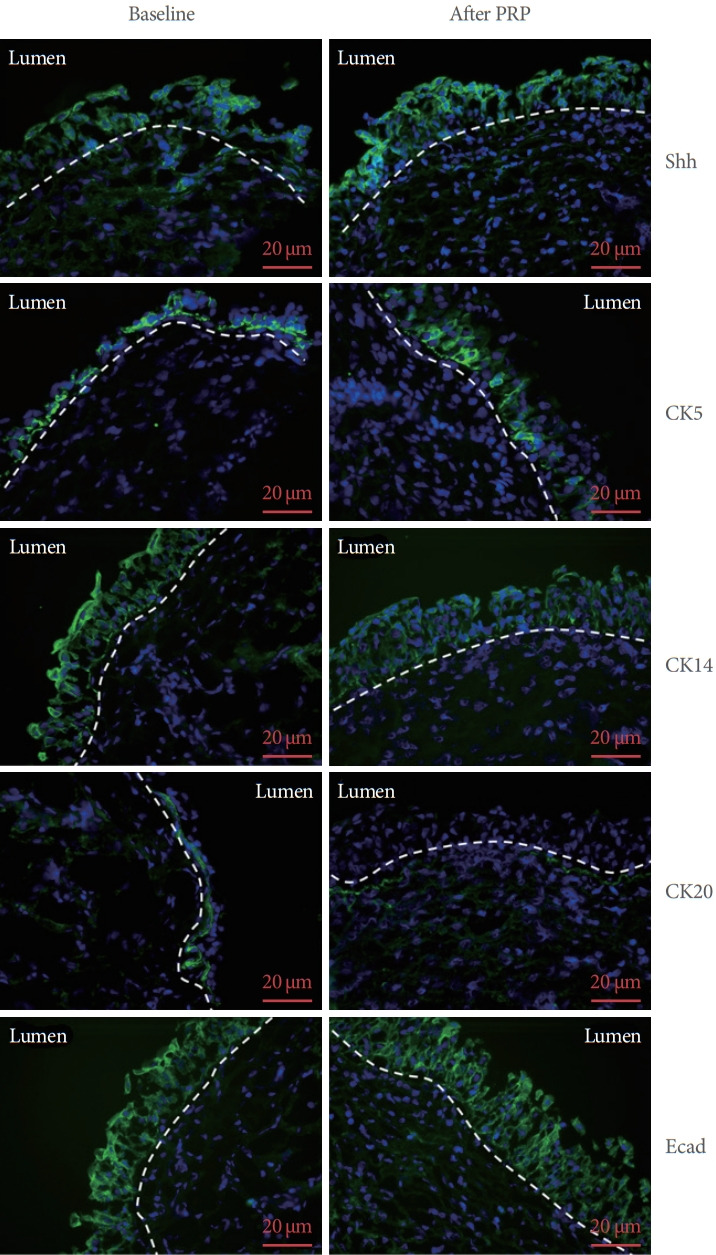
A total of 19 patients with IC/BPS underwent 4 monthly intravesical PRP injections. Bladder biopsies were taken at the first and fourth PRP treatment. The bladder specimens were analyzed using the Western blot and immunochemical staining for progenitor cell markers for sonic hedgehog (Shh), CD34, and cytoskeleton proteins cytokeratin 5 (CK5), CK14, CK20; barrier function markers for zonula occludens-1 (ZO-1), E-cadherin, and intercellular adhesive molecule-1, tryptase and transforming growth factor-β (TGF-β). Global response assessment (GRA) was used to evaluate treatment outcomes.
The mean age of patients was 55.6 years. After PRP injections, the functional bladder capacity and maximum flow rate increased, and the visual analogue scale (VAS) of pain, interstitial cystitis (IC) symptom index, IC problem index, O'Leary-Sant symptom score, and GRA improved in all patients. Urothelium Shh, CK5, ZO-1, E-cadherin, and TGF-β expressions increased significantly after repeated PRP injections. By subgrouping, according to PRP treatment outcomes, significant increases in Shh, E-cadherin, and ZO-1 expressions were noted only in patients with GRA ≥1 or improved VAS, but not in patients with GRA=0 and no improvement in VAS.
The level of urothelial barrier function protein and cell proliferation protein expression in the patients with IC/BPS was increased after repeat intravesical PRP injections. Intravesical repeat PRP injections may have potential to improve urothelial health and result in symptoms improvement in the patients with IC/BPS.
研究膀胱内注射富血小板血浆(PRP)后,间质性膀胱炎/膀胱疼痛综合征(IC/BPS)患者的尿路上皮细胞增殖、细胞骨架、炎症及屏障功能蛋白表达情况。
19例IC/BPS患者每月接受4次膀胱内PRP注射。在首次和第四次PRP治疗时进行膀胱活检。使用蛋白质印迹法和免疫化学染色对膀胱标本进行分析,检测音猬因子(Shh)、CD34等祖细胞标志物以及细胞角蛋白5(CK5)、CK14、CK20等细胞骨架蛋白;紧密连接蛋白1(ZO-1)、E-钙黏蛋白等屏障功能标志物,细胞间黏附分子-1、类胰蛋白酶和转化生长因子-β(TGF-β)。采用整体反应评估(GRA)来评估治疗效果。
患者的平均年龄为55.6岁。PRP注射后,所有患者的膀胱功能容量和最大尿流率增加,疼痛视觉模拟评分(VAS)、间质性膀胱炎(IC)症状指数、IC问题指数、奥利里-桑特症状评分及GRA均有所改善。重复PRP注射后,尿路上皮Shh、CK5、ZO-1、E-钙黏蛋白和TGF-β表达显著增加。根据PRP治疗效果进行亚组分析,仅在GRA≥1或VAS改善的患者中,Shh、E-钙黏蛋白和ZO-1表达显著增加,而在GRA = 0且VAS无改善的患者中未观察到显著增加。
重复膀胱内注射PRP后,IC/BPS患者的尿路上皮屏障功能蛋白和细胞增殖蛋白表达水平升高。膀胱内重复注射PRP可能有助于改善IC/BPS患者的尿路上皮健康并缓解症状。