Department of Psychiatry, Rijnstate Hospital, Arnhem, The Netherlands.
Department of Clinical Neurophysiology, University of Twente, Enschede, The Netherlands.
Acta Psychiatr Scand. 2022 Apr;145(4):343-356. doi: 10.1111/acps.13397. Epub 2022 Feb 8.
The authors conducted a systematic review and meta-analysis of pharmacological interventions to diminish cognitive side effects of ECT.
Electronic databases of Pubmed, PsycInfo, Embase and Scopus were searched from inception through 1 April, 2021, using terms for ECT (e.g. electroconvulsive therapy), cognitive outcome (e.g. cogni*) and pharmacological intervention (e.g. calcium channel blocker and general terms, like protein). Original studies with humans receiving ECT were included, which applied pharmacological interventions in comparison with placebo or no additive intervention to diminish cognitive side effects. Data quality was assessed using Risk of Bias and GRADE. Random-effects models were used. PROSPERO registration number was CRD42021212773.
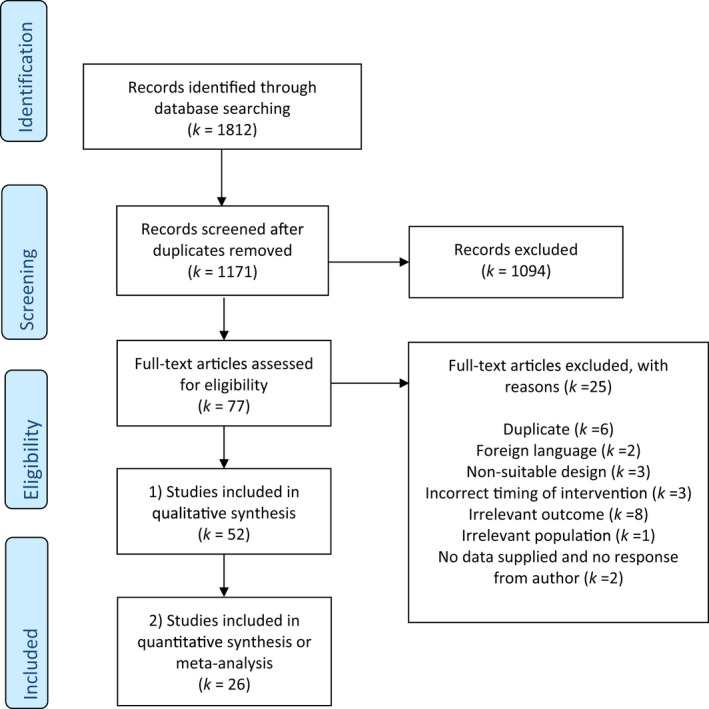
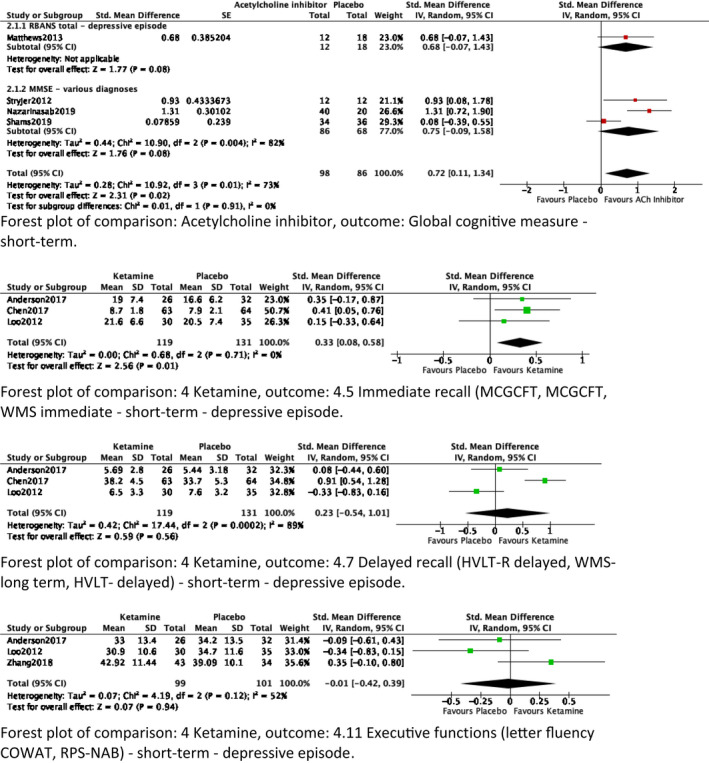
Qualitative synthesis (systematic review) showed 52 studies reporting sixteen pharmacological intervention-types. Quantitative synthesis (meta-analysis) included 26 studies (1387 patients) describing twelve pharmacological intervention-types. Low-quality evidence of efficacy was established for memantine (large effect size) and liothyronine (medium effect size). Very low-quality evidence shows effect of acetylcholine inhibitors, piracetam and melatonin in some cognitive domains. Evidence of no efficacy was revealed for ketamine (very low-quality), herbal preparations with anti-inflammatory properties (very low to low-quality) and opioid receptor agonists (low-quality).
Memantine and liothyronine are promising for further research and future application. Quality of evidence was low because of differences in ECT techniques, study populations and cognitive measurements. These findings provide a guide for rational choices of potential pharmacological intervention research targets to decrease the burden of cognitive side effects of ECT. Future research should be more uniform in design and attempt to clarify pathophysiological mechanisms of cognitive side effects of ECT.
作者对减少电休克治疗认知副作用的药物干预措施进行了系统评价和荟萃分析。
从建库至 2021 年 4 月 1 日,通过 Pubmed、PsycInfo、Embase 和 Scopus 电子数据库,使用电休克(如电抽搐治疗)、认知结果(如 cogni*)和药物干预(如钙通道阻滞剂和一般术语,如蛋白)的术语进行搜索。纳入接受电休克治疗的人类的原始研究,这些研究应用药物干预措施与安慰剂或无附加干预措施比较,以减少认知副作用。使用偏倚风险和 GRADE 评估数据质量。使用随机效应模型。PROSPERO 注册号为 CRD42021212773。
定性综合(系统评价)显示,有 52 项研究报告了 16 种药物干预类型。定量综合(荟萃分析)包括 26 项研究(1387 例患者),描述了 12 种药物干预类型。对于美金刚(大效应量)和左甲状腺素(中效应量),确定了低质量的疗效证据。乙酰胆碱抑制剂、吡拉西坦和褪黑素在某些认知领域有效果的证据非常低。氯胺酮(极低质量)、具有抗炎特性的草药制剂(低质量至极低质量)和阿片受体激动剂(低质量)没有效果的证据。
美金刚和左甲状腺素有希望进一步研究和未来应用。由于电休克技术、研究人群和认知测量的差异,证据质量较低。这些发现为减少电休克治疗认知副作用的潜在药物干预研究目标的合理选择提供了指导。未来的研究应在设计上更加统一,并尝试阐明电休克治疗认知副作用的病理生理机制。