Oliva Vincenzo, Fico Giovanna, De Prisco Michele, Gonda Xenia, Rosa Adriane R, Vieta Eduard
Departament de Medicina, Facultat de Medicina i Ciències de la Salut, Institut de Neurociències, Universitat de Barcelona (UB), c. Casanova, 143, 08036, Barcelona, Spain.
Bipolar and Depressive Disorders Unit, Hospìtal Clinic de Barcelona, c. Villarroel, 170, 08036, Barcelona, Spain.
Lancet Reg Health Eur. 2024 Nov 29;48:101135. doi: 10.1016/j.lanepe.2024.101135. eCollection 2025 Jan.
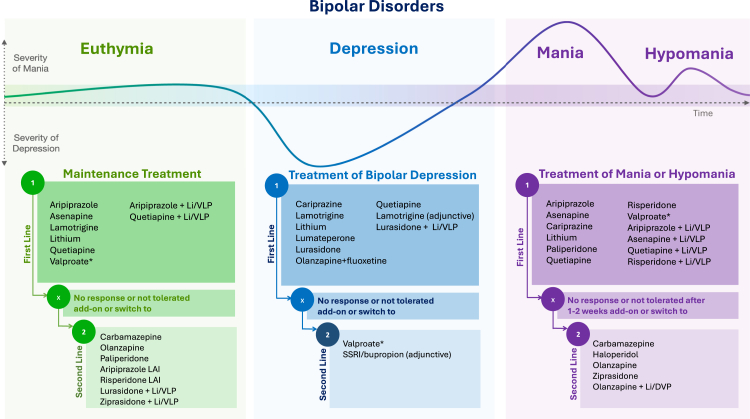
Bipolar disorders are chronic psychiatric conditions characterized by recurrent episodes of mania and depression. Affecting over 1% of the global population, these disorders contribute significantly to disability and mortality, often due to suicide and cardiovascular disease. Diagnostic challenges arise from symptom overlap with unipolar depression, frequently leading to delays. Bipolar disorders are driven by complex genetic, neurobiological, and environmental factors and are commonly accompanied by psychiatric and medical comorbidities, further complicating diagnosis and treatment. Standard management strategies include mood stabilizers, antipsychotics, and selective use of antidepressants, complemented by psychosocial interventions like cognitive-behavioral therapy and psychoeducation, which are vital for relapse prevention. Despite recent advancements, the management of bipolar disorders remains challenging, constrained by clinical variability, an absence of specific biomarkers, and differences in approved treatments and treatment guidelines across regions. Emerging research underscores the potential of precision psychiatry and digital health tools to enhance diagnosis and treatment. Nonetheless, critical gaps persist, particularly in implementing equitable care worldwide. This review offers a comprehensive update on bipolar disorders, examining clinical presentation, early diagnosis, pathogenesis, therapeutic strategies, and future perspectives to guide clinicians and researchers in addressing these ongoing challenges in research and clinical practice.
None.
双相情感障碍是一种慢性精神疾病,其特征为躁狂和抑郁反复发作。这些疾病影响着全球超过1%的人口,常常导致残疾和死亡,主要原因是自杀和心血管疾病。由于症状与单相抑郁重叠,诊断面临挑战,常常导致诊断延迟。双相情感障碍由复杂的遗传、神经生物学和环境因素驱动,通常伴有精神和医学合并症,这进一步使诊断和治疗复杂化。标准管理策略包括心境稳定剂、抗精神病药物以及选择性使用抗抑郁药,并辅以认知行为疗法和心理教育等社会心理干预措施,这些措施对预防复发至关重要。尽管最近有进展,但双相情感障碍的管理仍然具有挑战性,受到临床变异性、缺乏特异性生物标志物以及各地区批准的治疗方法和治疗指南差异的限制。新兴研究强调了精准精神病学和数字健康工具在改善诊断和治疗方面的潜力。然而,关键差距仍然存在,特别是在全球范围内实施公平护理方面。这篇综述全面更新了双相情感障碍的相关内容,探讨了临床表现、早期诊断、发病机制、治疗策略和未来展望,以指导临床医生和研究人员应对研究和临床实践中这些持续存在的挑战。
无。