Institute of Public Health, College of Medicine and Health Sciences, UAE University, Al-Ain, United Arab Emirates.
Department of Environmental Health and Behavioral Sciences, School of Public Health, College of Health Sciences, Mekelle University, Mekelle, Ethiopia.
World J Emerg Surg. 2022 Jan 26;17(1):7. doi: 10.1186/s13017-022-00412-4.
Motorized 2-3-wheelers-related death is high due to the exposed body of the driver/passenger and the high speed. The United Nation (UN) Decade of Action for road safety aimed to reduce road traffic deaths by 50% by the year 2020. We aimed to study the factors affecting the death rates of motorized 2-3 wheelers injured victims and whether the reduction in the death rates has met the UN target.
Data were retrieved from the WHO Global Status Reports on Road Safety published over 2009 to 2018 which covered the years of 2007 to 2016. Studied variables included motorized 2-3 wheelers death rates, percentage of helmet-wearing rate, helmet law enforcement, speed law enforcement, gross national income per capita, vehicles/person ratio, and motorized 2-3 wheelers/person ratio. A mixed linear model was used to define factors affecting the change of motorized 2-3 wheelers death rates over time.
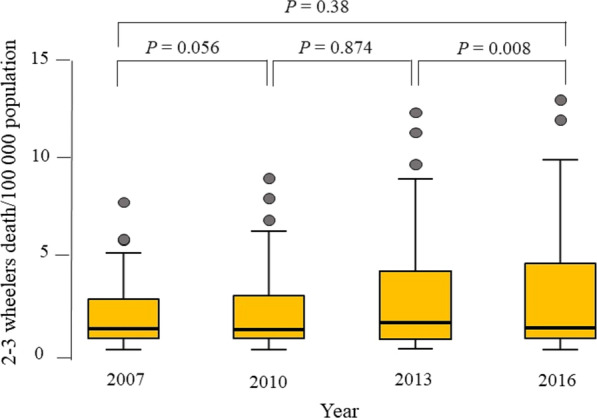
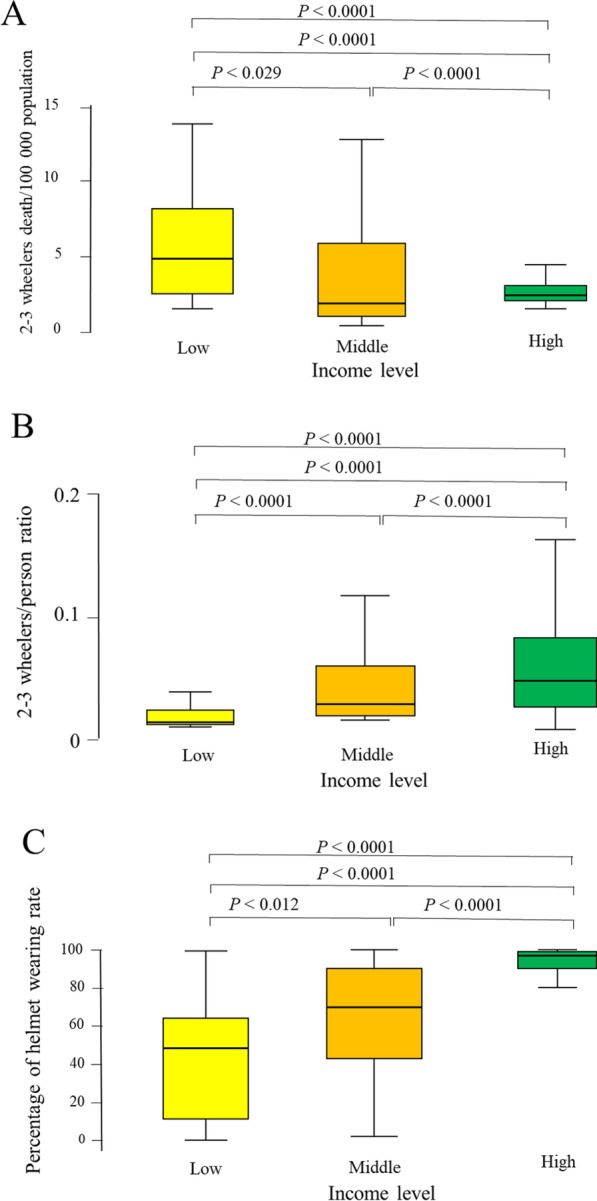
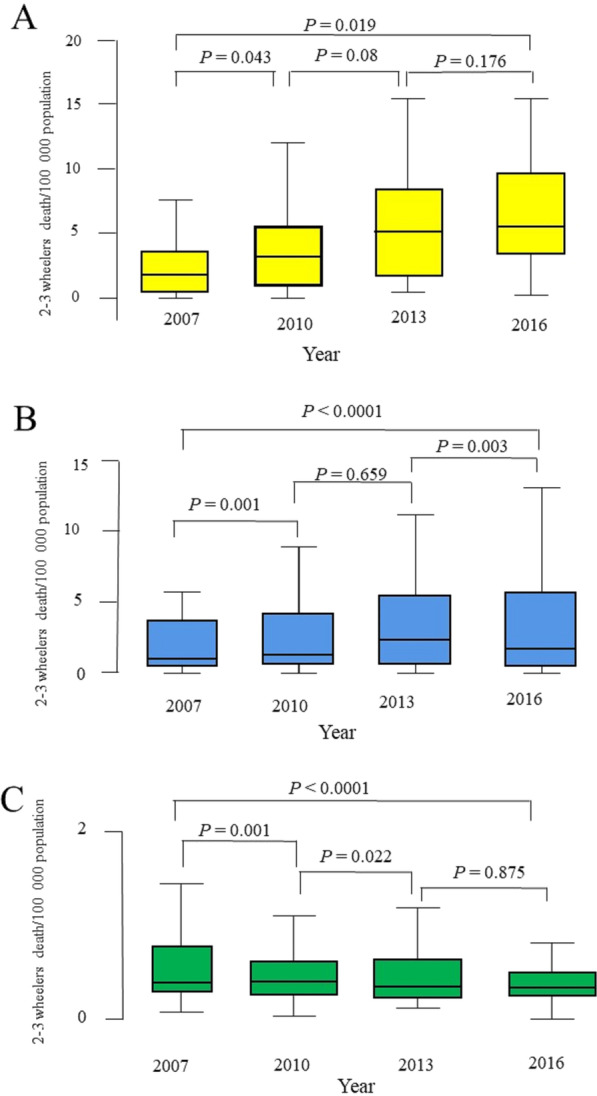
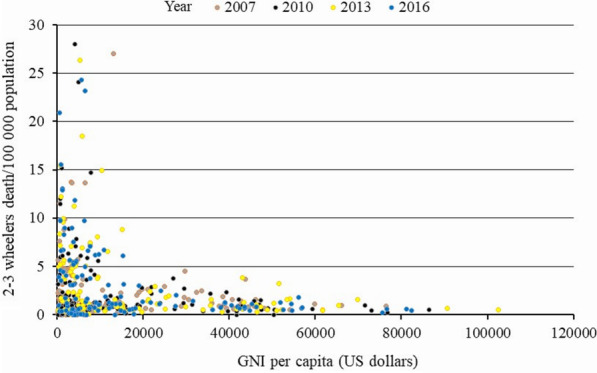
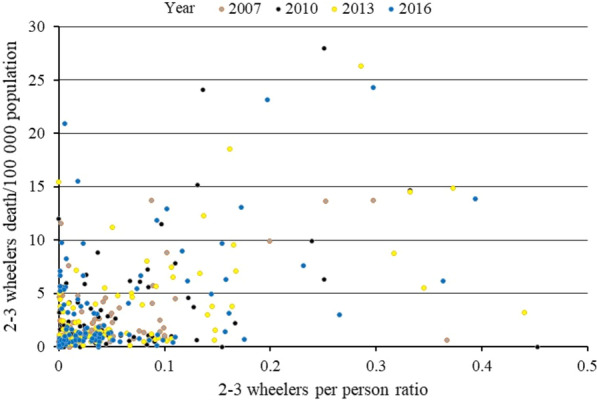
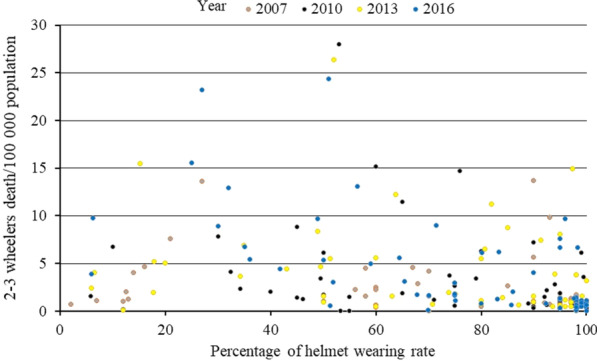
The global mean motorized 2-3 wheelers death rates increased from 2.37/100,000 population to 3.23/100,000 population over the studied decade (a relative ratio of 1.36) which was not statistically significant. Factors that affected mortality included GNI (p = 0.025), motorized 2-3 wheelers per person ratio (p < 0.0001), percentage of helmet wearing rate (p = 0.046), and the interaction between vehicle/person ratio and motorized 2-3 wheelers/person ratio (p = 0.016). There was a significant increase in the death rates over time in the low-income countries (a relative ratio of 2.52, p = 0.019, Friedman test), and middle-income countries (a relative ratio of 1.46, p < 0.0001, Friedman test), compared with a significant decrease in the high-income countries (a relative ratio of 0.72, p < 0.0001, Friedman test).
Global mortality of motorized 2-3 wheelers has increased by a relative ratio of 1.36 over a recent decade. The UN target of reducing death was not met. The increase was related to the increase in motorized 2-3 wheelers per person ratio and economic inequity which has to be addressed globally. The economic global gap significantly impacts the mortality rates of motorized 2-3 wheelers.
由于驾驶员/乘客身体暴露在外且速度较快,因此与机动 2-3 轮车相关的死亡人数居高不下。联合国(UN)道路安全行动十年旨在到 2020 年将道路交通死亡人数减少 50%。我们旨在研究影响机动 2-3 轮车受伤者死亡率的因素,以及死亡率的降低是否达到了联合国的目标。
从世界卫生组织(WHO)2009 年至 2018 年发布的全球道路安全状况报告中检索数据,涵盖了 2007 年至 2016 年的数据。研究变量包括机动 2-3 轮车死亡率、头盔佩戴率、头盔执法、速度执法、人均国民总收入、车辆/人口比以及机动 2-3 轮车/人口比。使用混合线性模型来确定影响机动 2-3 轮车死亡率随时间变化的因素。
在研究的十年中,全球机动 2-3 轮车死亡率从 2.37/100,000 人增加到 3.23/100,000 人(相对比率为 1.36),但无统计学意义。影响死亡率的因素包括国民总收入(p=0.025)、机动 2-3 轮车人均比例(p<0.0001)、头盔佩戴率(p=0.046)以及车辆/人口比与机动 2-3 轮车/人口比之间的相互作用(p=0.016)。低收入国家(相对比率为 2.52,p=0.019,弗里德曼检验)和中等收入国家(相对比率为 1.46,p<0.0001,弗里德曼检验)的死亡率随着时间的推移显著增加,而高收入国家的死亡率则显著下降(相对比率为 0.72,p<0.0001,弗里德曼检验)。
在最近十年中,全球机动 2-3 轮车的死亡率增加了相对比率 1.36。联合国降低死亡率的目标没有实现。这种增加与机动 2-3 轮车人均比例的增加以及经济不平等有关,这需要在全球范围内加以解决。经济全球差距对机动 2-3 轮车的死亡率有重大影响。