Watanabe Eizo, Takasu Osamu, Teratake Youichi, Sakamoto Teruo, Ikeda Toshiaki, Kotani Joji, Kitamura Nobuya, Ohmori Masaaki, Teratani Ayako, Honda Goichi, Hatano Masahiko, Mayer Benjamin, Schneider E Marion, Oda Shigeto
Department of Emergency and Critical Care Medicine, Chiba University Graduate School of Medicine, Chiba, Japan.
General Medical Science, Chiba University Graduate School of Medicine, Chiba, Japan.
Front Med (Lausanne). 2022 Jan 10;8:762198. doi: 10.3389/fmed.2021.762198. eCollection 2021.
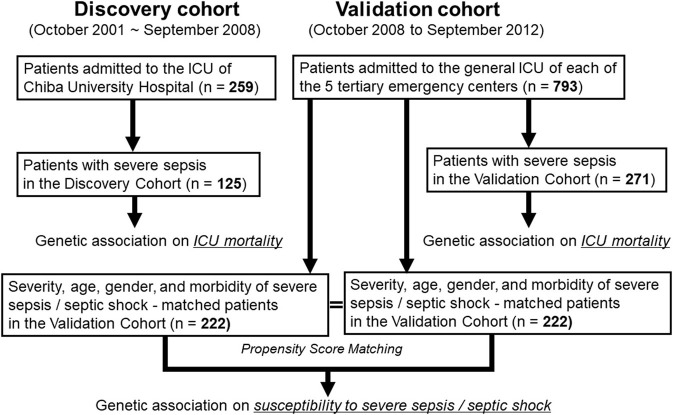
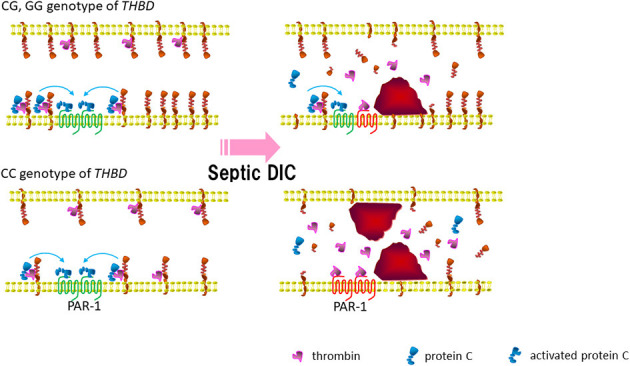
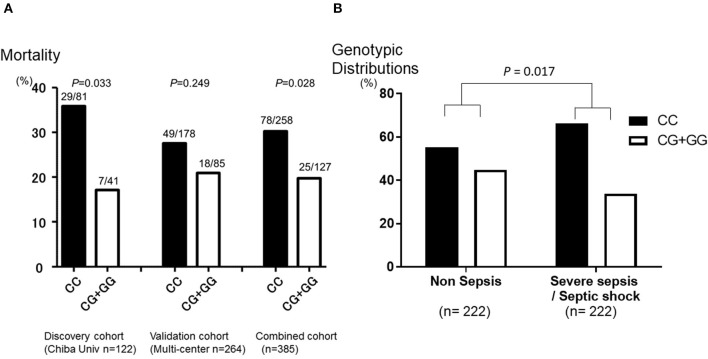
Disseminated intravascular coagulation plays a key role in the pathophysiology of sepsis. Thrombomodulin is essential in the protein C system of coagulation cascade, and functional polymorphisms influence the human thrombomodulin gene (). Therefore, we conducted a multicenter study to evaluate the influence of such polymorphisms on the pathophysiology of sepsis. A collaborative case-control study in the intensive care unit (ICU) of each of five tertiary emergency centers. The study included 259 patients (of whom 125 displayed severe sepsis), who were admitted to the ICU of Chiba University Hospital, Chiba, Japan between October 2001 and September 2008 (discovery cohort) and 793 patients (of whom 271 patients displayed severe sepsis), who were admitted to the five ICUs between October 2008 and September 2012 (multicenter validation cohort). To assess the susceptibility to severe sepsis, we further selected 222 critically ill patients from the validation cohort matched for age, gender, morbidity, and severity with the patients with severe sepsis, but without any evidence of sepsis. We examined whether the eight single nucleotide polymorphisms (SNPs) were associated with susceptibility to and/or mortality of sepsis. Higher mortality on severe sepsis in the discovery and combined cohorts was significantly associated with the CC genotype in a promoter SNP (-1920C/G; rs2239562) [odds ratio [] 2.709 (1.067-6.877), = 0.033 and 1.768 (1.060-2.949), = 0.028]. Furthermore, rs2239562 SNP was associated with susceptibility to severe sepsis [ 1.593 (1.086-2.338), = 0.017]. The data demonstrate that rs2239562, the promoter SNP influences both the outcome and susceptibility to severe sepsis.
弥散性血管内凝血在脓毒症的病理生理学中起关键作用。血栓调节蛋白在凝血级联反应的蛋白C系统中至关重要,其功能多态性会影响人类血栓调节蛋白基因()。因此,我们开展了一项多中心研究,以评估此类多态性对脓毒症病理生理学的影响。在五个三级急诊中心的重症监护病房(ICU)进行了一项合作病例对照研究。该研究纳入了259例患者(其中125例表现为严重脓毒症),这些患者于2001年10月至2008年9月期间入住日本千叶县千叶大学医院的ICU(发现队列),以及793例患者(其中271例表现为严重脓毒症),这些患者于2008年10月至2012年9月期间入住这五个ICU(多中心验证队列)。为了评估对严重脓毒症的易感性,我们从验证队列中进一步选取了222例危重症患者,这些患者在年龄、性别、发病率和严重程度方面与严重脓毒症患者匹配,但无任何脓毒症证据。我们检查了八个单核苷酸多态性(SNP)是否与脓毒症的易感性和/或死亡率相关。发现队列和合并队列中严重脓毒症患者较高的死亡率与启动子SNP(-1920C/G;rs2239562)中的CC基因型显著相关[比值比[]2.709(1.067 - 6.877), = 0.033和1.768(1.060 - 2.949), = 0.028]。此外,rs2239562 SNP与严重脓毒症的易感性相关[1.593(1.086 - 2.338), = 0.017]。数据表明,启动子SNP rs2239562既影响严重脓毒症的结局,也影响其易感性。