Oromia Regional Health Bureau, Toke Kutaye Health Office, Guder, Ethiopia.
Department of Public Health, College of Medicine and Health Sciences, Ambo University, Ambo, Ethiopia.
PLoS One. 2022 Jan 27;17(1):e0262320. doi: 10.1371/journal.pone.0262320. eCollection 2022.
Age inappropriate vaccination of children increases the rate of mortality and morbidity. All studies conducted in some areas of Ethiopia were only quantitative in nature and focused on the main cities ignoring rural communities.
The objective of this study is to assess vaccination timeliness and associated factors among children in Toke Kutaye district, central Ethiopia.
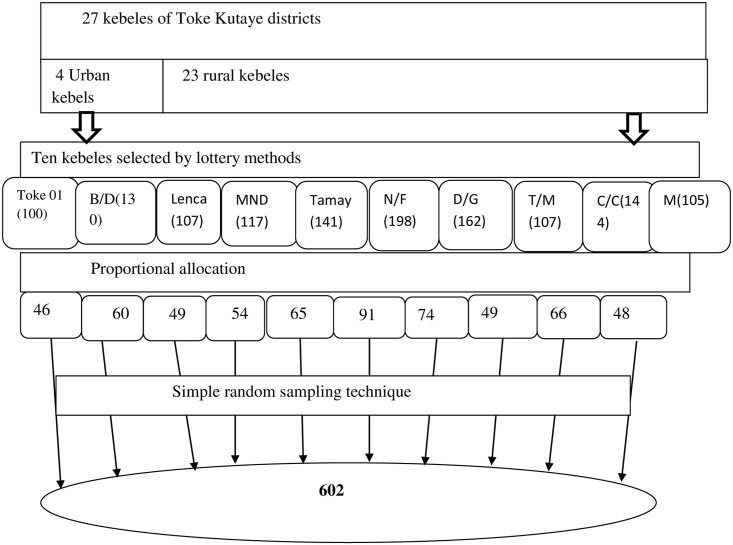
A community-based cross-sectional study with quantitative and qualitative data collection methods was used, for which simple random sampling was used to select 602 mothers/caregivers who have vaccinated children aged 12 to 23 months in the district. The collected data were entered into Epi-data version 3.1 and exported to SPSS version 23 for analysis. Bivariate analysis with a P-value of < 0.25 was used to select candidate variables for multivariate logistic regression. Adjusted odds ratio (AOR) with 95% CI and p-value < 0.05 were used to declare a significant association. Qualitative data responses were classified and then organized by content with thematic analysis.
A total of 590 respondents responded to the interviews, making a response rate of 98%. In this study, 23.9% (95% CI: 20.4-27.7) of children aged 12-23 months had received all vaccines in the recommended time intervals. Urban residence (AOR: 3.15, 95% CI: 1.56-6.4), participation of pregnant women in conferences (AOR: 2.35, 95% CI: 1.2-4.57), institutional delivery (AOR: 2.5: 95% CI: 1.32-4.20), and sufficient knowledge of mothers (AOR: 3, 95% CI: 1.82-5.10) were significantly associated with the timeliness of childhood vaccination. Qualitative findings revealed that lack of knowledge and lack of information from mothers or caregivers, and inadequate communication with health workers hindered timely vaccination.
The overall timeliness of the child's vaccination was low in this study. Residence, participation in a conference, place of delivery, and knowledge of the mothers were predictors of vaccination timeliness. Hence, promoting institutional delivery and increasing pregnant mothers awreness on vaccination timeliness through conference participation is compulsory.
儿童接种不适当的疫苗会增加死亡率和发病率。在埃塞俄比亚的一些地区进行的所有研究都只是定量的,并且只关注主要城市,而忽略了农村社区。
本研究旨在评估埃塞俄比亚中部托科库塔耶地区儿童的疫苗接种及时性及其相关因素。
本研究采用了基于社区的横断面研究,结合了定量和定性数据收集方法,采用简单随机抽样方法选择了该地区 12 至 23 个月龄的 602 名已接种疫苗的母亲/照顾者。收集的数据输入 Epi-data 版本 3.1 并导出到 SPSS 版本 23 进行分析。使用 P 值<0.25 的双变量分析选择多变量逻辑回归的候选变量。使用调整后的优势比(AOR)和 95%置信区间(CI)以及 p 值<0.05 来表示显著关联。定性数据的响应通过内容分类,然后通过主题分析进行组织。
共有 590 名受访者接受了访谈,应答率为 98%。在这项研究中,12-23 个月龄的儿童中有 23.9%(95%CI:20.4-27.7)按推荐时间间隔接种了所有疫苗。城市居住(AOR:3.15,95%CI:1.56-6.4)、孕妇参加会议(AOR:2.35,95%CI:1.2-4.57)、机构分娩(AOR:2.5:95%CI:1.32-4.20)和母亲有足够的知识(AOR:3,95%CI:1.82-5.10)与儿童疫苗接种的及时性显著相关。定性研究结果表明,母亲或照顾者缺乏知识和信息,以及与卫生工作者沟通不足,阻碍了及时接种疫苗。
本研究中,儿童整体疫苗接种及时性较低。居住地点、参加会议、分娩地点和母亲的知识是疫苗接种及时性的预测因素。因此,必须通过会议参与来促进机构分娩和提高孕妇对疫苗接种及时性的认识。