
miR-21中的单核苷酸多态性(rs1292037和rs13137)与中国人群的2型糖尿病相关。
The Single Nucleotide Polymorphisms (rs1292037 and rs13137) in miR-21 Were Associated with T2DM in a Chinese Population.
作者信息
Li Yiping, Yang Jia, Tao Wenyu, Yang Man, Wang Xiaoling, Lu Tinglian, Li Chuanyin, Yang Ying, Yao Yufeng
机构信息
Department of Endocrinology, The Affiliated Hospital of Yunnan University & The Second People's Hospital of Yunnan Province, Kunming City, Yunnan, People's Republic of China.
Institute of Medical Biology, Chinese Academy of Medical Sciences & Peking Union Medical College, Kunming City, People's Republic of China.
出版信息
Diabetes Metab Syndr Obes. 2022 Jan 20;15:189-198. doi: 10.2147/DMSO.S345758. eCollection 2022.
BACKGROUND
Insulin receptor (INSR), insulin receptor substrate (IRS) and glucose transporter 4 (GLUT4) play important roles in the insulin resistance pathway. The microRNA (miRNA or miR) involved in INSR, IRS or GLUT4 could be associated with the development of type 2 diabetes (T2DM).
METHODS
The aim of this study was to investigate the association of T2DM with 12 single nucleotide polymorphisms (SNPs) in 7 miRNAs (miR-195, miR-126, miR-144, miR-155, miR-21, miR-93 and miR-222) involved in the insulin resistance pathway. A total of 1593 subjects with T2DM and 1656 nondiabetic subjects were genotyped. Then, the associations of these SNPs with the development of T2DM and individual metabolic traits were evaluated, such as fasting plasma glucose (FPG) and glycosylated haemoglobin (HbA1C).
RESULTS
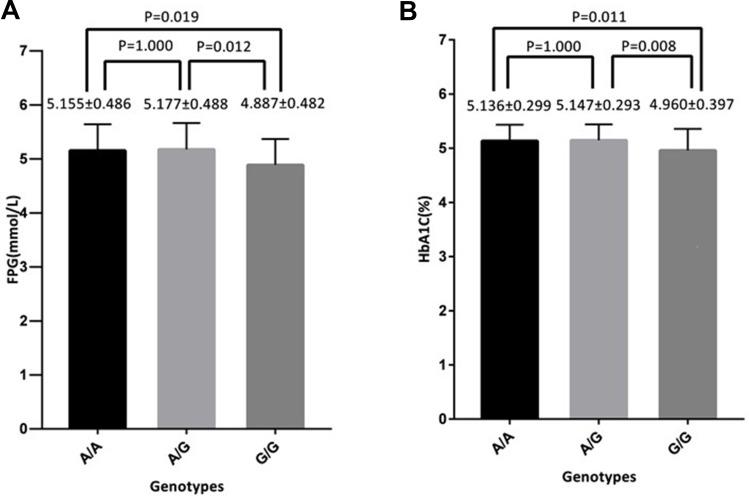
Our data showed that the C allele of rs1292037 in miR-21 could increase the risk of developing T2DM (P = 0.002, OR = 1.17; 95% CI: 1.06-1.29). In addition, the T allele of rs13137 in miR-21 could be a risk factor for T2DM (P = 0.003, OR = 1.16; 95% CI: 1.05-1.28). According to inheritance mode analysis, compared with the T/T-T/C genotype, the C/C genotype of rs1292037 showed a risk effect in T2DM in the recessive mode (P = 0.001, OR = 1.35; 95% CI: 1.13-1.63). For rs13137, compared with the A/A-A/T genotype, the T/T genotype also showed a risk effect in T2DM in the recessive mode (P = 0.001, OR = 1.35; 95% CI: 1.13-1.62). Moreover, in the nondiabetic group, compared with the rs78312845 A/G (FPG = 5.177±0.488mmol/L; HbA1C = 5.147±0.293%) and A/A genotypes (FPG = 5.155±0.486mmol/L; HbA1C = 5.136±0.299%), the G/G genotype (FPG = 4.887±0.482mmol/L; HbA1C = 4.960±0.397%) was associated with lower FPG (P = 0.012 and 0.019) and HbA1C (P = 0.008 and 0.011).
CONCLUSION
Our results revealed that rs1292037 and rs13137 in miR-21 were associated with T2DM susceptibility in a Han Chinese population. Moreover, the rs78312845 in miR-195 contributed to the level of FPG and HbA1C in nondiabetic group in the Han Chinese population.
背景
胰岛素受体(INSR)、胰岛素受体底物(IRS)和葡萄糖转运蛋白4(GLUT4)在胰岛素抵抗途径中发挥重要作用。参与INSR、IRS或GLUT4的微小RNA(miRNA或miR)可能与2型糖尿病(T2DM)的发生有关。
方法
本研究旨在调查T2DM与参与胰岛素抵抗途径的7种miRNA(miR-195、miR-126、miR-144、miR-155、miR-21、miR-93和miR-222)中的12个单核苷酸多态性(SNP)之间的关联。对1593例T2DM患者和1656例非糖尿病患者进行基因分型。然后,评估这些SNP与T2DM发生及个体代谢特征(如空腹血糖(FPG)和糖化血红蛋白(HbA1C))之间的关联。
结果
我们的数据显示,miR-21中rs1292037的C等位基因可增加患T2DM的风险(P = 0.002,OR = 1.17;95%CI:1.06 - 1.29)。此外,miR-21中rs13137的T等位基因可能是T2DM的一个危险因素(P = 0.003,OR = 1.16;95%CI:1.05 - 1.28)。根据遗传模式分析,与T/T - T/C基因型相比,rs1292037的C/C基因型在隐性模式下对T2DM显示出风险效应(P = 0.001,OR = 1.35;95%CI:1.13 - 1.63)。对于rs13137,与A/A - A/T基因型相比,T/T基因型在隐性模式下对T2DM也显示出风险效应(P = 0.001,OR = 1.35;95%CI:1.13 - 1.62)。此外,在非糖尿病组中,与rs78312845的A/G基因型(FPG = 5.177±0.488mmol/L;HbA1C = 5.147±0.293%)和A/A基因型(FPG = 5.155±0.486mmol/L;HbA1C = 5.136±0.299%)相比,G/G基因型(FPG = 4.887±0.482mmol/L;HbA1C = 4.960±0.397%)与较低的FPG(P = 0.012和0.019)和HbA1C(P = 0.008和0.011)相关。
结论
我们的结果表明,miR-21中的rs1292037和rs13137与中国汉族人群的T2DM易感性相关。此外,miR-195中的rs783
 Zotero 插件