KEMRI/Wellcome Trust Research Programme Centre for Geographic Medicine Research-Coast, Kilifi, Kenya.
Public Health Service of Amsterdam, Department of Infectious Diseases, Amsterdam, The Netherlands.
HIV Med. 2022 Aug;23(7):750-763. doi: 10.1111/hiv.13237. Epub 2022 Jan 27.
To assess frequency and predictors of switching between being on and off PrEP and being lost to follow-up (LTFU) among men who have sex with men (MSM) and transgender women (TGW) with access to PrEP services in Sub-Saharan Africa.
This was a prospective cohort study of MSM and TGW from coastal Kenya who initiated daily oral PrEP from June 2017 to June 2019. Participants were followed monthly for HIV-1 testing, PrEP refill, risk assessment and risk reduction counselling. Follow-up was censored at the last visit before 30 June 2019, or the last HIV-1-negative visit (for those with HIV-1 seroconversion), whichever occurred first. We estimated transition intensities (TI) and predictors of switching: (i) between being off and on PrEP; and (ii) from either PrEP state and being LTFU (i.e. not returning to the clinic for > 90 days) using a multi-state Markov model.
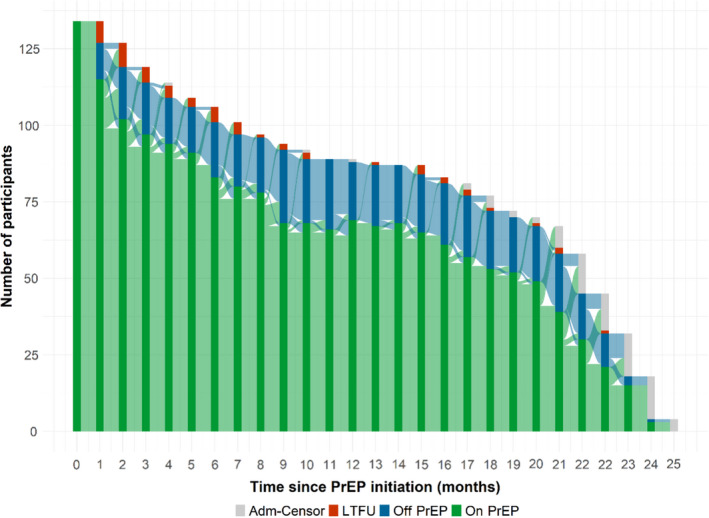
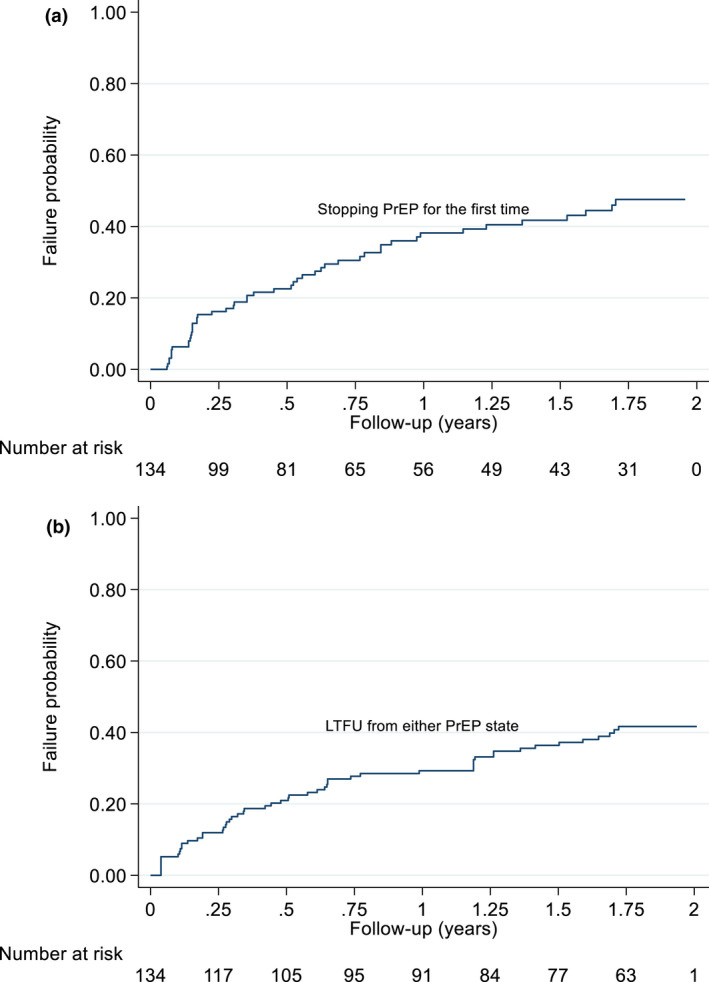
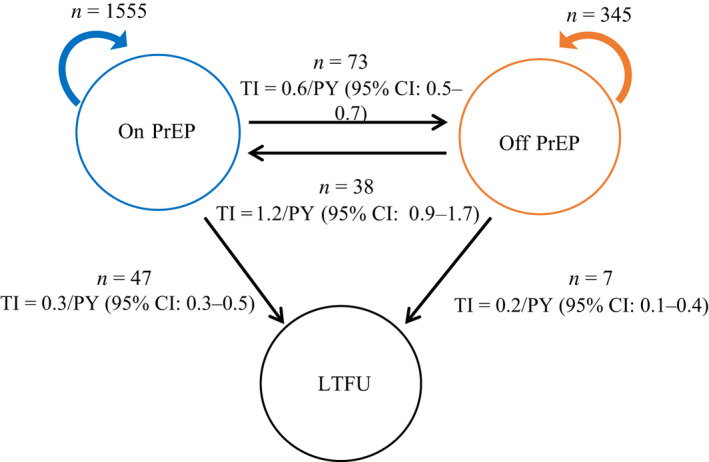
In all, 134 participants starting PrEP were followed for a median of 20.3 months [interquartile range (IQR): 7.7-22.1]. A total of 49 (36.6%) people stopped PrEP 73 times [TI = 0.6/person-year (PY), 95% confidence interval (CI): 0.5-0.7] and, of these, 25 (51.0%) restarted PrEP 38 times (TI = 1.2/PY, 95% CI: 0.9-1.7). In multivariable analysis, stopping PrEP was related to anal sex ≤ 3 months, substance-use disorder and travelling. Restarting PrEP was related to non-Christian or non-Muslim religion and travelling. A total of 54 participants were LTFU: on PrEP (n = 47, TI = 0.3/PY, 95% CI: 0.3-0.5) and off PrEP (n = 7, TI = 0.2/PY, 95% CI: 0.1-0.4). In multivariable analysis, becoming LTFU while on PrEP was associated with secondary education or higher, living in the area for ≤ 1 year, residence outside the immediate clinic area and alcohol-use disorder.
Switching between being on and off PrEP or becoming LTFU while on PrEP was frequent among individuals at risk of HIV-1 acquisition. Alternative PrEP options (e.g. event-driven PrEP) may need to be considered for MSM and TGW with PrEP-taking challenges, while improved engagement with care is needed for all MSM and TGW regardless of PrEP regimen.
评估在撒哈拉以南非洲地区获得 PrEP 服务的男男性行为者(MSM)和跨性别女性(TGW)中,PrEP 停药和失访(LTFU)之间的转换频率和预测因素。
这是一项对肯尼亚沿海地区 MSM 和 TGW 的前瞻性队列研究,他们于 2017 年 6 月至 2019 年 6 月期间开始每日口服 PrEP。参与者每月接受一次 HIV-1 检测、PrEP 补充、风险评估和风险降低咨询。随访截止日期为 2019 年 6 月 30 日前的最后一次就诊或最后一次 HIV-1 阴性就诊(对于 HIV-1 血清转换者),以先发生者为准。我们使用多状态马尔可夫模型估计了转换的强度(TI)和预测因素:(i)从 PrEP 停药到开始 PrEP;(ii)从 PrEP 状态到 LTFU(即 90 天以上未返回诊所)。
共有 134 名开始 PrEP 的参与者被随访中位数为 20.3 个月[四分位间距(IQR):7.7-22.1]。共有 49 人(36.6%)停止 PrEP 73 次[TI=0.6/人年(PY),95%置信区间(CI):0.5-0.7],其中 25 人(51.0%)重新开始 PrEP 38 次(TI=1.2/PY,95%CI:0.9-1.7)。多变量分析显示,停止 PrEP 与 ≤3 个月的肛交、药物使用障碍和旅行有关。重新开始 PrEP 与非基督教或非穆斯林宗教和旅行有关。共有 54 名参与者失访:PrEP 时失访(n=47,TI=0.3/PY,95%CI:0.3-0.5)和 PrEP 停药时失访(n=7,TI=0.2/PY,95%CI:0.1-0.4)。多变量分析显示,PrEP 时失访与中等或高等教育、在该地区居住时间≤1 年、居住在诊所以外地区以及酒精使用障碍有关。
在有 HIV-1 感染风险的个体中,PrEP 开始和停止或 PrEP 期间失访的情况较为频繁。对于 PrEP 服用有困难的 MSM 和 TGW,可能需要考虑其他 PrEP 选择(例如事件驱动的 PrEP),而无论 PrEP 方案如何,都需要加强对所有 MSM 和 TGW 的治疗。