School of Pharmaceutical and Population Health Informatics, Dehradun Institute of Technology, Dehradun, 248009, India.
Jodas Expoim Pvt Ltd, Hyderabad, 500072, India.
Pharmaceut Med. 2022 Feb;36(1):11-20. doi: 10.1007/s40290-021-00417-5. Epub 2022 Jan 30.
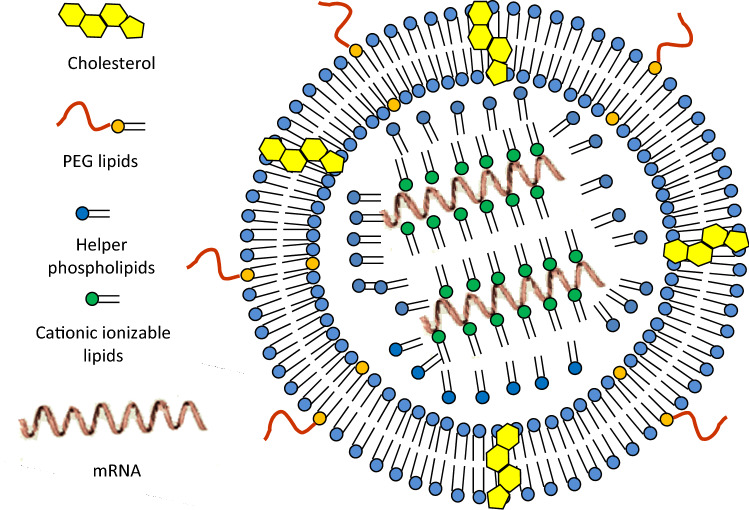
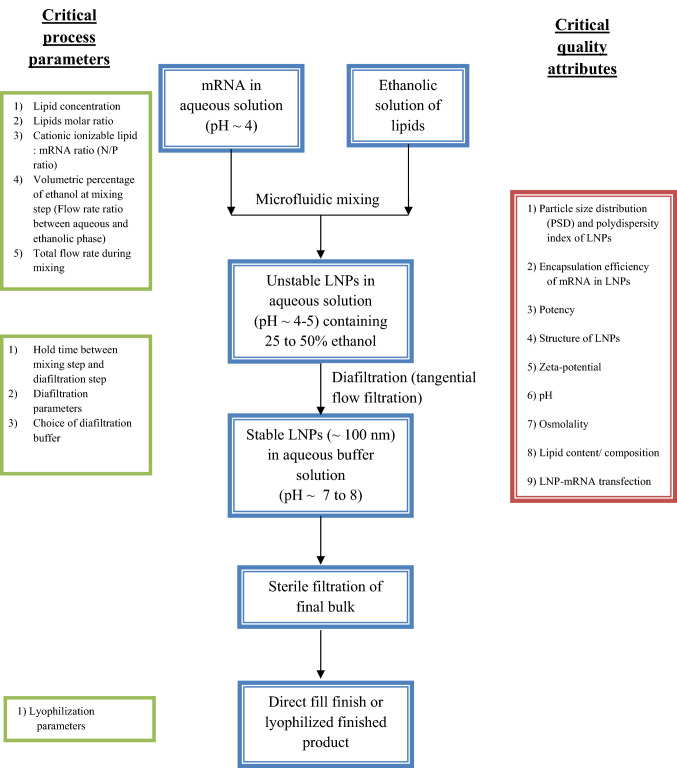
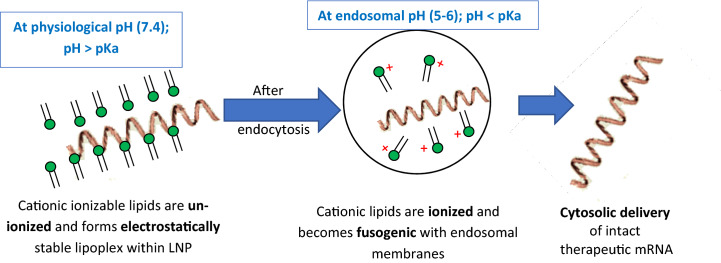
The therapeutic potential for messenger RNA (mRNA) in infectious diseases and cancer was first realized almost three decades ago, but only in 2018 did the first lipid nanoparticle-based small interfering RNA (siRNA) therapy reach the market with the United States Food and Drug Administration (FDA) approval of patisiran (Onpattro™) for hereditary ATTR amyloidosis. This was largely made possible by major advances in the formulation technology for stabilized lipid-based nanoparticles (LNPs). Design of the cationic ionizable lipids, which are a key component of the LNP formulations, with an acid dissociation constant (pKa) close to the early endosomal pH, would not only ensure effective encapsulation of mRNA into the stabilized lipoplexes within the LNPs, but also its subsequent endosomal release into the cytoplasm after endocytosis. Unlike other gene therapy modalities, which require nuclear delivery, the site of action for exogenous mRNA vaccines is the cytosol where they get translated into antigenic proteins and thereby elicit an immune response. LNPs also protect the mRNA against enzymatic degradation by the omnipresent ribonucleases (RNases). Cationic nano emulsion (CNE) is also explored as an alternative and relatively thermostable mRNA vaccine delivery vehicle. In this review, we have summarized the various delivery strategies explored for mRNA vaccines, including naked mRNA injection; ex vivo loading of dendritic cells; CNE; cationic peptides; cationic polymers and finally the clinically successful COVID-19 LNP vaccines (Pfizer/BioNTech and Moderna vaccines)-their components, design principles, formulation parameter optimization and stabilization challenges. Despite the clinical success of LNP-mRNA vaccine formulations, there is a specific need to enhance their storage stability above 0 °C for these lifesaving vaccines to reach the developing world.
信使 RNA(mRNA)在传染病和癌症中的治疗潜力早在三十年前就首次被认识到,但直到 2018 年,第一种基于脂质纳米颗粒的小干扰 RNA(siRNA)疗法才获得美国食品和药物管理局(FDA)批准,用于遗传性转甲状腺素淀粉样变性的 patisiran(Onpattro™)。这在很大程度上要归功于稳定的基于脂质的纳米颗粒(LNPs)制剂技术的重大进展。阳离子可离子化脂质的设计是 LNP 制剂的关键组成部分,其酸离解常数(pKa)接近早期内体 pH,不仅可以确保将 mRNA 有效包封到 LNPs 中的稳定脂质体中,还可以在细胞内吞作用后将其从内涵体中释放到细胞质中。与其他基因治疗方式不同,外源 mRNA 疫苗不需要核内递送,其作用部位是细胞质,在细胞质中它们被翻译成抗原蛋白,从而引发免疫反应。LNPs 还可以防止无处不在的核糖核酸酶(RNases)对 mRNA 的酶降解。阳离子纳米乳液(CNE)也被探索作为替代物和相对热稳定的 mRNA 疫苗递送载体。在这篇综述中,我们总结了探索 mRNA 疫苗的各种递送策略,包括裸露 mRNA 注射;树突状细胞的体外加载;CNE;阳离子肽;阳离子聚合物,最后是临床成功的 COVID-19 LNP 疫苗(辉瑞/生物科技和 Moderna 疫苗)-它们的成分、设计原则、制剂参数优化和稳定化挑战。尽管 LNP-mRNA 疫苗制剂取得了临床成功,但这些救生疫苗需要在 0°C 以上提高其储存稳定性,以使其能够到达发展中国家。