Department of Obstetrics and Gynecology, Faculty of Medicine, University of Tsukuba.
Institute for Global Health Policy Research, Bureau of International Health Cooperation, National Center for Global Health and Medicine.
J Epidemiol. 2022 Apr 5;32(4):188-194. doi: 10.2188/jea.JE20210458. Epub 2022 Feb 11.
Reluctance of people to receive recommended vaccines is a growing concern, as distribution of vaccines is considered critical to ending the COVID-19 pandemic. There is little information regarding pregnant women's views toward coronavirus vaccination in Japan. Therefore, we investigated the vaccination rate and reasons for vaccination and vaccine hesitancy among pregnant women in Japan.
We conducted a cross-sectional study involving 1,791 pregnant women using data from the Japan "COVID-19 and Society" Internet Survey, conducted from July to August 2021, and valid response from 1,621 respondents were analyzed. We defined participants with vaccine hesitancy as those who identified with the statement "I do not want to be vaccinated" or "I want to 'wait and see' before getting vaccinated." Multivariate Poisson regression analysis was used to investigate the factors contributing to vaccine hesitancy.
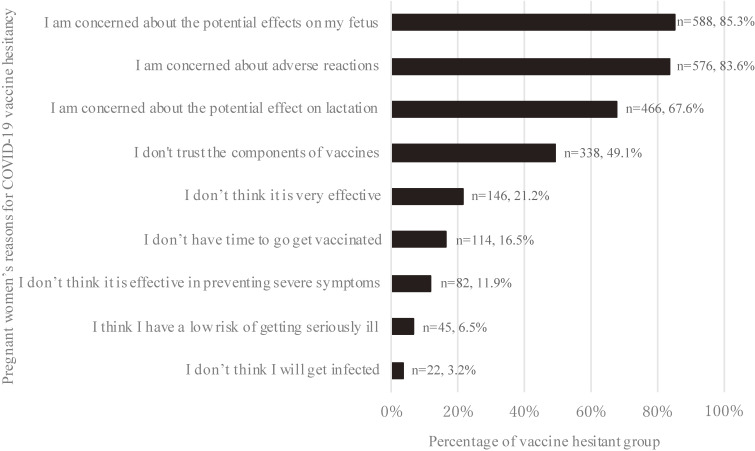
The prevalence of vaccination and vaccine hesitancy among pregnant women was 13.4% (n = 217) and 50.9% (n = 825), respectively. The main reasons for hesitancy were concerns about adverse reactions and negative effects on the fetus and breastfeeding. Vaccine hesitancy was significantly associated with the lack of trust in the government (adjusted prevalence ratio, 1.26; 95% confidence interval, 1.03-1.54). Other factors, such as age, educational attainment, and state of emergency declaration, were not associated with vaccine hesitancy.
COVID-19 vaccination is not widespread among pregnant women in Japan, although many vaccines have been shown to be safe in pregnancy. Accurate information dissemination and boosting trust in the government may be important to address vaccine hesitancy among pregnant women.
人们对接种推荐疫苗的抵触情绪日益加剧,因为疫苗的分发被认为是结束 COVID-19 大流行的关键。有关日本孕妇对冠状病毒疫苗接种看法的信息很少。因此,我们调查了日本孕妇的疫苗接种率以及接种和疫苗犹豫的原因。
我们使用了 2021 年 7 月至 8 月进行的日本“COVID-19 和社会”互联网调查的数据,对 1791 名孕妇进行了横断面研究,对 1621 名有效应答者进行了分析。我们将疫苗犹豫者定义为认同“我不想接种疫苗”或“我想在接种疫苗前观望一下”的人。采用多变量 Poisson 回归分析来探讨导致疫苗犹豫的因素。
孕妇的疫苗接种率和疫苗犹豫率分别为 13.4%(n=217)和 50.9%(n=825)。犹豫不决的主要原因是担心不良反应以及对胎儿和母乳喂养的负面影响。对政府缺乏信任与疫苗犹豫显著相关(调整后患病率比,1.26;95%置信区间,1.03-1.54)。其他因素,如年龄、教育程度和紧急状态宣言,与疫苗犹豫无关。
尽管许多疫苗在怀孕期间已被证明是安全的,但 COVID-19 疫苗在日本孕妇中的接种率并不高。准确的信息传播和增强对政府的信任可能是解决孕妇疫苗犹豫的重要因素。