Suzuki Tomoya, Kotera Yasuhiro, Ozaki Akihiko, Tanimoto Tetsuya, Bhandari Divya, Horiuchi Sayaka, Tabuchi Takahiro
Pediatric Medicine, Okinawa Prefectural Chubu Hospital, Okinawa, JPN.
Faculty of Medicine and Health Sciences, University of Nottingham, Nottingham, GBR.
Cureus. 2024 Oct 5;16(10):e70873. doi: 10.7759/cureus.70873. eCollection 2024 Oct.
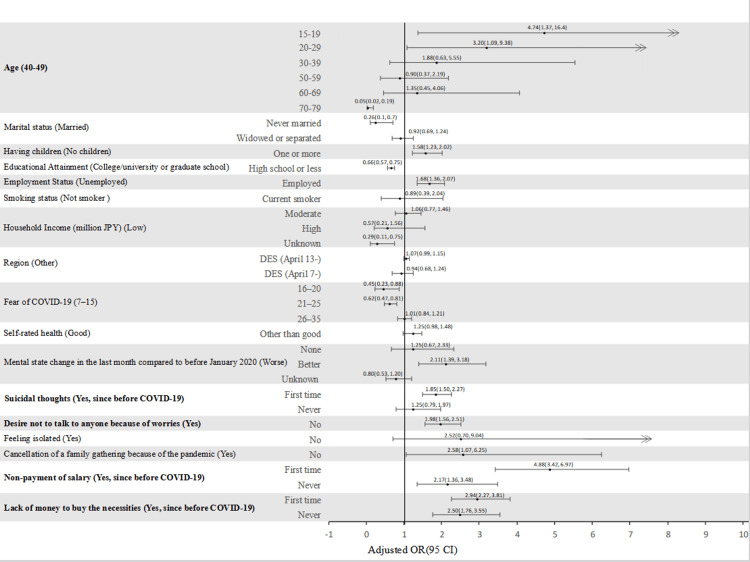
Introduction and background Non-consensual sex, including rape and sexual assault, has been a global concern and may have been influenced by the COVID-19 pandemic. However, information on this topic is limited. Therefore, our objective was to survey the incidence rate of non-consensual sex among Japanese women aged 15-79 years between April and September 2020, during the early stages of the COVID-19 pandemic in Japan. Materials and methods We utilized data from a sample of approximately 2.2 million individuals who participated in a web-based self-reported questionnaire survey from a nationwide, cross-sectional internet survey conducted in Japan between August and September 2020. Sampling weights were applied to calculate national estimates, and multivariable logistic regression was performed to identify factors associated with non-consensual sex. Data were extracted from a web-based, self-administered survey of approximately 2.2 million individuals. Results The study examined the incidence of non-consensual sex among 12,809 women with valid responses, finding an overall rate of 1.1% across all participants. Higher rates were observed among women aged 20-29 (2.4%) and employed women (1.5%) compared to unemployed women (0.7%). No significant difference was noted based on living areas. Increased FCV-19S scores, worsening or improving mental health before COVID-19, suicidal thoughts, and feelings of isolation were all linked to higher incidence rates. Non-payment of salary and lack of money for necessities also correlated with higher rates. Key risk factors included age 15-19 or 20-29, employment, financial instability, suicidal thoughts, and isolation. Notably, 20% of women aged 15-19 reported suicidal ideation. Conclusions This study underscores the critical need for mental and financial support for young women, highlighting the importance of early intervention for economically vulnerable groups. Comprehensive education on sexual consent is essential, especially during societal upheavals like the COVID-19 pandemic, to prevent non-consensual sex and support affected individuals.
引言与背景 非自愿性行为,包括强奸和性侵犯,一直是全球关注的问题,并且可能受到了新冠疫情的影响。然而,关于这个话题的信息有限。因此,我们的目标是调查2020年4月至9月期间,在日本新冠疫情早期阶段,15至79岁日本女性中非自愿性行为的发生率。材料与方法 我们利用了来自约220万人样本的数据,这些人参与了2020年8月至9月在日本进行的一项全国性横断面网络问卷调查,该调查通过网络进行自我报告。应用抽样权重来计算全国估计数,并进行多变量逻辑回归以确定与非自愿性行为相关的因素。数据来自对约220万人的基于网络的自我管理调查。结果 该研究调查了12809名有有效回复的女性中非自愿性行为的发生率,发现所有参与者的总体发生率为1.1%。与失业女性(0.7%)相比,20至29岁的女性(2.4%)和就业女性(1.5%)的发生率更高。根据居住地区未发现显著差异。FCV - 19S评分增加、新冠疫情前心理健康状况恶化或改善、自杀念头以及孤独感都与较高的发生率相关。工资未支付和缺乏购买生活必需品的资金也与较高的发生率相关。关键风险因素包括年龄在15至19岁或20至29岁、就业、经济不稳定、自杀念头和孤独感。值得注意的是,15至19岁的女性中有20%报告有自杀意念。结论 本研究强调了对年轻女性提供心理和经济支持的迫切需求,突出了对经济弱势群体进行早期干预的重要性。关于性同意的全面教育至关重要,尤其是在像新冠疫情这样的社会动荡时期,以防止非自愿性行为并支持受影响的个人。