Safar Center for Resuscitation Research, Department of Critical Care Medicine, University of Pittsburgh Medical Center, 4401 Penn Ave, Pittsburgh, PA, 15224, USA; Center for Free Radical and Antioxidant Health, Department of Environmental and Occupational Health, University of Pittsburgh School of Public Health, 130 Desoto St, Pittsburgh, PA, 15261, USA.
Neuroscience Center and Department of Pediatrics, Massachusetts General Hospital and Harvard Medical School, 55 Fruit St. Boston, MA, 02114, USA.
Redox Biol. 2022 Apr;50:102232. doi: 10.1016/j.redox.2022.102232. Epub 2022 Jan 10.
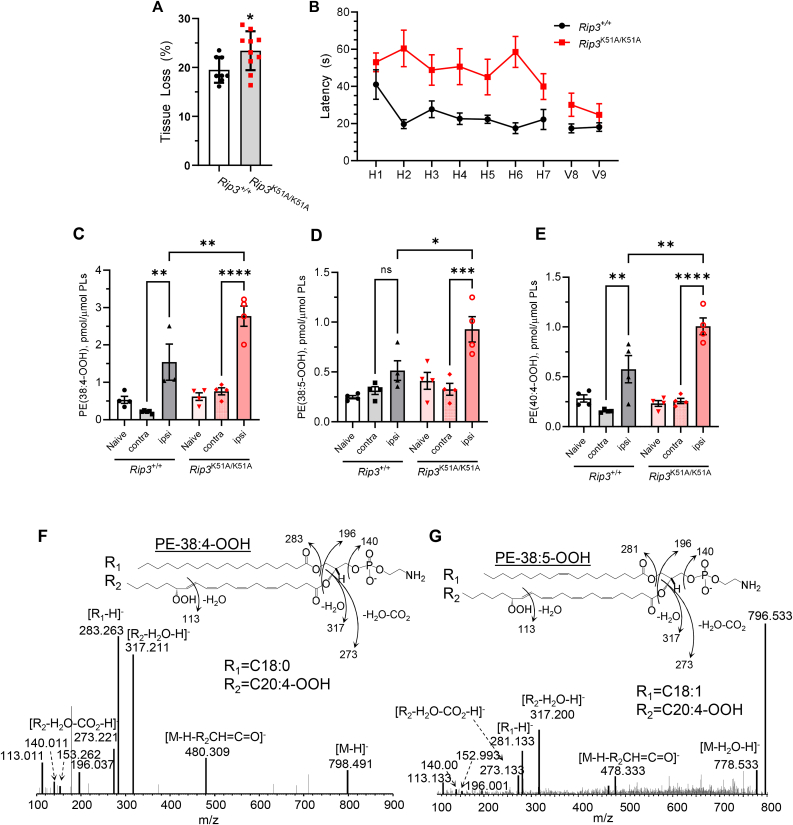
Ferroptosis and necroptosis are two pro-inflammatory cell death programs contributing to major pathologies and their inhibition has gained attention to treat a wide range of disease states. Necroptosis relies on activation of RIP1 and RIP3 kinases. Ferroptosis is triggered by oxidation of polyunsaturated phosphatidylethanolamines (PUFA-PE) by complexes of 15-Lipoxygenase (15LOX) with phosphatidylethanolamine-binding protein 1 (PEBP1). The latter, also known as RAF kinase inhibitory protein, displays promiscuity towards multiple proteins. In this study we show that RIP3 K51A kinase inactive mice have increased ferroptotic burden and worse outcome after irradiation and brain trauma rescued by anti-ferroptotic compounds Liproxstatin-1 and Ferrostatin 16-86. Given structural homology between RAF and RIP3, we hypothesized that PEBP1 acts as a necroptosis-to-ferroptosis switch interacting with either RIP3 or 15LOX. Using genetic, biochemical, redox lipidomics and computational approaches, we uncovered that PEBP1 complexes with RIP3 and inhibits necroptosis. Elevated expression combined with higher affinity enables 15LOX to pilfer PEBP1 from RIP3, thereby promoting PUFA-PE oxidation and ferroptosis which sensitizes Rip3 kinase-deficient mice to total body irradiation and brain trauma. This newly unearthed PEBP1/15LOX-driven mechanism, along with previously established switch between necroptosis and apoptosis, can serve multiple and diverse cell death regulatory functions across various human disease states.
铁死亡和坏死性细胞死亡是两种促炎细胞死亡程序,它们导致多种主要疾病,其抑制作用已引起人们关注,用于治疗广泛的疾病状态。坏死性细胞死亡依赖于 RIP1 和 RIP3 激酶的激活。铁死亡是由 15-脂氧合酶(15LOX)与磷脂乙醇胺结合蛋白 1(PEBP1)复合物氧化多不饱和磷脂酰乙醇胺(PUFA-PE)引发的。后者也称为 RAF 激酶抑制蛋白,对多种蛋白质具有混杂性。在这项研究中,我们表明 RIP3 K51A 激酶失活的小鼠在接受辐射和脑外伤后铁死亡负担增加,结果更差,通过抗铁死亡化合物 Liproxstatin-1 和 Ferrostatin 16-86 可挽救。鉴于 RAF 和 RIP3 之间的结构同源性,我们假设 PEBP1 作为一种坏死性细胞死亡到铁死亡的开关,与 RIP3 或 15LOX 相互作用。我们利用遗传、生化、氧化还原脂质组学和计算方法,揭示了 PEBP1 与 RIP3 形成复合物并抑制坏死性细胞死亡。高表达与高亲和力相结合,使 15LOX 能够从 RIP3 中窃取 PEBP1,从而促进 PUFA-PE 氧化和铁死亡,使 Rip3 激酶缺陷型小鼠对全身辐射和脑外伤敏感。这种新发现的 PEBP1/15LOX 驱动机制,以及之前确立的坏死性细胞死亡与细胞凋亡之间的转换,可在多种人类疾病状态下发挥多种和不同的细胞死亡调控功能。