School of Materials Science and Engineering, Key Laboratory of Advanced Ceramics and Machining Technology (Ministry of Education) and Tianjin Key Laboratory of Composite and Functional Materials, Tianjin University, Tianjin 300072, People's Republic of China.
School of Materials Science and Engineering and Tianjin Key Laboratory of Molecular Optoelectronic Science, Tianjin University, Tianjin 300072, People's Republic of China.
Proc Natl Acad Sci U S A. 2022 Feb 8;119(6). doi: 10.1073/pnas.2116775119.
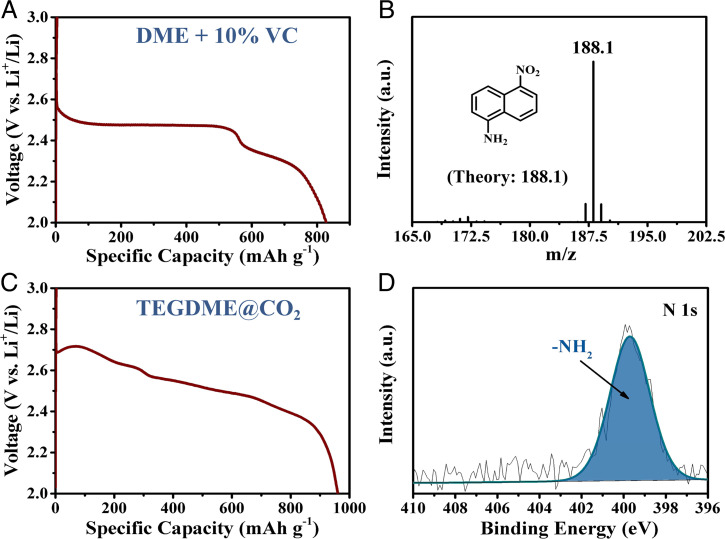
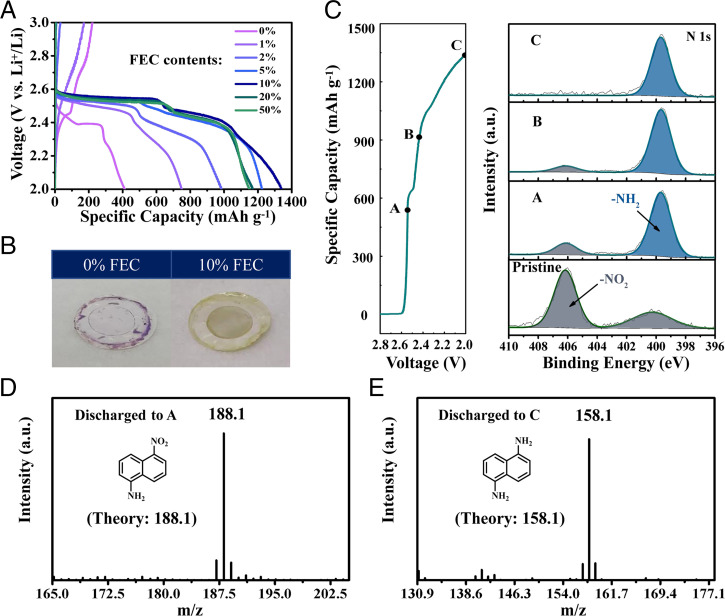
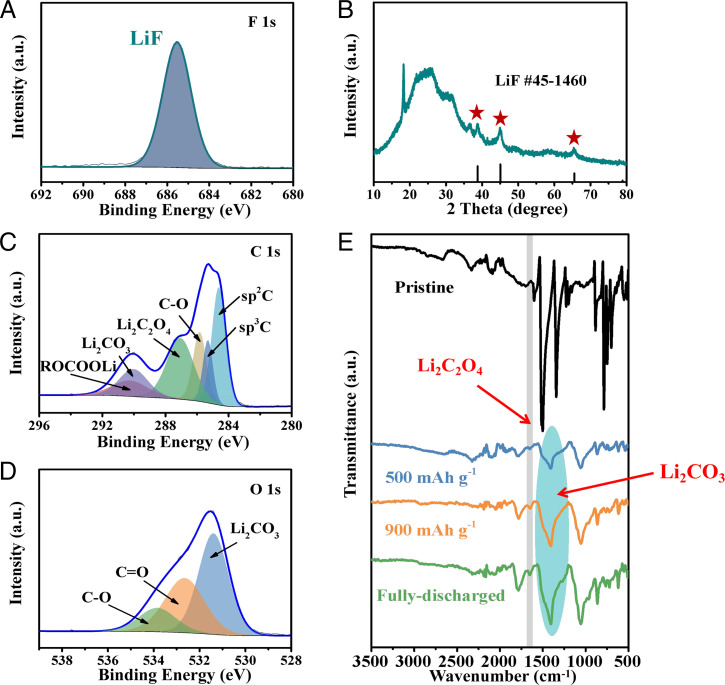
Organic electrode materials have emerged as promising alternatives to conventional inorganic materials because of their structural diversity and environmental friendliness feature. However, their low energy densities, limited by the single-electron reaction per active group, have plagued the practical applications. Here, we report a nitroaromatic cathode that performs a six-electron reaction per nitro group, drastically improving the specific capacity and energy density compared with the organic electrodes based on single-electron reactions. Based on such a reaction mechanism, the organic cathode of 1,5-dinitronaphthalene demonstrates an ultrahigh specific capacity of 1,338 mAh⋅g and energy density of 3,273 Wh⋅kg, which surpass all existing organic cathodes. The reaction path was verified as a conversion from nitro to amino groups. Our findings open up a pathway, in terms of battery chemistry, for ultrahigh-energy-density Li-organic batteries.
有机电极材料因其结构多样性和环境友好性而成为传统无机材料的有前途的替代品。然而,由于每个活性基团的单电子反应限制,其能量密度较低,这一直困扰着实际应用。在这里,我们报告了一种硝基芳香族阴极,每个硝基基团可进行六电子反应,与基于单电子反应的有机电极相比,极大地提高了比容量和能量密度。基于这种反应机理,1,5-二硝基萘的有机阴极表现出超高的比容量 1,338 mAh·g 和能量密度 3,273 Wh·kg,超过了所有现有的有机阴极。反应路径被验证为从硝基到氨基的转化。我们的发现为超高能量密度的 Li-有机电池在电池化学方面开辟了一条途径。