
炎症性肠病诊断后吸烟行为的改变与全因死亡率的关系。
Smoking Behaviour Changes After Diagnosis of Inflammatory Bowel Disease and Risk of All-cause Mortality.
机构信息
Division of Gastroenterology, Massachusetts General Hospital and Harvard Medical School, Boston, MA, USA.
Clinical and Translation Epidemiology Unit, Massachusetts General Hospital and Harvard Medical School, Boston, MA, USA.
出版信息
J Crohns Colitis. 2022 Aug 4;16(7):1030-1038. doi: 10.1093/ecco-jcc/jjac015.
BACKGROUND AND AIMS
We examined smoking behaviour changes after diagnoses of Crohn's disease [CD] and ulcerative colitis [UC] and evaluated their impact on mortality.
METHODS
Study population included incident CD or UC cases from three cohorts of the Nurses' Health Study [NHS], NHSII, and Health Professionals Follow-up Study. Smoking and other risk factors were prospectively assessed. Smoking behaviour changes were categorised as never, former [i.e., quit smoking before diagnosis], quitters [i.e., quit smoking after diagnosis], and current [i.e., continue smoking after diagnosis]. Follow-up for date and cause of death was completed through linkage to the National Death Index. Cox proportional hazard regression was used to estimate hazard ratios [HRs] and 95% confidence intervals [CIs].
RESULTS
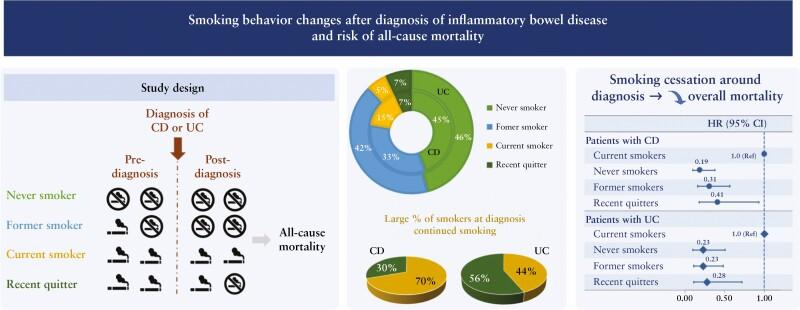
Among 909 eligible CD and UC cases, 45% were never smokers, 38% were past smokers, and 16% were active smokers at the time of diagnosis. Among active smokers, 70% of patients with CD and 44% of patients with UC continued to smoke after diagnosis. In patients with CD, compared with current smokers, the multivariable-adjusted HRs [95% CI] of death were 0.19 [0.10 to 0.38] for never smokers, 0.31 [0.16 to 0.57] for former smokers, and 0.41 [0.18 to 0.93] for quitters. Similarly for UC, compared with current smokers, we observed a reduced risk of mortality for never smokers [HR = 0.23, 95% CI 0.10 to 0.51], former smokers [HR = 0.23, 95% CI 0.11 to 0.48], and quitters [HR = 0.28, 95% CI 0.11 to 0.72].
CONCLUSIONS
In three cohorts of health professionals, a substantial proportion of patients with new diagnosis of CD and UC and history of smoking continued to smoke after diagnosis. Smoking cessation around the time of diagnosis was associated with a significant reduction in mortality.
背景和目的
我们研究了克罗恩病(CD)和溃疡性结肠炎(UC)诊断后吸烟行为的变化,并评估了其对死亡率的影响。
方法
研究人群包括来自护士健康研究(NHS)、NHSII 和健康专业人员随访研究的三个队列的新发 CD 或 UC 病例。前瞻性评估吸烟和其他危险因素。吸烟行为变化分为从不吸烟[即诊断前戒烟]、曾经吸烟[即诊断后戒烟]和目前吸烟[即诊断后继续吸烟]。通过与国家死亡索引链接完成日期和死因的随访。使用 Cox 比例风险回归估计危险比(HR)和 95%置信区间(CI)。
结果
在 909 名符合条件的 CD 和 UC 病例中,45%为从不吸烟者,38%为曾经吸烟者,16%为诊断时的现吸烟者。在现吸烟者中,70%的 CD 患者和 44%的 UC 患者在诊断后继续吸烟。在 CD 患者中,与目前吸烟者相比,多变量调整后的死亡 HR(95%CI)为从不吸烟者 0.19(0.10 至 0.38),曾经吸烟者 0.31(0.16 至 0.57),戒烟者 0.41(0.18 至 0.93)。对于 UC 也是如此,与目前吸烟者相比,我们观察到从不吸烟者(HR=0.23,95%CI 0.10 至 0.51)、曾经吸烟者(HR=0.23,95%CI 0.11 至 0.48)和戒烟者(HR=0.28,95%CI 0.11 至 0.72)的死亡率风险降低。
结论
在三个健康专业人员队列中,相当一部分新发 CD 和 UC 患者和吸烟史患者在诊断后继续吸烟。诊断时戒烟与死亡率显著降低相关。
 Zotero 插件