Department of Bioengineering, University of Washington, Seattle, Washington, USAgrid.34477.33.
Department of Family Medicine, University of Washington, Seattle, Washington, USAgrid.34477.33.
J Clin Microbiol. 2022 Mar 16;60(3):e0207021. doi: 10.1128/JCM.02070-21. Epub 2022 Feb 2.
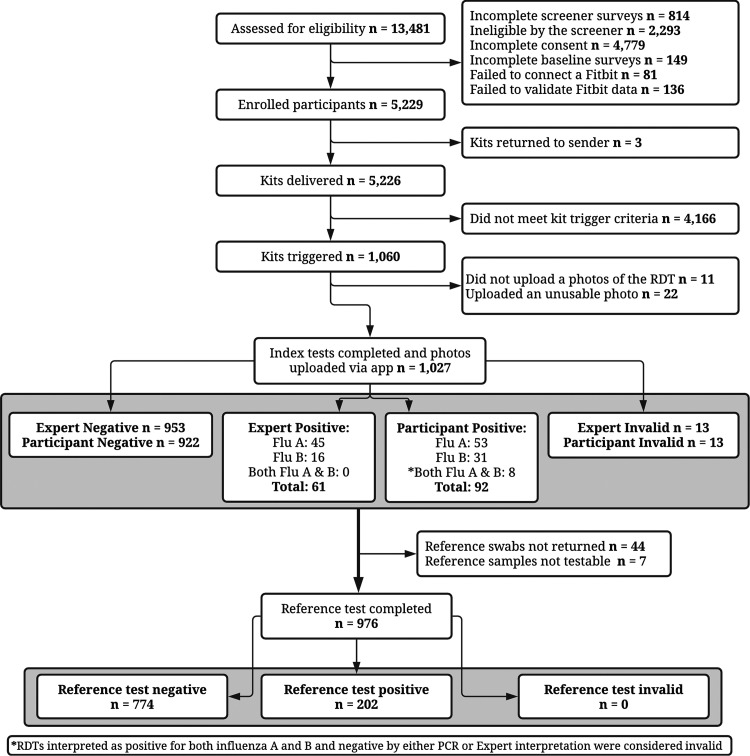
At-home testing with rapid diagnostic tests (RDTs) for respiratory viruses could facilitate early diagnosis, guide patient care, and prevent transmission. Such RDTs are best used near the onset of illness when viral load is highest and clinical action will be most impactful, which may be achieved by at-home testing. We evaluated the diagnostic accuracy of the QuickVue Influenza A+B RDT in an at-home setting. A convenience sample of 5,229 individuals who were engaged with an on-line health research platform were prospectively recruited throughout the United States. "Flu@home" test kits containing a QuickVue RDT and reference sample collection and shipping materials were prepositioned with participants at the beginning of the study. Participants responded to daily symptom surveys. If they reported experiencing cough along with aches, fever, chills, and/or sweats, they used their flu@home kit following instructions on a mobile app and indicated what lines they saw on the RDT. Of the 976 participants who met criteria to use their self-collection kit and completed study procedures, 202 (20.7%) were positive for influenza by qPCR. The RDT had a sensitivity of 28% (95% CI = 21 to 36) and specificity of 99% (98 to 99) for influenza A, and 32% (95% CI = 20 to 46) and 99% (95% CI = 98 to 99), for influenza B. Our results support the concept of app-supported, prepositioned at-home RDT kits using symptom-based triggers, although it cannot be recommended with the RDT used in this study. Further research is needed to determine ways to improve the accuracy and utility of home-based testing for influenza.
家庭使用快速诊断检测(RDT)进行呼吸道病毒检测有助于早期诊断、指导患者护理并预防传播。此类 RDT 在病毒载量最高且临床操作最具影响力时(即疾病发作初期)效果最佳,而家庭使用 RDT 即可实现这一点。我们评估了 QuickVue 流感 A+B RDT 在家庭环境中的诊断准确性。一项在美国各地进行的前瞻性研究中,便利地招募了 5229 名参与在线健康研究平台的个体。“在家流感检测”试剂盒中包含 QuickVue RDT 以及参考样本采集和运输材料,在研究开始时就预先分发给参与者。参与者每日回复症状调查问卷。如果他们报告出现咳嗽,同时伴有疼痛、发热、寒战和/或出汗等症状,他们就会根据移动应用程序上的说明使用自己的“在家流感检测”试剂盒,并指出 RDT 上出现的线。在符合使用自我采集试剂盒标准并完成研究程序的 976 名参与者中,202 名(20.7%)通过 qPCR 检测为流感阳性。该 RDT 对流感 A 的灵敏度为 28%(95%CI=21 至 36),特异性为 99%(98 至 99),对流感 B 的灵敏度为 32%(95%CI=20 至 46),特异性为 99%(95%CI=98 至 99)。我们的结果支持基于症状触发、应用程序支持、预先定位的家庭 RDT 试剂盒的概念,尽管不能推荐使用本研究中使用的 RDT。需要进一步研究来确定如何提高家庭检测流感的准确性和实用性。