• 文献检索
  • 文档翻译
  • 深度研究
  • 学术资讯
  • Suppr Zotero 插件Zotero 插件
  • 邀请有礼
  • 套餐&价格
  • 历史记录
应用&插件
Suppr Zotero 插件Zotero 插件浏览器插件Mac 客户端Windows 客户端微信小程序
定价
高级版会员购买积分包购买API积分包
服务
文献检索文档翻译深度研究API 文档MCP 服务
关于我们
关于 Suppr公司介绍联系我们用户协议隐私条款
关注我们

Suppr 超能文献

核心技术专利:CN118964589B侵权必究
粤ICP备2023148730 号-1Suppr @ 2026

文献检索

告别复杂PubMed语法,用中文像聊天一样搜索,搜遍4000万医学文献。AI智能推荐,让科研检索更轻松。

立即免费搜索

文件翻译

保留排版,准确专业,支持PDF/Word/PPT等文件格式,支持 12+语言互译。

免费翻译文档

深度研究

AI帮你快速写综述,25分钟生成高质量综述,智能提取关键信息,辅助科研写作。

立即免费体验

肥厚型心肌病的疾病进展:使用机器学习进行建模

Disease Progression of Hypertrophic Cardiomyopathy: Modeling Using Machine Learning.

作者信息

Pičulin Matej, Smole Tim, Žunkovič Bojan, Kokalj Enja, Robnik-Šikonja Marko, Kukar Matjaž, Fotiadis Dimitrios I, Pezoulas Vasileios C, Tachos Nikolaos S, Barlocco Fausto, Mazzarotto Francesco, Popović Dejana, Maier Lars S, Velicki Lazar, Olivotto Iacopo, MacGowan Guy A, Jakovljević Djordje G, Filipović Nenad, Bosnić Zoran

机构信息

Faculty of Computer and Information Science, University of Ljubljana, Ljubljana, Slovenia.

Unit of Medical Technology and Intelligent Information Systems, Department of Materials Science and Engineering, University of Ioannina, Ioannina, Greece.

出版信息

JMIR Med Inform. 2022 Feb 2;10(2):e30483. doi: 10.2196/30483.

DOI:10.2196/30483
PMID:35107432
原文链接:https://pmc.ncbi.nlm.nih.gov/articles/PMC8851344/
Abstract

BACKGROUND

Cardiovascular disorders in general are responsible for 30% of deaths worldwide. Among them, hypertrophic cardiomyopathy (HCM) is a genetic cardiac disease that is present in about 1 of 500 young adults and can cause sudden cardiac death (SCD).

OBJECTIVE

Although the current state-of-the-art methods model the risk of SCD for patients, to the best of our knowledge, no methods are available for modeling the patient's clinical status up to 10 years ahead. In this paper, we propose a novel machine learning (ML)-based tool for predicting disease progression for patients diagnosed with HCM in terms of adverse remodeling of the heart during a 10-year period.

METHODS

The method consisted of 6 predictive regression models that independently predict future values of 6 clinical characteristics: left atrial size, left atrial volume, left ventricular ejection fraction, New York Heart Association functional classification, left ventricular internal diastolic diameter, and left ventricular internal systolic diameter. We supplemented each prediction with the explanation that is generated using the Shapley additive explanation method.

RESULTS

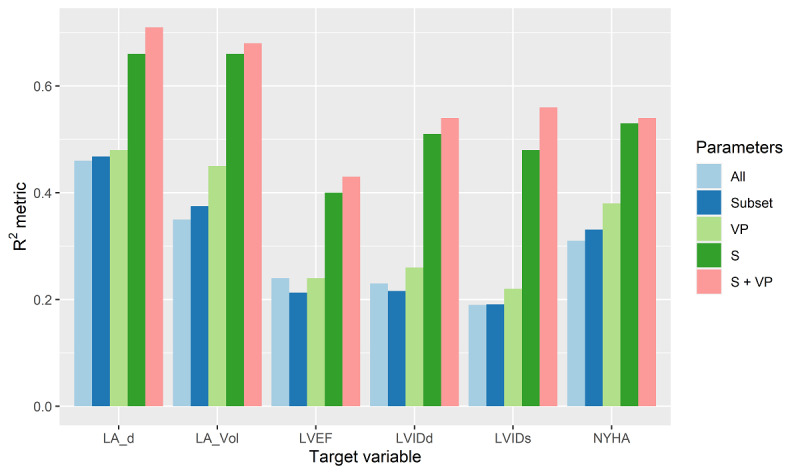
The final experiments showed that predictive error is lower on 5 of the 6 constructed models in comparison to experts (on average, by 0.34) or a consortium of experts (on average, by 0.22). The experiments revealed that semisupervised learning and the artificial data from virtual patients help improve predictive accuracies. The best-performing random forest model improved R from 0.3 to 0.6.

CONCLUSIONS

By engaging medical experts to provide interpretation and validation of the results, we determined the models' favorable performance compared to the performance of experts for 5 of 6 targets.

摘要

背景

心血管疾病总体上导致全球30%的死亡。其中,肥厚型心肌病(HCM)是一种遗传性心脏病,约每500名年轻人中就有1人患病,可导致心源性猝死(SCD)。

目的

尽管目前的先进方法可以对患者的心源性猝死风险进行建模,但据我们所知,尚无方法可对患者未来10年的临床状况进行建模。在本文中,我们提出了一种基于机器学习(ML)的新型工具,用于预测被诊断为HCM的患者在10年期间心脏不良重塑方面的疾病进展。

方法

该方法由6个预测回归模型组成,这些模型独立预测6个临床特征的未来值:左心房大小、左心房容积、左心室射血分数、纽约心脏协会功能分级、左心室内径舒张末期值和左心室内径收缩末期值。我们用使用Shapley加法解释方法生成的解释对每个预测进行补充。

结果

最终实验表明,与专家(平均低0.34)或专家联盟(平均低0.22)相比,6个构建模型中的5个模型的预测误差更低。实验表明,半监督学习和虚拟患者的人工数据有助于提高预测准确性。表现最佳的随机森林模型将R值从0.3提高到了0.6。

结论

通过让医学专家对结果进行解释和验证,我们确定了与专家对6个目标中的5个目标的表现相比,这些模型具有良好的性能。
https://cdn.ncbi.nlm.nih.gov/pmc/blobs/aa83/8851344/b0eebd8f8027/medinform_v10i2e30483_fig4.jpg
https://cdn.ncbi.nlm.nih.gov/pmc/blobs/aa83/8851344/7c472ea58c76/medinform_v10i2e30483_fig1.jpg
https://cdn.ncbi.nlm.nih.gov/pmc/blobs/aa83/8851344/d61641424673/medinform_v10i2e30483_fig2.jpg
https://cdn.ncbi.nlm.nih.gov/pmc/blobs/aa83/8851344/34d009075453/medinform_v10i2e30483_fig3.jpg
https://cdn.ncbi.nlm.nih.gov/pmc/blobs/aa83/8851344/b0eebd8f8027/medinform_v10i2e30483_fig4.jpg
https://cdn.ncbi.nlm.nih.gov/pmc/blobs/aa83/8851344/7c472ea58c76/medinform_v10i2e30483_fig1.jpg
https://cdn.ncbi.nlm.nih.gov/pmc/blobs/aa83/8851344/d61641424673/medinform_v10i2e30483_fig2.jpg
https://cdn.ncbi.nlm.nih.gov/pmc/blobs/aa83/8851344/34d009075453/medinform_v10i2e30483_fig3.jpg
https://cdn.ncbi.nlm.nih.gov/pmc/blobs/aa83/8851344/b0eebd8f8027/medinform_v10i2e30483_fig4.jpg

相似文献

1
Disease Progression of Hypertrophic Cardiomyopathy: Modeling Using Machine Learning.肥厚型心肌病的疾病进展:使用机器学习进行建模
JMIR Med Inform. 2022 Feb 2;10(2):e30483. doi: 10.2196/30483.
2
A machine learning-based risk stratification model for ventricular tachycardia and heart failure in hypertrophic cardiomyopathy.基于机器学习的肥厚型心肌病伴室性心动过速和心力衰竭风险分层模型。
Comput Biol Med. 2021 Aug;135:104648. doi: 10.1016/j.compbiomed.2021.104648. Epub 2021 Jul 12.
3
[Predicting value of 2014 European guidelines risk prediction model for sudden cardiac death (HCM Risk-SCD) in Chinese patients with hypertrophic cardiomyopathy].[2014年欧洲指南心脏性猝死风险预测模型(HCM Risk-SCD)对中国肥厚型心肌病患者的预测价值]
Zhonghua Xin Xue Guan Bing Za Zhi. 2017 Dec 24;45(12):1033-1038. doi: 10.3760/cma.j.issn.0253-3758.2017.12.006.
4
Impact of adverse left ventricular remodeling on sudden cardiac death in patients with hypertrophic cardiomyopathy.肥厚型心肌病患者中左心室不良重塑对心源性猝死的影响。
Clin Cardiol. 2014 Aug;37(8):493-8. doi: 10.1002/clc.22293. Epub 2014 Jul 4.
5
Predicting the development of adverse cardiac events in patients with hypertrophic cardiomyopathy using machine learning.利用机器学习预测肥厚型心肌病患者不良心脏事件的发生。
Int J Cardiol. 2021 Mar 15;327:117-124. doi: 10.1016/j.ijcard.2020.11.003. Epub 2020 Nov 9.
6
A novel clinical risk prediction model for sudden cardiac death in hypertrophic cardiomyopathy (HCM risk-SCD).肥厚型心肌病患者心脏性猝死的新型临床风险预测模型(HCM risk-SCD)。
Eur Heart J. 2014 Aug 7;35(30):2010-20. doi: 10.1093/eurheartj/eht439. Epub 2013 Oct 14.
7
Modes of death and clinical outcomes in adult patients with hypertrophic cardiomyopathy in Thailand.泰国成年肥厚型心肌病患者的死亡模式和临床结局。
BMC Cardiovasc Disord. 2019 Jan 3;19(1):1. doi: 10.1186/s12872-018-0984-0.
8
The usefulness of sST2 and galectin-3 as novel biomarkers for better risk stratification in hypertrophic cardiomyopathy.可溶性ST2和半乳糖凝集素-3作为肥厚型心肌病中用于更好风险分层的新型生物标志物的效用。
Kardiol Pol. 2017;75(10):997-1004. doi: 10.5603/KP.a2017.0118. Epub 2017 Jun 14.
9
Machine learning modeling identifies hypertrophic cardiomyopathy subtypes with genetic signature.机器学习建模可识别具有基因特征的肥厚型心肌病亚型。
Front Med. 2023 Aug;17(4):768-780. doi: 10.1007/s11684-023-0982-1. Epub 2023 May 1.
10
Comparison of the new risk prediction model (HCM Risk-SCD) and classic risk factors for sudden death in patients with hypertrophic cardiomyopathy and defibrillator.比较肥厚型心肌病和除颤器患者新的风险预测模型(HCM Risk-SCD)和经典风险因素对猝死的预测价值。
Europace. 2016 May;18(5):773-7. doi: 10.1093/europace/euv079. Epub 2015 Apr 7.

引用本文的文献

1
Artificial Intelligence in Hypertrophic Cardiomyopathy: Advances, Challenges, and Future Directions for Personalized Risk Prediction and Management.肥厚型心肌病中的人工智能:个性化风险预测与管理的进展、挑战及未来方向
Cureus. 2025 Jul 14;17(7):e87907. doi: 10.7759/cureus.87907. eCollection 2025 Jul.
2
Development of a Cohort Analytics Tool for Monitoring Progression Patterns in Cardiovascular Diseases: Advanced Stochastic Modeling Approach.开发用于监测心血管疾病进展模式的队列分析工具:高级随机建模方法。
JMIR Med Inform. 2024 Sep 24;12:e59392. doi: 10.2196/59392.
3
A review of evaluation approaches for explainable AI with applications in cardiology.

本文引用的文献

1
Meeting the unmet needs of clinicians from AI systems showcased for cardiology with deep-learning-based ECG analysis.展示了基于深度学习的心电图分析人工智能系统如何满足临床医生的未满足需求。
Proc Natl Acad Sci U S A. 2021 Jun 15;118(24). doi: 10.1073/pnas.2020620118.
2
Detection and Classification of Myocardial Delayed Enhancement Patterns on MR Images with Deep Neural Networks: A Feasibility Study.基于深度神经网络的磁共振图像中心肌延迟强化模式的检测与分类:一项可行性研究
Radiol Artif Intell. 2019 May 29;1(3):e180061. doi: 10.1148/ryai.2019180061. eCollection 2019 May.
3
Predicting Cardiovascular Risk Using Social Media Data: Performance Evaluation of Machine-Learning Models.
用于可解释人工智能并应用于心脏病学的评估方法综述。
Artif Intell Rev. 2024;57(9):240. doi: 10.1007/s10462-024-10852-w. Epub 2024 Aug 9.
4
Synthetic data generation methods in healthcare: A review on open-source tools and methods.医疗保健领域的合成数据生成方法:关于开源工具和方法的综述
Comput Struct Biotechnol J. 2024 Jul 9;23:2892-2910. doi: 10.1016/j.csbj.2024.07.005. eCollection 2024 Dec.
5
Primer on Machine Learning in Electrophysiology.电生理学中的机器学习入门
Arrhythm Electrophysiol Rev. 2023 Mar 28;12:e06. doi: 10.15420/aer.2022.43. eCollection 2023.
6
Computational Modeling on Drugs Effects for Left Ventricle in Cardiomyopathy Disease.心肌病疾病中药物对左心室影响的计算建模
Pharmaceutics. 2023 Feb 28;15(3):793. doi: 10.3390/pharmaceutics15030793.
7
Machine Learning for Online Automatic Prediction of Common Disease Attributes Using Never-Ending Image Learner.使用永不停歇图像学习器进行常见疾病属性的在线自动预测的机器学习
Diagnostics (Basel). 2022 Dec 28;13(1):95. doi: 10.3390/diagnostics13010095.
8
Performance evaluation of machine learning and Computer Coded Verbal Autopsy (CCVA) algorithms for cause of death determination: A comparative analysis of data from rural South Africa.机器学习和计算机编码语言尸检(CCVA)算法在死因判定中的性能评估:来自南非农村地区数据的比较分析。
Front Public Health. 2022 Sep 27;10:990838. doi: 10.3389/fpubh.2022.990838. eCollection 2022.
利用社交媒体数据预测心血管风险:机器学习模型的性能评估
JMIR Cardio. 2021 Feb 19;5(1):e24473. doi: 10.2196/24473.
4
Prediction of disease progression and outcomes in multiple sclerosis with machine learning.基于机器学习的多发性硬化疾病进展和结局预测。
Sci Rep. 2020 Dec 3;10(1):21038. doi: 10.1038/s41598-020-78212-6.
5
Semi-Supervised Learning in Medical Images Through Graph-Embedded Random Forest.通过图嵌入随机森林实现医学图像中的半监督学习
Front Neuroinform. 2020 Nov 10;14:601829. doi: 10.3389/fninf.2020.601829. eCollection 2020.
6
Improving risk prediction in heart failure using machine learning.利用机器学习改善心力衰竭的风险预测。
Eur J Heart Fail. 2020 Jan;22(1):139-147. doi: 10.1002/ejhf.1628. Epub 2019 Nov 12.
7
Improving the clinical understanding of hypertrophic cardiomyopathy by combining patient data, machine learning and computer simulations: A case study.通过整合患者数据、机器学习和计算机模拟提高对肥厚型心肌病的临床认识:一项案例研究
Morphologie. 2019 Dec;103(343):169-179. doi: 10.1016/j.morpho.2019.09.001. Epub 2019 Sep 27.
8
Current applications of big data and machine learning in cardiology.大数据与机器学习在心脏病学中的当前应用。
J Geriatr Cardiol. 2019 Aug;16(8):601-607. doi: 10.11909/j.issn.1671-5411.2019.08.002.
9
Machine learning for comprehensive forecasting of Alzheimer's Disease progression.机器学习在阿尔茨海默病进展全面预测中的应用。
Sci Rep. 2019 Sep 20;9(1):13622. doi: 10.1038/s41598-019-49656-2.
10
Impact of Artificial Intelligence on Interventional Cardiology: From Decision-Making Aid to Advanced Interventional Procedure Assistance.人工智能对介入心脏病学的影响:从决策辅助到先进的介入手术辅助。
JACC Cardiovasc Interv. 2019 Jul 22;12(14):1293-1303. doi: 10.1016/j.jcin.2019.04.048.