• 文献检索
  • 文档翻译
  • 深度研究
  • 学术资讯
  • Suppr Zotero 插件Zotero 插件
  • 邀请有礼
  • 套餐&价格
  • 历史记录
应用&插件
Suppr Zotero 插件Zotero 插件浏览器插件Mac 客户端Windows 客户端微信小程序
定价
高级版会员购买积分包购买API积分包
服务
文献检索文档翻译深度研究API 文档MCP 服务
关于我们
关于 Suppr公司介绍联系我们用户协议隐私条款
关注我们

Suppr 超能文献

核心技术专利:CN118964589B侵权必究
粤ICP备2023148730 号-1Suppr @ 2026

文献检索

告别复杂PubMed语法,用中文像聊天一样搜索,搜遍4000万医学文献。AI智能推荐,让科研检索更轻松。

立即免费搜索

文件翻译

保留排版,准确专业,支持PDF/Word/PPT等文件格式,支持 12+语言互译。

免费翻译文档

深度研究

AI帮你快速写综述,25分钟生成高质量综述,智能提取关键信息,辅助科研写作。

立即免费体验

CD73 上皮祖细胞有助于维持内稳态和更新,在嗜酸性食管炎中被耗尽。

CD73 Epithelial Progenitor Cells That Contribute to Homeostasis and Renewal Are Depleted in Eosinophilic Esophagitis.

机构信息

Division of Pediatric Gastroenterology, Hepatology, and Nutrition, The Children's Hospital of Philadelphia, Philadelphia, Pennsylvania.

Division of Pediatric Gastroenterology, Hepatology, and Nutrition, The Children's Hospital of Philadelphia, Philadelphia, Pennsylvania; Department of Surgery, National Hospital Organization, Fukuokahigashi Medical Center, Koga, Fukuoka, Japan.

出版信息

Cell Mol Gastroenterol Hepatol. 2022;13(5):1449-1467. doi: 10.1016/j.jcmgh.2022.01.018. Epub 2022 Jan 30.

DOI:10.1016/j.jcmgh.2022.01.018
PMID:35108658
原文链接:https://pmc.ncbi.nlm.nih.gov/articles/PMC8957025/
Abstract

BACKGROUND & AIMS: Although basal cell hyperplasia is a histologic hallmark of eosinophilic esophagitis (EoE), little is known about the capabilities of epithelial renewal and differentiation in the EoE inflammatory milieu. In murine esophageal epithelium, there are self-renewing and slowly proliferating basal stem-like cells characterized by concurrent expression of CD73 (5'-nucleotidase ecto) and CD104 (integrin β4). Here, we investigated CD73CD104 cells within the basal population of human esophageal epithelium and clarified the biological significance of these cells in the EoE epithelium.

METHODS

We performed flow cytometry on esophageal biopsy samples from EoE and non-EoE patients to determine the quantity of CD73CD104 cells in the epithelium. Simulating the EoE milieu we stimulated primary patient-derived and immortalized cell line-derived esophageal organoids with interleukin (IL)4 and IL13 and analyzed by flow cytometry, immunohistochemistry, and quantitative reverse-transcription polymerase chain reaction. We performed single-cell RNA sequencing on primary organoids in the setting of IL13 stimulation and evaluated the CD73CD104 population. We performed fluorescent-activated cell sorting to purify CD73CD104 and CD73 CD104 populations and seeded these groups in organoid culture to evaluate the organoid formation rate and organoid size. We used RNA interference to knock down CD73 in esophageal organoids to evaluate organoid formation rates and size. We evaluated the effects of signal transducer and activator of transcription 6 (STAT6) signaling inhibition by RNA interference, a STAT6 inhibitor, AS1517499, as well as the proton pump inhibitor omeprazole.

RESULTS

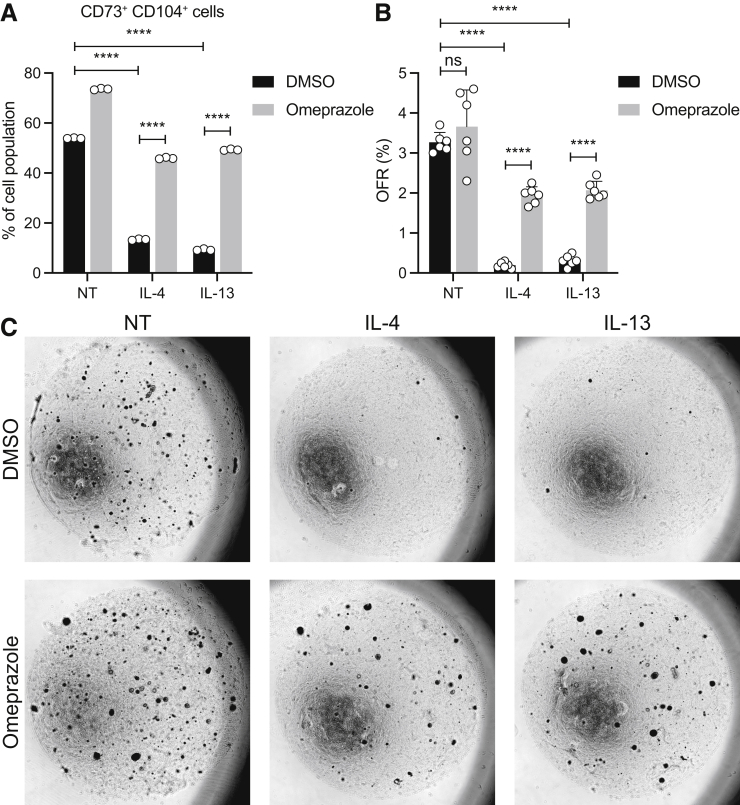
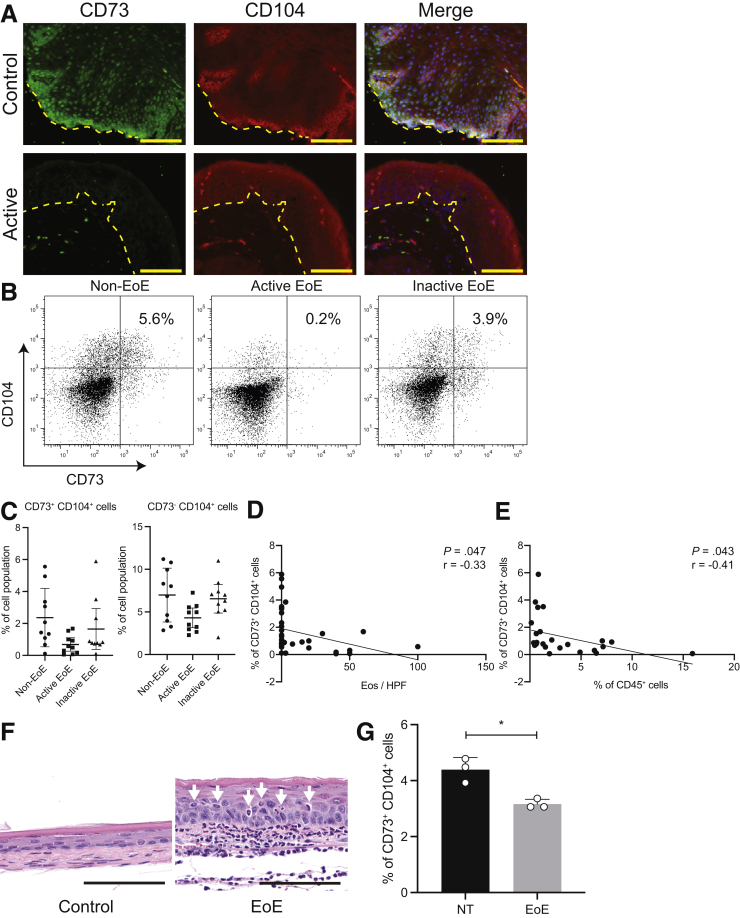
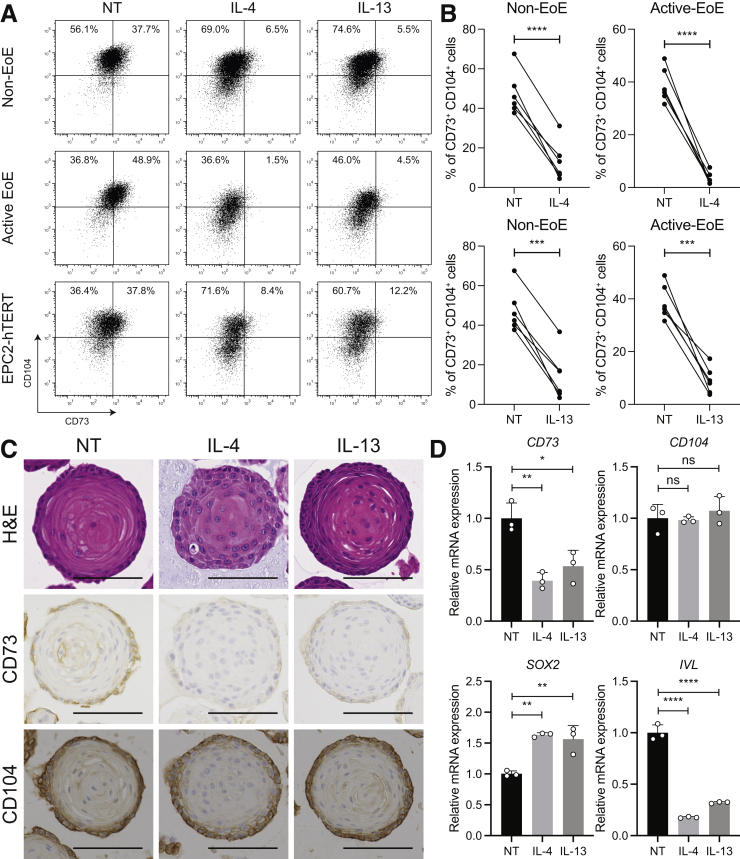
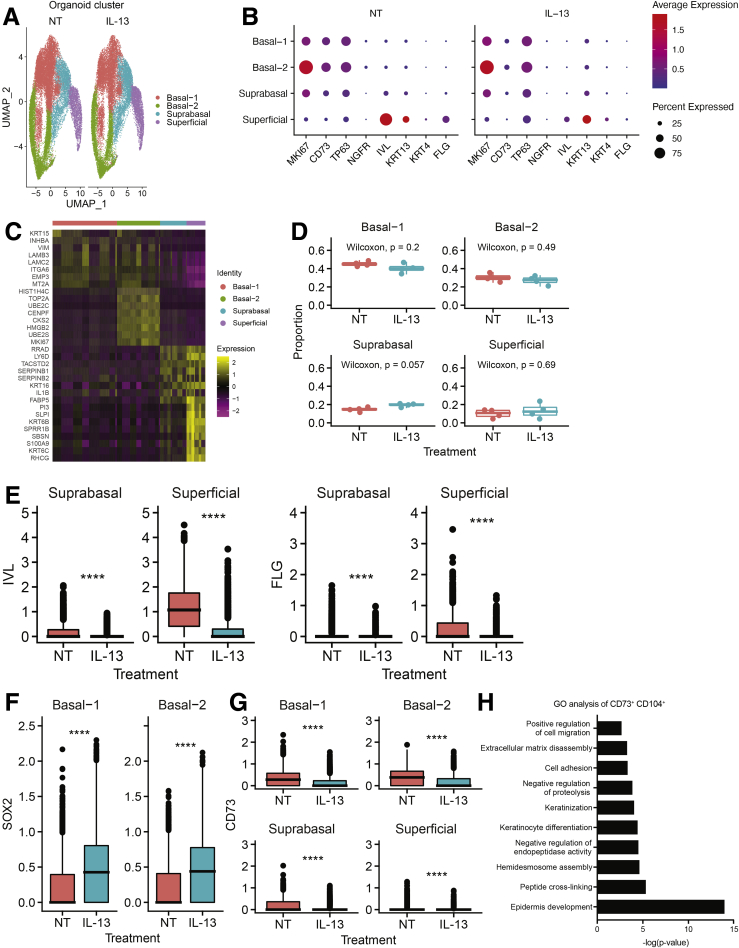
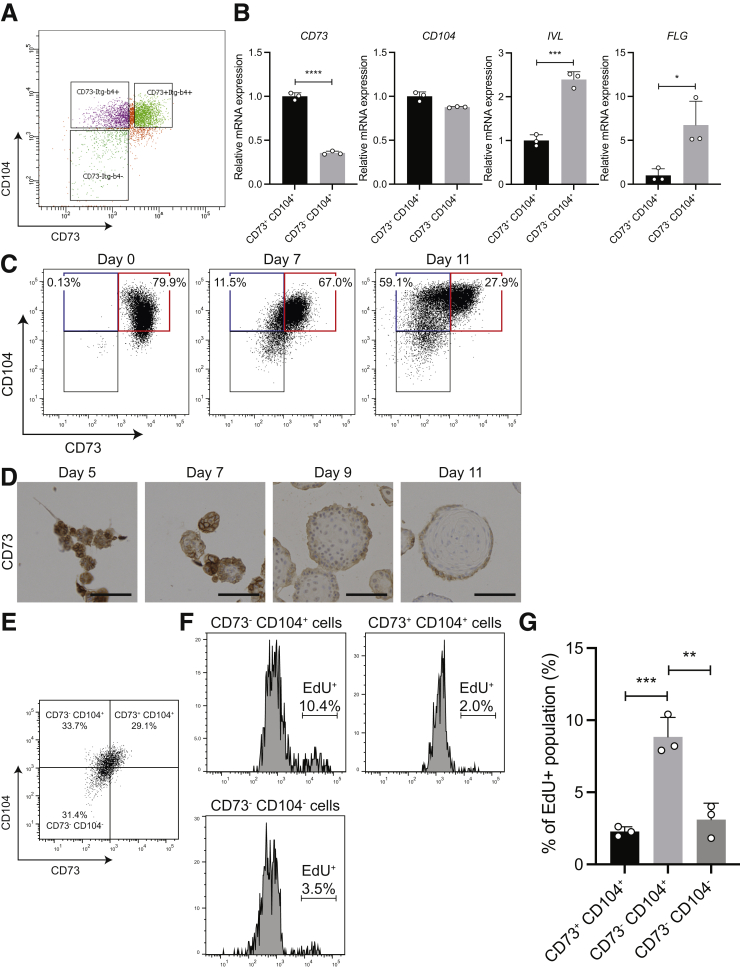
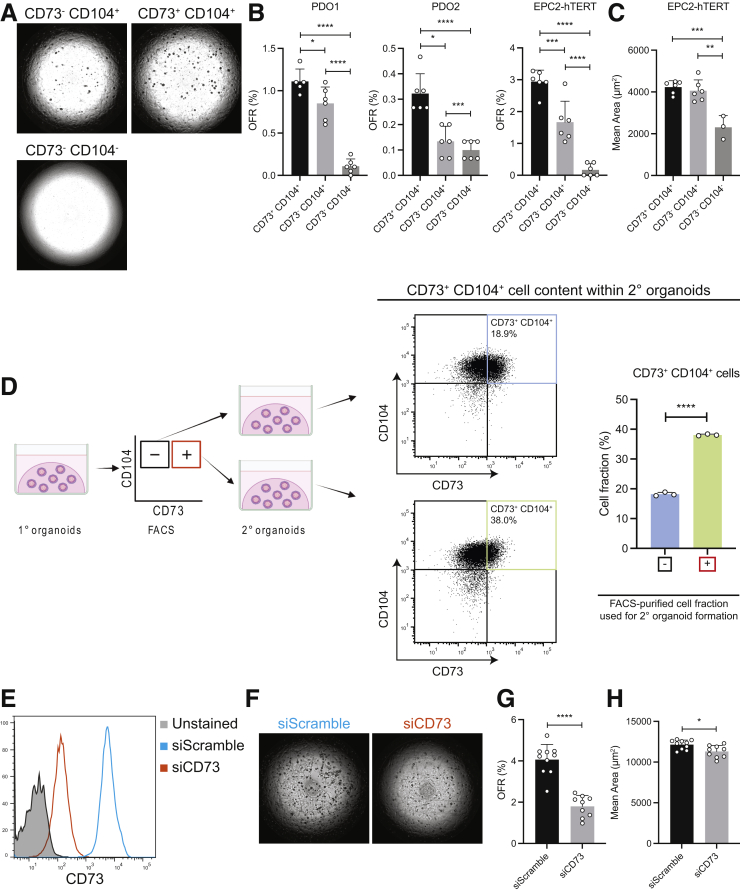
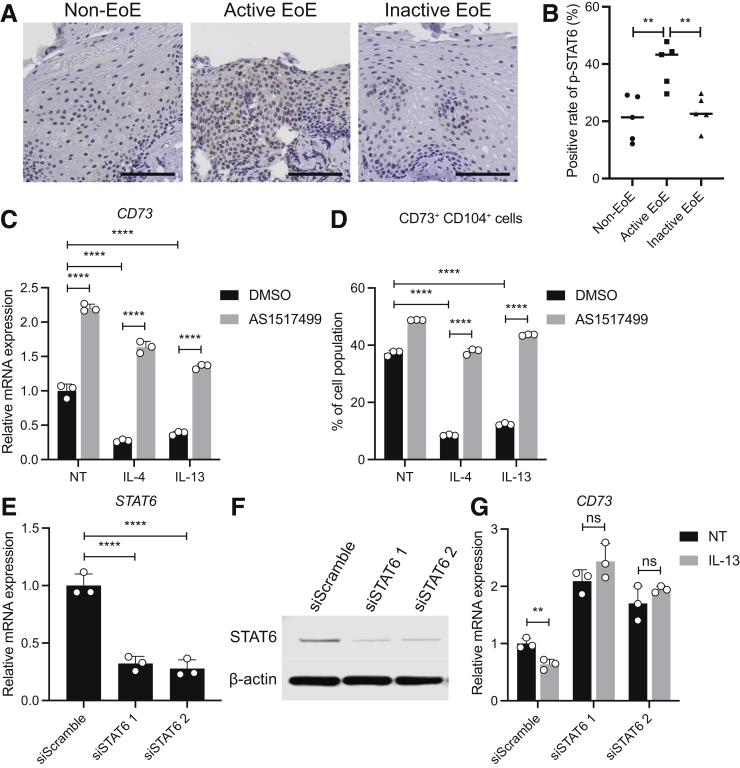
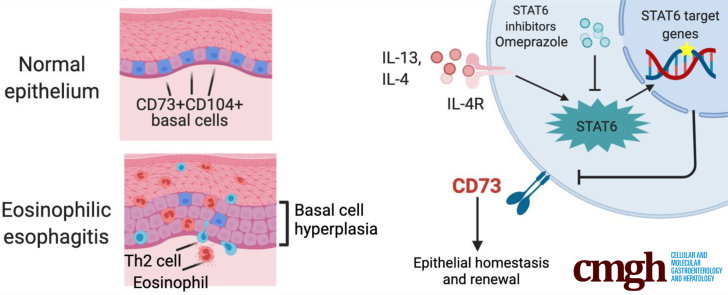
EoE patients showed decreased epithelial CD73CD104 cell content. IL4 and IL13 stimulation depleted this population in 3-dimensional organoids with a recapitulation of basal cell hyperplasia as corroborated by single-cell RNA sequencing of the organoids, which suggests depletion of CD73CD104 cells. The CD73CD104 population had enhanced organoid formation compared with the CD73CD104 population. Similarly, knock-down of CD73 resulted in decreased organoid formation rate. Genetic and pharmacologic inhibition of STAT6 prevented T helper 2 cytokine-induced depletion of CD73CD104 cells. Lastly, omeprazole treatment prevented the effects of IL4 and IL13 on the CD73CD104 population.

CONCLUSIONS

This study addressed the role of CD73CD104 cells in epithelial renewal and homeostasis in the context of EoE. The depletion of the CD73CD104 self-renewal population by helper T cell 2 cytokines in EoE milieu may be perpetuating epithelial injury. Future therapies targeting epithelial restitution in EoE could decrease the need for immune modulation and steroid therapy.

摘要

背景与目的

尽管基底细胞增生是嗜酸性食管炎(EoE)的组织学标志,但对于 EoE 炎症环境中上皮细胞更新和分化的能力知之甚少。在鼠食管上皮中,存在自我更新和缓慢增殖的基底样干细胞,其特征是同时表达 CD73(5'-核苷酸酶外切酶)和 CD104(整合素β4)。在这里,我们研究了人食管上皮基底细胞群中的 CD73CD104 细胞,并阐明了这些细胞在 EoE 上皮中的生物学意义。

方法

我们对来自 EoE 和非 EoE 患者的食管活检样本进行流式细胞术,以确定上皮中 CD73CD104 细胞的数量。通过模拟 EoE 环境,我们用白细胞介素(IL)4 和 IL13 刺激原代患者来源和永生化细胞系衍生的食管类器官,并通过流式细胞术、免疫组织化学和定量逆转录聚合酶链反应进行分析。我们在 IL13 刺激的情况下对原代类器官进行单细胞 RNA 测序,并评估 CD73CD104 群体。我们进行荧光激活细胞分选以纯化 CD73CD104 和 CD73 CD104 群体,并将这些群体接种到类器官培养物中,以评估类器官形成率和类器官大小。我们使用 RNA 干扰敲低食管类器官中的 CD73,以评估类器官形成率和大小。我们通过 RNA 干扰、STAT6 抑制剂 AS1517499 和质子泵抑制剂奥美拉唑评估 STAT6 信号转导抑制的作用。

结果

EoE 患者表现出上皮 CD73CD104 细胞含量减少。IL4 和 IL13 刺激导致 3 维类器官中该群体耗竭,单细胞 RNA 测序证实了基底细胞增生的重制,这表明 CD73CD104 细胞耗竭。与 CD73CD104 群体相比,CD73CD104 群体具有增强的类器官形成能力。同样,敲低 CD73 导致类器官形成率降低。STAT6 的遗传和药物抑制可防止辅助性 T 细胞 2 细胞因子诱导的 CD73CD104 细胞耗竭。最后,奥美拉唑治疗可预防 IL4 和 IL13 对 CD73CD104 群体的影响。

结论

本研究探讨了 CD73CD104 细胞在 EoE 背景下上皮更新和稳态中的作用。在 EoE 环境中,辅助性 T 细胞 2 细胞因子对 CD73CD104 自我更新群体的耗竭可能会持续造成上皮损伤。未来针对 EoE 上皮修复的治疗方法可能会减少对免疫调节和类固醇治疗的需求。
https://cdn.ncbi.nlm.nih.gov/pmc/blobs/b3ec/8957025/f60d5ab1bff3/gr8.jpg
https://cdn.ncbi.nlm.nih.gov/pmc/blobs/b3ec/8957025/3d9c5b1a86fc/fx1.jpg
https://cdn.ncbi.nlm.nih.gov/pmc/blobs/b3ec/8957025/3b0dec72b1ad/gr1.jpg
https://cdn.ncbi.nlm.nih.gov/pmc/blobs/b3ec/8957025/592b49046658/gr2.jpg
https://cdn.ncbi.nlm.nih.gov/pmc/blobs/b3ec/8957025/8cd8308d11f3/gr3.jpg
https://cdn.ncbi.nlm.nih.gov/pmc/blobs/b3ec/8957025/c385a84a2b1b/gr4.jpg
https://cdn.ncbi.nlm.nih.gov/pmc/blobs/b3ec/8957025/ba9958f6c2a7/gr5.jpg
https://cdn.ncbi.nlm.nih.gov/pmc/blobs/b3ec/8957025/49fa3e886cc5/gr6.jpg
https://cdn.ncbi.nlm.nih.gov/pmc/blobs/b3ec/8957025/d29d35a473b8/gr7.jpg
https://cdn.ncbi.nlm.nih.gov/pmc/blobs/b3ec/8957025/f60d5ab1bff3/gr8.jpg
https://cdn.ncbi.nlm.nih.gov/pmc/blobs/b3ec/8957025/3d9c5b1a86fc/fx1.jpg
https://cdn.ncbi.nlm.nih.gov/pmc/blobs/b3ec/8957025/3b0dec72b1ad/gr1.jpg
https://cdn.ncbi.nlm.nih.gov/pmc/blobs/b3ec/8957025/592b49046658/gr2.jpg
https://cdn.ncbi.nlm.nih.gov/pmc/blobs/b3ec/8957025/8cd8308d11f3/gr3.jpg
https://cdn.ncbi.nlm.nih.gov/pmc/blobs/b3ec/8957025/c385a84a2b1b/gr4.jpg
https://cdn.ncbi.nlm.nih.gov/pmc/blobs/b3ec/8957025/ba9958f6c2a7/gr5.jpg
https://cdn.ncbi.nlm.nih.gov/pmc/blobs/b3ec/8957025/49fa3e886cc5/gr6.jpg
https://cdn.ncbi.nlm.nih.gov/pmc/blobs/b3ec/8957025/d29d35a473b8/gr7.jpg
https://cdn.ncbi.nlm.nih.gov/pmc/blobs/b3ec/8957025/f60d5ab1bff3/gr8.jpg

相似文献

1
CD73 Epithelial Progenitor Cells That Contribute to Homeostasis and Renewal Are Depleted in Eosinophilic Esophagitis.CD73 上皮祖细胞有助于维持内稳态和更新,在嗜酸性食管炎中被耗尽。
Cell Mol Gastroenterol Hepatol. 2022;13(5):1449-1467. doi: 10.1016/j.jcmgh.2022.01.018. Epub 2022 Jan 30.
2
The Esophageal Organoid System Reveals Functional Interplay Between Notch and Cytokines in Reactive Epithelial Changes.食管类器官系统揭示了Notch与细胞因子在反应性上皮变化中的功能相互作用。
Cell Mol Gastroenterol Hepatol. 2018 Jan 3;5(3):333-352. doi: 10.1016/j.jcmgh.2017.12.013. eCollection 2018 Mar.
3
JAK-STAT6 Pathway Inhibitors Block Eotaxin-3 Secretion by Epithelial Cells and Fibroblasts from Esophageal Eosinophilia Patients: Promising Agents to Improve Inflammation and Prevent Fibrosis in EoE.JAK-STAT6信号通路抑制剂可阻断嗜酸性食管炎患者上皮细胞和成纤维细胞分泌嗜酸性粒细胞趋化因子-3:有望改善炎症并预防嗜酸性食管炎纤维化的药物
PLoS One. 2016 Jun 16;11(6):e0157376. doi: 10.1371/journal.pone.0157376. eCollection 2016.
4
Lysyl Oxidase Regulates Epithelial Differentiation and Barrier Integrity in Eosinophilic Esophagitis.赖氨酰氧化酶调节嗜酸性粒细胞性食管炎中的上皮分化和屏障完整性。
Cell Mol Gastroenterol Hepatol. 2024;17(6):923-937. doi: 10.1016/j.jcmgh.2024.01.025. Epub 2024 Feb 9.
5
IL-13-induced STAT3-dependent signaling networks regulate esophageal epithelial proliferation in eosinophilic esophagitis.IL-13 诱导的 STAT3 依赖性信号网络调节嗜酸性粒细胞性食管炎中的食管上皮细胞增殖。
J Allergy Clin Immunol. 2023 Dec;152(6):1550-1568. doi: 10.1016/j.jaci.2023.07.021. Epub 2023 Aug 29.
6
In Esophageal Squamous Cells From Eosinophilic Esophagitis Patients, Th2 Cytokines Increase Eotaxin-3 Secretion Through Effects on Intracellular Calcium and a Non-Gastric Proton Pump.在嗜酸性粒细胞性食管炎患者的食管鳞状细胞中,通过对细胞内钙和非胃质子泵的影响,Th2 细胞因子增加了嗜酸性粒细胞趋化因子-3 的分泌。
Gastroenterology. 2021 May;160(6):2072-2088.e6. doi: 10.1053/j.gastro.2021.02.016. Epub 2021 Feb 11.
7
Solute carrier family 9, subfamily A, member 3 (SLC9A3)/sodium-hydrogen exchanger member 3 (NHE3) dysregulation and dilated intercellular spaces in patients with eosinophilic esophagitis.溶质载体家族 9,亚家族 A,成员 3(SLC9A3)/钠-氢交换体成员 3(NHE3)失调与嗜酸性粒细胞性食管炎患者细胞间隙扩张。
J Allergy Clin Immunol. 2018 Dec;142(6):1843-1855. doi: 10.1016/j.jaci.2018.03.017. Epub 2018 May 4.
8
Omeprazole blocks STAT6 binding to the eotaxin-3 promoter in eosinophilic esophagitis cells.奥美拉唑阻断 STAT6 与嗜酸性粒细胞性食管炎细胞中 eotaxin-3 启动子的结合。
PLoS One. 2012;7(11):e50037. doi: 10.1371/journal.pone.0050037. Epub 2012 Nov 21.
9
Omeprazole blocks eotaxin-3 expression by oesophageal squamous cells from patients with eosinophilic oesophagitis and GORD.奥美拉唑可抑制嗜酸粒细胞性食管炎和 GORD 患者食管鳞状细胞表达嗜酸性粒细胞趋化因子-3。
Gut. 2013 Jun;62(6):824-32. doi: 10.1136/gutjnl-2012-302250. Epub 2012 May 12.
10
Autophagy mediates epithelial cytoprotection in eosinophilic oesophagitis.自噬介导嗜酸性粒细胞性食管炎中的上皮细胞保护作用。
Gut. 2017 Jul;66(7):1197-1207. doi: 10.1136/gutjnl-2015-310341. Epub 2016 Feb 16.

引用本文的文献

1
Increased primary breast tumor expression of CD73 is associated with development of bone metastases and is a potential biomarker for adjuvant bisphosphonate use.原发性乳腺肿瘤中CD73表达增加与骨转移的发生相关,并且是辅助使用双膦酸盐的潜在生物标志物。
Sci Rep. 2025 Mar 19;15(1):9449. doi: 10.1038/s41598-025-92841-9.
2
Interferon-γ Signaling in Eosinophilic Esophagitis Affects Epithelial Barrier Function and Programmed Cell Death.嗜酸性粒细胞性食管炎中的干扰素-γ信号传导影响上皮屏障功能和程序性细胞死亡。
Cell Mol Gastroenterol Hepatol. 2025;19(5):101466. doi: 10.1016/j.jcmgh.2025.101466. Epub 2025 Jan 28.
3
Eosinophilic esophagitis drives tissue fibroblast regenerative programs toward pathologic dysfunction.
嗜酸性粒细胞性食管炎促使组织成纤维细胞再生程序走向病理性功能障碍。
J Allergy Clin Immunol. 2025 Apr;155(4):1333-1345. doi: 10.1016/j.jaci.2024.11.028. Epub 2024 Nov 29.
4
Development and dysfunction of structural cells in eosinophilic esophagitis.嗜酸性粒细胞性食管炎中结构细胞的发育和功能障碍。
J Allergy Clin Immunol. 2024 Jun;153(6):1485-1499. doi: 10.1016/j.jaci.2024.04.006.
5
Common and disparate clinical presentations and mechanisms in different eosinophilic gastrointestinal diseases.不同嗜酸性粒细胞性胃肠道疾病的常见和不同临床表现及机制。
J Allergy Clin Immunol. 2024 Jun;153(6):1472-1484. doi: 10.1016/j.jaci.2024.03.013. Epub 2024 Mar 28.
6
Interferon-γ signaling in eosinophilic esophagitis has implications for epithelial barrier function and programmed cell death.嗜酸性粒细胞性食管炎中的干扰素-γ信号传导对上皮屏障功能和程序性细胞死亡有影响。
bioRxiv. 2024 Jan 30:2024.01.26.577407. doi: 10.1101/2024.01.26.577407.
7
Epithelial overexpression of IL-33 induces eosinophilic esophagitis dependent on IL-13.上皮细胞中 IL-33 的过度表达依赖于 IL-13 诱导嗜酸性食管炎。
J Allergy Clin Immunol. 2024 May;153(5):1355-1368. doi: 10.1016/j.jaci.2024.01.017. Epub 2024 Feb 3.
8
Stage II oesophageal carcinoma: peril in disguise associated with cellular reprogramming and oncogenesis regulated by pseudogenes.二期食管癌:与伪基因调控的细胞重编程和致癌相关的伪装危险。
BMC Genomics. 2024 Feb 2;25(1):135. doi: 10.1186/s12864-024-10023-9.
9
Ecto-5'-nucleotidase (CD73): an emerging role as prognostic factor in allergic sensitization.ecto-5′-核苷酸酶(CD73):作为过敏致敏中预后因素的新作用。
Inflamm Res. 2024 Jan;73(1):111-115. doi: 10.1007/s00011-023-01820-1. Epub 2023 Dec 12.
10
Mammalian esophageal stratified tissue homeostasis is maintained distinctively by the epithelial pluripotent p63Sox2 and p63Sox2 cell populations.哺乳动物食管分层组织的稳态由上皮多能性 p63Sox2 和 p63Sox2 细胞群独特地维持。
Cell Mol Life Sci. 2023 Sep 26;80(10):305. doi: 10.1007/s00018-023-04952-z.