Lal Megha, Burk Caitlin M, Gautam Ravi, Mrozek Zoe, Canziani Karina E, Trachsel Tina, Beers Jarad, Carroll Margaret C, Morgan Duncan M, Muir Amanda B, Shreffler Wayne G, Ruffner Melanie A
Division of Allergy and Immunology, Children's Hospital of Philadelphia, Philadelphia, Pennsylvania.
Food Allergy Center and Center for Immunology and Inflammatory Diseases, Massachusetts General Hospital, Boston, Massachusetts.
Cell Mol Gastroenterol Hepatol. 2025;19(5):101466. doi: 10.1016/j.jcmgh.2025.101466. Epub 2025 Jan 28.
BACKGROUND & AIMS: Eosinophilic esophagitis (EoE) is a chronic esophageal inflammatory disorder characterized by eosinophil-rich mucosal inflammation and tissue remodeling. Prior research has revealed the upregulation of interferon (IFN) response signature genes (ISGs) in biopsy tissue from patients with EoE, but the specific cell types that contribute to this IFN response and the effect of interferons on the esophageal epithelium remain incompletely understood. Here, we use single-cell RNA sequencing (scRNA-seq) to examine the expression of IFN and ISGs during EoE and explore how IFN-α and IFN-γ treatments affect epithelial function.
Epithelial gene expression from patients with EoE was examined using scRNA-seq and a confirmatory bulk RNA-seq experiment of isolated epithelial cells. The functional impact of IFN-α and IFN-γ on epithelial cells was investigated using organoid models.
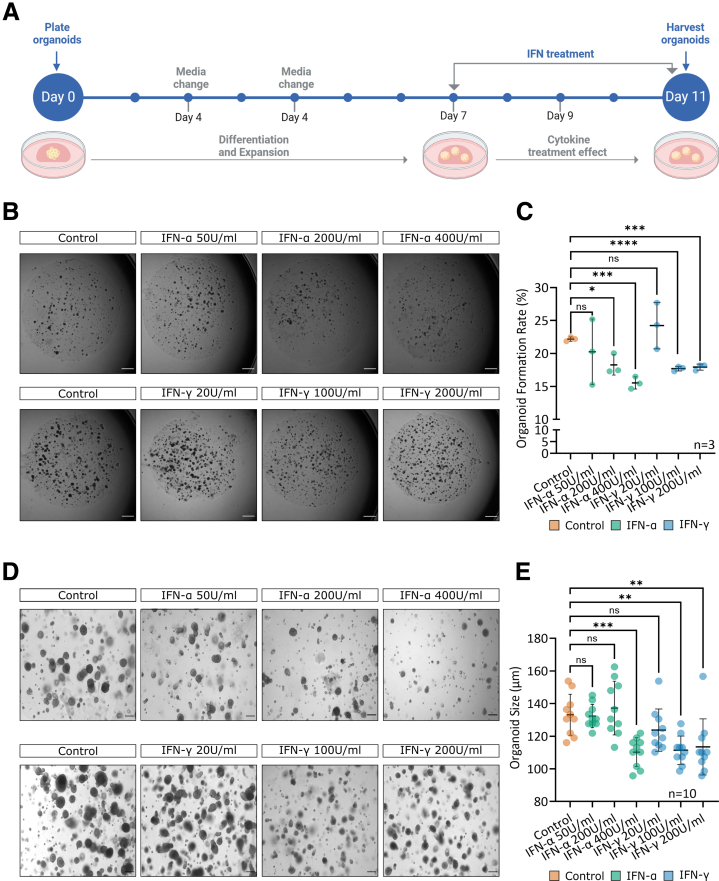
Using scRNA-seq, the highest number of differentially regulated ISGs was found in the epithelial cells of patients with active EoE, and ISGs in transitional epithelial cells correlated significantly with eosinophil counts and endoscopic reference scores. IFN-γ and IFN-α treatments reduced organoid formation rate and size in a dose-dependent manner, with IFN-γ showing a more pronounced impact on measures of epithelial barrier formation and induction of caspase activity. We identify high IFNG expression in a cluster of majority CD8+ T cells with high expression of CD69 and FOS.
These findings reveal that interferon, especially IFN-γ, plays a central role in epithelial cell dysfunction, significantly affecting gene expression, cellular differentiation, and barrier integrity. Clarifying the contribution of varied cytokine signals in EoE may help explain the heterogeneity in patient presentation and therapeutic response.
嗜酸性粒细胞性食管炎(EoE)是一种慢性食管炎症性疾病,其特征为富含嗜酸性粒细胞的黏膜炎症和组织重塑。先前的研究已经揭示了EoE患者活检组织中干扰素(IFN)反应特征基因(ISGs)的上调,但对促成这种IFN反应的特定细胞类型以及干扰素对食管上皮的影响仍不完全清楚。在此,我们使用单细胞RNA测序(scRNA-seq)来检查EoE期间IFN和ISGs的表达,并探索IFN-α和IFN-γ治疗如何影响上皮功能。
使用scRNA-seq和分离的上皮细胞的验证性批量RNA-seq实验来检查EoE患者的上皮基因表达。使用类器官模型研究IFN-α和IFN-γ对上皮细胞的功能影响。
使用scRNA-seq,在活动性EoE患者的上皮细胞中发现差异调节的ISGs数量最多,过渡上皮细胞中的ISGs与嗜酸性粒细胞计数和内镜参考评分显著相关。IFN-γ和IFN-α治疗以剂量依赖性方式降低类器官形成率和大小,IFN-γ对上皮屏障形成和半胱天冬酶活性诱导的指标影响更为明显。我们在一群高表达CD69和FOS的大多数CD8+T细胞中发现了高IFNG表达。
这些发现表明,干扰素,尤其是IFN-γ,在上皮细胞功能障碍中起核心作用,显著影响基因表达、细胞分化和屏障完整性。阐明EoE中各种细胞因子信号的作用可能有助于解释患者表现和治疗反应的异质性。