Max Planck Institute for Intelligent Systems, 70569, Stuttgart, Germany.
Department of Biology, University of North Carolina at Chapel Hill, Chapel Hill, NC, 27599, USA.
Sci Rep. 2022 Feb 2;12(1):1793. doi: 10.1038/s41598-022-05739-1.
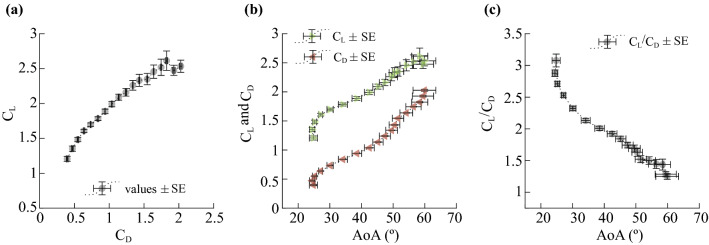
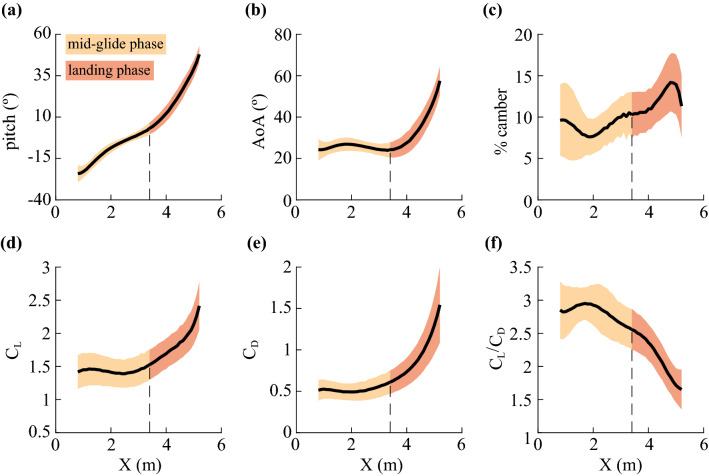
Gliding animals change their body shape and posture while producing and modulating aerodynamic forces during flight. However, the combined effect of these different factors on aerodynamic force production, and ultimately the animal's gliding ability, remains uncertain. Here, we quantified the time-varying morphology and aerodynamics of complete, voluntary glides performed by a population of wild gliding lizards (Draco dussumieri) in a seven-camera motion capture arena constructed in their natural environment. Our findings, in conjunction with previous airfoil models, highlight how three-dimensional (3D) wing shape including camber, planform, and aspect ratio enables gliding flight and effective aerodynamic performance by the lizard up to and over an angle of attack (AoA) of 55° without catastrophic loss of lift. Furthermore, the lizards maintained a near maximal lift-to-drag ratio throughout their mid-glide by changing body pitch to control AoA, while simultaneously modulating airfoil camber to alter the magnitude of aerodynamic forces. This strategy allows an optimal aerodynamic configuration for horizontal transport while ensuring adaptability to real-world flight conditions and behavioral requirements. Overall, we empirically show that the aerodynamics of biological airfoils coupled with the animal's ability to control posture and their 3D wing shape enable efficient gliding and adaptive flight control in the natural habitat.
滑翔动物在飞行过程中会改变身体形状和姿势,同时产生和调节空气动力。然而,这些不同因素对空气动力产生的综合影响,以及最终动物的滑翔能力,仍然不确定。在这里,我们通过在自然环境中建造的一个七相机运动捕捉竞技场,量化了一群野生滑翔蜥蜴(Draco dussumieri)在完全自愿的滑翔过程中随时间变化的形态和空气动力学。我们的研究结果,结合以前的翼型模型,突出了三维(3D)翼型形状,包括弯度、平面形状和纵横比,如何使蜥蜴能够进行滑翔飞行和有效的空气动力性能,直至并超过 55°的迎角(AoA)而不会灾难性地失去升力。此外,蜥蜴通过改变身体俯仰来控制迎角,同时调节翼型弯度来改变空气动力的大小,从而在整个滑翔过程中保持接近最大的升阻比。这种策略允许在水平运输中实现最佳的空气动力配置,同时确保对现实世界的飞行条件和行为要求的适应性。总的来说,我们通过经验证明,生物翼型的空气动力学与动物控制姿势的能力以及它们的 3D 翼型形状相结合,使它们能够在自然栖息地中实现高效的滑翔和自适应飞行控制。