Aerospace Engineering Department, Amirkabir University of Technology, Tehran, Iran.
Department of Mechanical and Aerospace Engineering, Tarbiat Modares University, Tehran, Iran.
Sci Rep. 2022 Nov 9;12(1):19117. doi: 10.1038/s41598-022-23590-2.
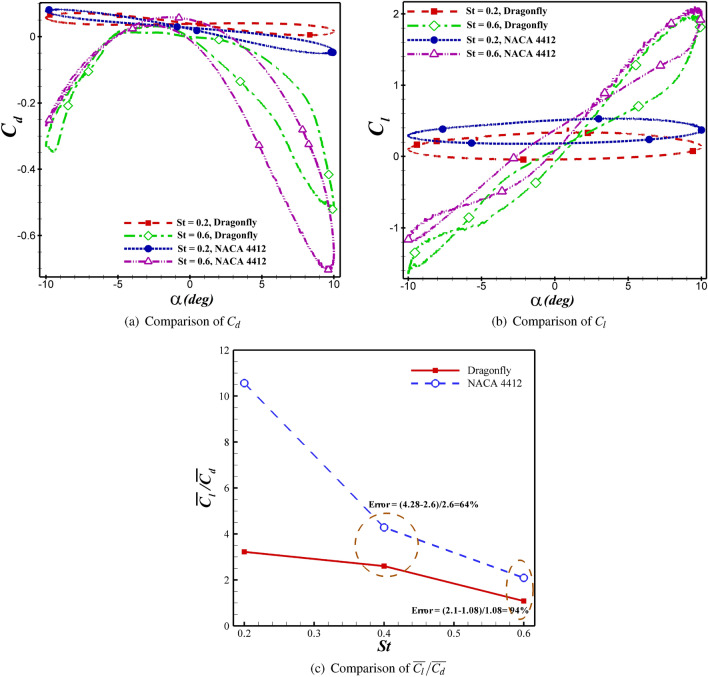
This research numerically investigates the flapping motion effect on the flow around two subsonic airfoils near a ground wall. Thus far, the aerodynamic efficiency of the dragonfly-inspired flapping airfoil has not been challenged by an asymmetric cambered airfoil considering the ground effect phenomenon, especially in the MAV flight range. The analysis is carried out on the basis of an unsteady Reynolds-averaged Navier-stokes (URANS) simulation, whereby the Transition SST turbulence model simulates the flow characteristics. Dragonfly-inspired and NACA4412 airfoils are selected in this research to assess the geometry effect on aerodynamic efficiency. Moreover, the impacts of Reynolds number (Re), Strouhal number (St), and average ground clearance of the flapping airfoil are investigated. The results indicate a direct relationship between the airfoil's aerodynamic performance ([Formula: see text]/[Formula: see text]) and the ground effect. The [Formula: see text]/[Formula: see text] increases by reducing the airfoil and ground distance, especially at [Formula: see text]. At [Formula: see text], by increasing the St from 0.2 to 0.6, the values of [Formula: see text]/[Formula: see text] decrease from 10.34 to 2.1 and 3.22 to 1.8 for NACA4412 and dragonfly airfoils, respectively. As a result, the [Formula: see text]/[Formula: see text] of the NACA4412 airfoil is better than that of the dragonfly airfoil, especially at low oscillation frequency. The efficiency difference between the two airfoils at St=0.6 is approximately 14%, indicating that the [Formula: see text]/[Formula: see text] difference decreases substantially with increasing frequency. For [Formula: see text], the results show the dragonfly airfoil to have better [Formula: see text]/[Formula: see text] in all frequencies than the NACA4412 airfoil.
本研究通过数值模拟的方式研究了近壁面条件下,两个亚声速翼型扑翼运动对绕流的影响。迄今为止,考虑到地面效应现象,还没有对具有非对称弯度翼型的蜻蜓启发式扑翼空气动力效率进行挑战,特别是在微型飞行器飞行范围内。本研究基于非定常雷诺平均纳维-斯托克斯(URANS)模拟进行分析,其中过渡 SST 湍流模型模拟了流动特性。本研究选择了蜻蜓启发式翼型和 NACA4412 翼型来评估几何形状对空气动力效率的影响。此外,还研究了雷诺数(Re)、斯特劳哈尔数(St)和扑翼空气动力平均离地间隙的影响。结果表明,翼型空气动力性能([Formula: see text]/[Formula: see text])与地面效应之间存在直接关系。随着翼型和地面距离的减小,[Formula: see text]/[Formula: see text]增加,特别是在[Formula: see text]。在[Formula: see text]时,通过将 St 从 0.2 增加到 0.6,NACA4412 翼型和蜻蜓翼型的[Formula: see text]/[Formula: see text]值分别从 10.34 减小到 2.1 和从 3.22 减小到 1.8。因此,NACA4412 翼型的[Formula: see text]/[Formula: see text]优于蜻蜓翼型,特别是在低振荡频率时。在 St=0.6 时,两种翼型的效率差异约为 14%,表明随着频率的增加,[Formula: see text]/[Formula: see text]的差异会显著减小。对于[Formula: see text],结果表明在所有频率下,蜻蜓翼型的[Formula: see text]/[Formula: see text]都优于 NACA4412 翼型。