Duong Tina, Staunton Hannah, Braid Jessica, Barriere Aurelie, Trzaskoma Ben, Gao Ling, Willgoss Tom, Cruz Rosangel, Gusset Nicole, Gorni Ksenija, Randhawa Sharan, Yang Lida, Vuillerot Carole
Department of Neurology, Stanford University, Stanford, CA, United States.
Roche Products Limited, Welwyn Garden City, United Kingdom.
Front Neurol. 2022 Jan 17;12:770423. doi: 10.3389/fneur.2021.770423. eCollection 2021.
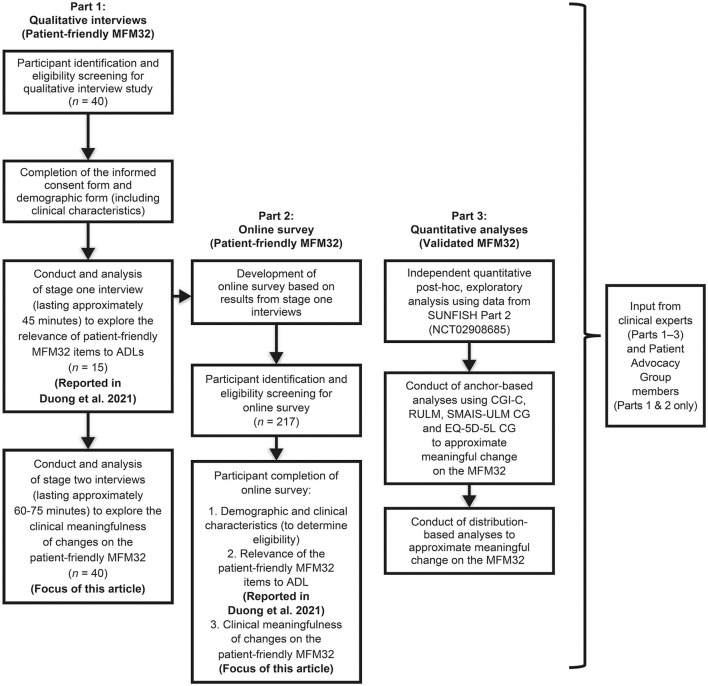
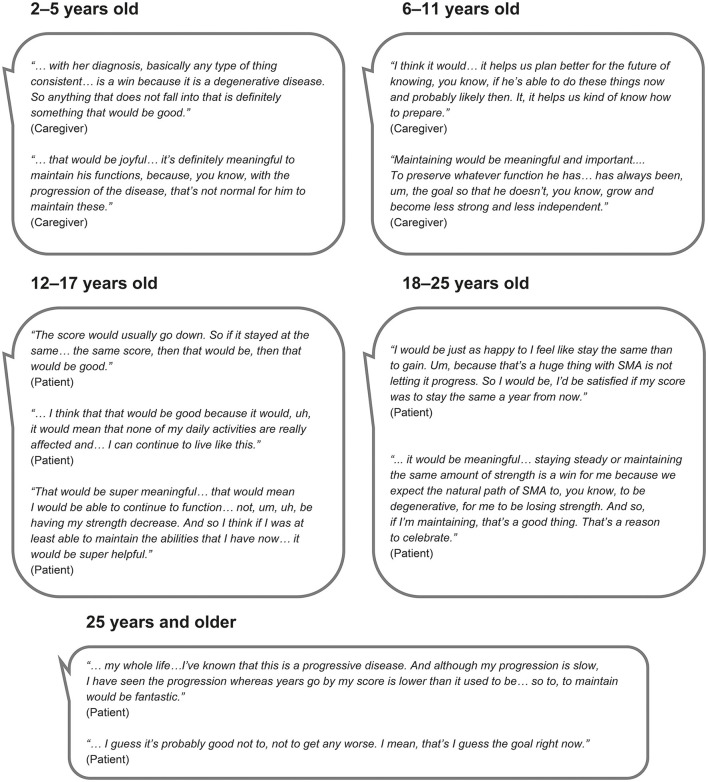
The 32-item Motor Function Measure (MFM32) is an assessment of motor function used to evaluate fine and gross motor ability in patients with neuromuscular disorders, including spinal muscular atrophy (SMA). Reliability and validity of the MFM32 have been documented in individuals with SMA. Through semi-structured qualitative interviews ( = 40) and an online survey in eight countries ( = 217) with individuals with Types 2 and 3 SMA aged 2-59 years old and caregivers, the meaning of changes on a patient-friendly version of the MFM32 was explored. In an independent analysis of clinical trial data, anchor- and distribution-based analyses were conducted in a sample of individuals with Type 2 and non-ambulant Type 3 SMA to estimate patient-centered quantitative MFM32 meaningful change thresholds. The results from this study demonstrate that, based on patient and caregiver insights, maintaining functional ability as assessed by a patient-friendly version of the MFM32 is an important outcome. Quantitative analyses using multiple anchors (median age range of 5-8 years old across anchor groups) indicated that an ~3-point improvement in MFM32 total score represents meaningful change at the individual patient level. Overall, the qualitative and quantitative findings from this study support the importance of examining a range of meaningful change thresholds on the MFM32 including ≥0 points change reflecting stabilization or improvement and ≥3 points change reflecting a higher threshold of improvement. Future research is needed to explore quantitative differences in meaningful change on the MFM32 based on age and functional subgroups.
32项运动功能量表(MFM32)是一种运动功能评估工具,用于评估神经肌肉疾病患者的精细和粗大运动能力,包括脊髓性肌萎缩症(SMA)。MFM32的信效度已在SMA患者中得到证实。通过对40名2至59岁的2型和3型SMA患者及其照料者进行半结构化定性访谈,以及在八个国家对217名患者进行在线调查,探讨了患者友好版MFM32变化的意义。在对临床试验数据的独立分析中,对2型和非行走型3型SMA患者样本进行了基于锚定和分布的分析,以估计以患者为中心的定量MFM32有意义变化阈值。本研究结果表明,根据患者和照料者的见解,通过患者友好版MFM32评估保持功能能力是一项重要结果。使用多个锚定进行的定量分析(各锚定组的中位年龄范围为5至8岁)表明,MFM32总分提高约3分代表个体患者水平的有意义变化。总体而言,本研究的定性和定量结果支持在MFM32上检查一系列有意义变化阈值的重要性,包括反映稳定或改善的≥0分变化和反映更高改善阈值的≥3分变化。未来需要开展研究,探讨基于年龄和功能亚组的MFM32有意义变化的定量差异。