Lilien Charlotte, Vrscaj Eva, Thapaliya Gita, Deconinck Nicolas, De Waele Liesbeth, Duong Tina, Haberlová Jana, Kumhera Markéta, Peirens Geertrui, Szabo Lena, Tahon Valentine, Tang Whitney J, Benmhammed Noor, Médard Laurie, Servais Laurent
MDUK Oxford Neuromuscular Centre, Department of Paediatrics, University of Oxford, Oxford OX3 9DU, UK.
Division of Child Neurology, Reference Center for Neuromuscular Diseases, Department of Paediatrics, University Hospital Liege & University of Liege, 4000 Liege, Belgium.
J Clin Med. 2024 Jun 11;13(12):3418. doi: 10.3390/jcm13123418.
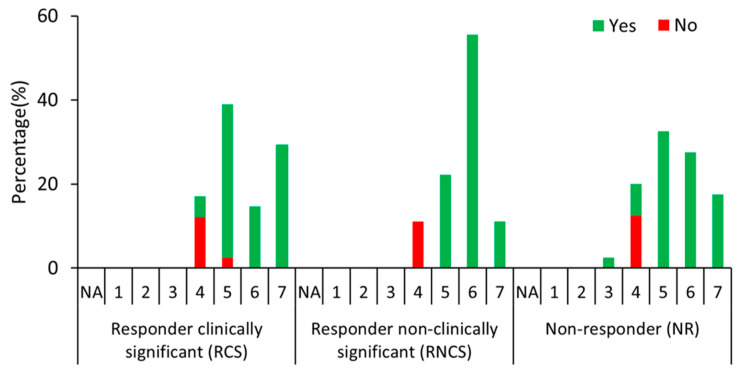
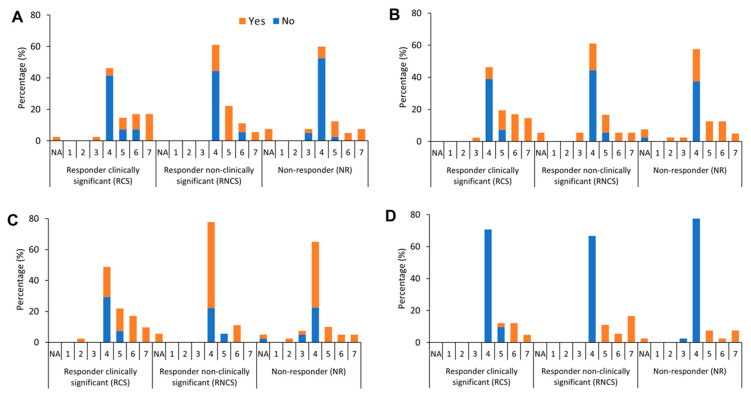
Patients with spinal muscular atrophy (SMA) treated with a disease-modifying therapy (DMT) are often classified as responders or non-responders based on the attainment of a specific improvement threshold on validated functional scales. This categorization may significantly impact treatment reimbursement in some countries. The aim of this research is to evaluate the perception of treatments and their benefit by patients considered as responders or non-responders. In this non-commercial multicenter study, 99 post-symptomatically treated SMA type I-III patients with a median age of 11.2 (0.39-57.4) years at treatment initiation were stratified into three groups based on their treatment outcomes, i.e., those exhibiting clinically significant improvement (N = 41), those with non-clinically significant improvement (N = 18), or those showing no improvement (N = 40). Fifteen months after treatment, the initiation patients or patients' caregivers were assessed using a patient-rated scoring system based on the Patient Global Impression of Change (PGIC) scale, comprising 22 questions targeting important aspects and tasks in the daily life of patients with SMA. We found no statistical difference in the patient perception of treatment benefits in 17 out of 22 domains across patient groups. Our results suggest that functional motor scales do not recapitulate patients' and patients' caregivers' experience of the effect of nusinersen treatment in SMA.
接受疾病修饰疗法(DMT)治疗的脊髓性肌萎缩症(SMA)患者,通常根据在经过验证的功能量表上达到特定改善阈值,被分类为反应者或无反应者。这种分类在一些国家可能会对治疗报销产生重大影响。本研究的目的是评估被视为反应者或无反应者的患者对治疗及其益处的看法。在这项非商业性多中心研究中,99例症状出现后接受治疗的I - III型SMA患者,治疗开始时的中位年龄为11.2(0.39 - 57.4)岁,根据治疗结果被分为三组,即表现出临床显著改善的患者(N = 41)、临床改善不显著的患者(N = 18)或无改善的患者(N = 40)。治疗15个月后,使用基于患者总体印象变化(PGIC)量表的患者自评评分系统对起始治疗的患者或患者的护理人员进行评估,该系统包含22个针对SMA患者日常生活中重要方面和任务的问题。我们发现,在22个领域中的17个领域,不同患者组对治疗益处的患者认知没有统计学差异。我们的结果表明,功能运动量表不能概括患者及患者护理人员对诺西那生治疗SMA效果的体验。