Laboratory of Tumor Immunology, Beijing Pediatric Research Institute, Beijing Children's Hospital affiliated to the Capital Medical University, National Center for Children's Health, Beijing, China.
Department of Interventional Pulmonology, Beijing Children's Hospital affiliated to the Capital Medical University, National Clinical Research Center for Respiratory Diseases, National Center for Children's Health, Beijing, China.
Front Immunol. 2022 Jan 17;12:760488. doi: 10.3389/fimmu.2021.760488. eCollection 2021.
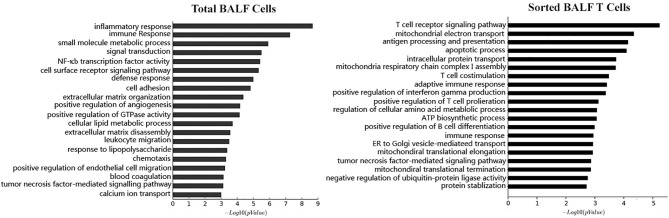
Severe mycoplasma pneumoniae pneumonia (MPP) in children presents with serious clinical complications. Without proper and prompt intervention, it could lead to deadly consequences. Dynamics of the inflammatory airway milieu and activation status of immune cells were believed to be the hallmark of the pathogenesis and progress of the disease. In this study, by employing the T-cell sorting and mRNA microarray, we were able to define the main feature of the chemokine/cytokine expression and the unique characteristics of T cells in the bronchoalveolar lavage fluid (BALF) from severe MPP patients at acute phase. Our study for the first time delineated the molecular changes in isolated BALF T cells in severe MPP children with respect to the cytokine/chemokine expression, cell activation, exhaustion, and apoptosis. By comparing the BALF aqueous expression of cytokines/chemokines with that in sorted T cells, our data give a preliminary clue capable of finishing out the possible cell source of the proinflammatory cytokines/chemokines from the BALF mixture. Meanwhile, our data provide a distinctively pellucid expression profile particularly belonging to the isolated BALF T cells demonstrating that in the inflammatory airway, overactivated T cells were exhausted and on the verge of apoptotic progress.
儿童重症肺炎支原体肺炎(MPP)表现出严重的临床并发症。如果没有适当和及时的干预,可能会导致致命的后果。炎症气道环境的动态变化和免疫细胞的激活状态被认为是疾病发病机制和进展的标志。在这项研究中,我们通过 T 细胞分选和 mRNA 微阵列,能够定义急性重症 MPP 患者支气管肺泡灌洗液(BALF)中趋化因子/细胞因子表达的主要特征和 T 细胞的独特特征。我们的研究首次描述了重症 MPP 儿童分离的 BALF T 细胞中细胞因子/趋化因子表达、细胞激活、耗竭和凋亡的分子变化。通过比较 BALF 中细胞因子/趋化因子的水性表达与分选 T 细胞中的表达,我们的数据提供了一个初步的线索,能够从 BALF 混合物中确定促炎细胞因子/趋化因子的可能细胞来源。同时,我们的数据提供了一个独特的清晰表达谱,特别是属于分离的 BALF T 细胞,表明在炎症气道中,过度激活的 T 细胞耗竭并处于凋亡过程中。