Department of Neuroscience "Rita Levi Montalcini", University of Turin, Via Cherasco 15, 10126, Turin, Italy.
Neurology 2 Unit, A.O.U. Città della Salute e della Scienza di Torino, Corso Bramante 88, 10126, Turin, Italy.
J Neurol. 2022 Jul;269(7):3706-3712. doi: 10.1007/s00415-022-10995-2. Epub 2022 Feb 3.
Botulinum toxin (BoNT) is a valuable treatment in movement disorders; however, time to onset and duration of efficacy may widely differ among patients. We aimed to clarify the impact of main demographic and clinical features on time to onset and duration of BoNT efficacy.
We analyzed time-to-onset and duration of BoNT efficacy in 186 consecutive patients treated with BoNT for blepharospasm, cervical dystonia, facial hemispasm, oromandibular dystonia, limb dystonia, and sialorrhea due to Parkinsonism. The following factors were considered as potential efficacy predictors: doses and types of toxin, sex, age, years of treatment, and clinical condition. Kruskall-Wallis, Spearman correlation, and multivariate linear regression were used for statistical analysis.
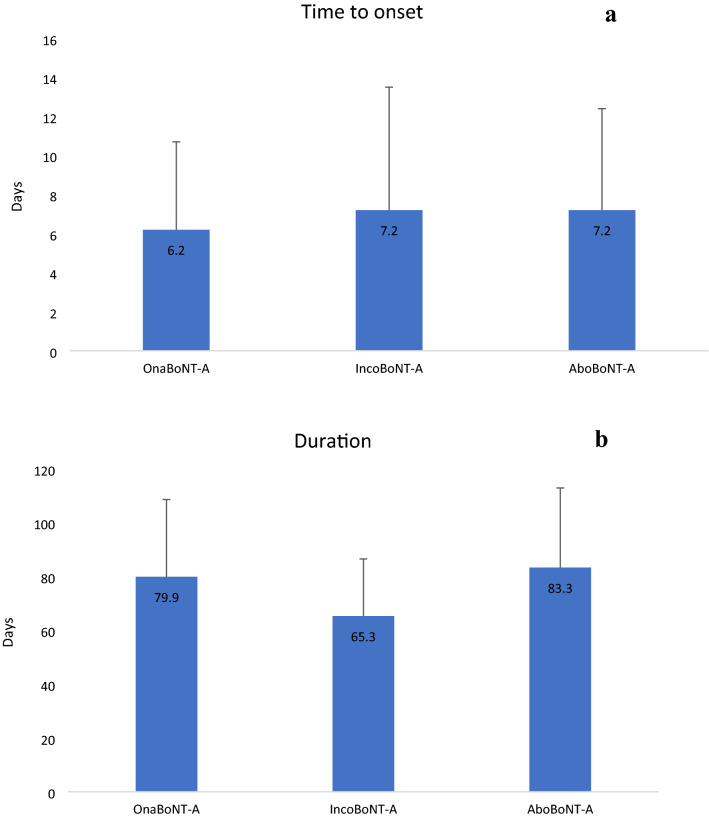
The average time to onset was 6.7 ± 5 days and duration of BONT efficacy 78.5 ± 28.4 days. Both time to onset and duration of efficacy were correlated with BoNT doses (p: 0.007 and p: 0.02). The multiple regression analysis showed that sex, age, years of BoNT treatment, doses, type of toxin, and clinical condition significantly predicted time to onset (F(11, 171) = 2.146, p: 0.020) with age being the strongest predictor (p: 0.004). The same model explained 20.1% of the variance of duration of BoNT efficacy, showing a significant prediction of the outcome (F(11, 164) = 3.754, p < 0.001), with doses (p < 0.001), type of toxin (p: 0.017), and clinical condition (p < 0.001) being the strongest predictors.
Our findings suggest that age, type of toxin, clinical condition and especially doses may account for the variability of BoNT efficacy in terms of time to onset and duration.
肉毒毒素(BoNT)是治疗运动障碍的有效方法,但不同患者的起效时间和疗效持续时间可能存在较大差异。我们旨在明确主要人口统计学和临床特征对 BoNT 起效时间和疗效持续时间的影响。
我们分析了 186 例连续接受 BoNT 治疗的眼睑痉挛、颈部肌张力障碍、面部半侧痉挛、口下颌肌张力障碍、肢体肌张力障碍和帕金森病唾液分泌过多患者的起效时间和 BoNT 疗效持续时间。考虑了以下因素作为潜在的疗效预测因素:毒素类型和剂量、性别、年龄、治疗年限和临床状况。使用 Kruskal-Wallis、Spearman 相关分析和多元线性回归进行统计学分析。
平均起效时间为 6.7±5 天,BoNT 疗效持续时间为 78.5±28.4 天。起效时间和疗效持续时间均与 BoNT 剂量相关(p:0.007 和 p:0.02)。多元回归分析显示,性别、年龄、BoNT 治疗年限、剂量、毒素类型和临床状况显著预测了起效时间(F(11,171)=2.146,p:0.020),其中年龄是最强的预测因素(p:0.004)。该模型解释了 BoNT 疗效持续时间方差的 20.1%,表明对结果有显著预测作用(F(11,164)=3.754,p<0.001),其中剂量(p<0.001)、毒素类型(p:0.017)和临床状况(p<0.001)是最强的预测因素。
我们的研究结果表明,年龄、毒素类型、临床状况,尤其是剂量,可能是 BoNT 起效时间和疗效持续时间差异的原因。