
一种用于白内障手术前人工晶状体选择的交互式计算机化患者决策辅助工具的开发与初步效用测试。
Development and Pilot Usefulness Testing of an Interactive Computerized Patient Decision Aid for Intraocular Lens Selection Before Cataract Surgery.
作者信息
Tsai Chong-Bin, Fang Chien-Liang, Chen Ming-Shan, Yen Min-Yueh, Yeh Chi-Yen, Lai Zhi-Ming, Hsu Mei-Ling, Wang Shan-Tair
机构信息
Department of Ophthalmology, Ditmanson Medical Foundation Chiayi Christian Hospital, Chiayi City, Taiwan.
Department of Optometry, College of Medical and Health Science, Asia University, Taichung, Taiwan.
出版信息
Patient Prefer Adherence. 2022 Jan 25;16:189-196. doi: 10.2147/PPA.S343655. eCollection 2022.
PURPOSE
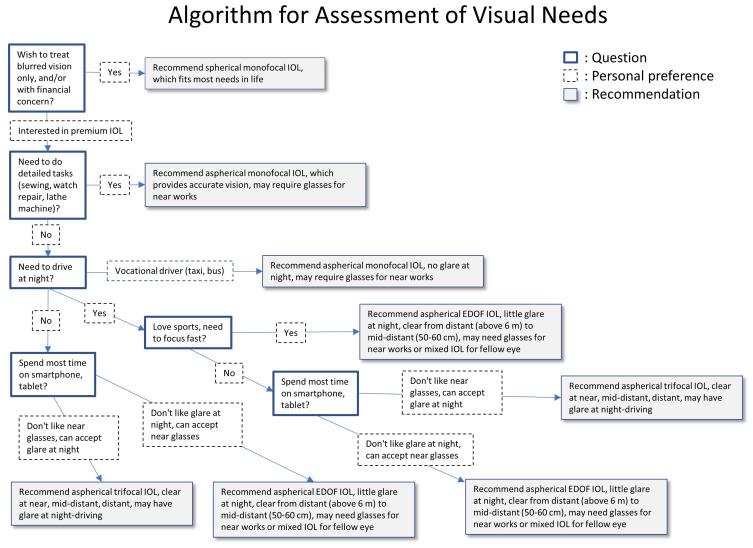
Modern cataract surgeries aim to treat impaired vision and also improve quality of life. An appropriate pre-operative selection of the intraocular lens is important to post-operative quality of life. Patients often have difficulty in choosing the best fit for individual needs. Patient decision aids (PDAs) are useful tools to assist patients in such decision-making process. However, most PDAs are paper-based and lack user interaction. This study is aimed to develop and evaluate an interactive computerized patient decision aid (cPDA) to help patients in the selection of an appropriate intraocular lens model before cataract surgery.
MATERIALS AND METHODS
Patients and their families who were making the decision regarding intraocular lens selection before cataract surgeries were eligible to participate in this study. A cPDA was built on an interactive robot, to help the patients in the decision-making process. The usefulness of the cPDA was measured with the Decision Self-Efficacy (DSE) scale and Preparation for Decision Making (PrepDM) scale.
RESULTS
A total of 50 participants (18 men and 32 women) were enrolled in the pilot test. The mean pre-cPDA DSE score was 46.5 ± 13.6, and the post-cPDA DSE score was 72.6 ±12.8. The average gain score on DSE was 26.1, and the standard deviation was 8.0. The gain score on DSE was statistically significant, and the effect size was bigger than 3. The patients with junior or senior high degrees had the highest gain score on DSE, and the ones with college or above degrees had the lowest. The patients with college or above degrees had the highest PrepDM score, and the ones with elementary school or below had the lowest. Age and sex were not significant correlates of PrepDM. The patients with college or above degrees had the highest preparedness, but the lowest gain on DSE.
CONCLUSION
Education levels are associated with the usefulness of cPDA, both for the preparedness and decision efficacy of patients. The results provide insight into the feasibility of cPDA for the decision-making of pre-operative intraocular lens selection.
目的
现代白内障手术旨在治疗视力受损问题并提高生活质量。术前合理选择人工晶状体对术后生活质量至关重要。患者在选择最适合个人需求的人工晶状体时往往存在困难。患者决策辅助工具(PDA)是帮助患者进行此类决策过程的有用工具。然而,大多数PDA是纸质的,缺乏用户交互。本研究旨在开发并评估一种交互式计算机化患者决策辅助工具(cPDA),以帮助患者在白内障手术前选择合适的人工晶状体型号。
材料与方法
在白内障手术前就人工晶状体选择做出决策的患者及其家属有资格参与本研究。基于交互式机器人构建了一个cPDA,以帮助患者进行决策过程。使用决策自我效能(DSE)量表和决策准备(PrepDM)量表来衡量cPDA的有用性。
结果
共有50名参与者(18名男性和32名女性)参加了试点测试。cPDA前的DSE平均得分是46.5±13.6分,cPDA后的DSE平均得分是72.6±12.8分。DSE的平均增益得分是26.1分,标准差是8.0。DSE的增益得分具有统计学意义,效应大小大于3。初中或高中学历的患者DSE增益得分最高,大专及以上学历的患者得分最低。大专及以上学历的患者PrepDM得分最高,小学及以下学历的患者得分最低。年龄和性别与PrepDM无显著相关性。大专及以上学历的患者准备程度最高,但DSE增益最低。
结论
教育水平与cPDA的有用性相关,这涉及患者的准备程度和决策效能。研究结果为cPDA在术前人工晶状体选择决策中的可行性提供了见解。


 Zotero 插件