Zuo Chunjian, Liu Guanchu, Bai Ye, Tian Jie, Chen Huanwen
Department of Cardiothoracic Surgery, The First Affiliated Hospital of Chongqing Medical University, Chongqing, China.
Department of Cardiothoracic Surgery, The Affiliated Hospital of North Sichuan Medical College, Nanchong, China.
Transl Cancer Res. 2021 Jan;10(1):22-37. doi: 10.21037/tcr-20-2745.
Brain metastasis (BM) causes high morbidity and mortality rates in lung cancer (LC) patients. The present study aims to develop models for predicting the development and prognosis of BM using a large LC cohort.
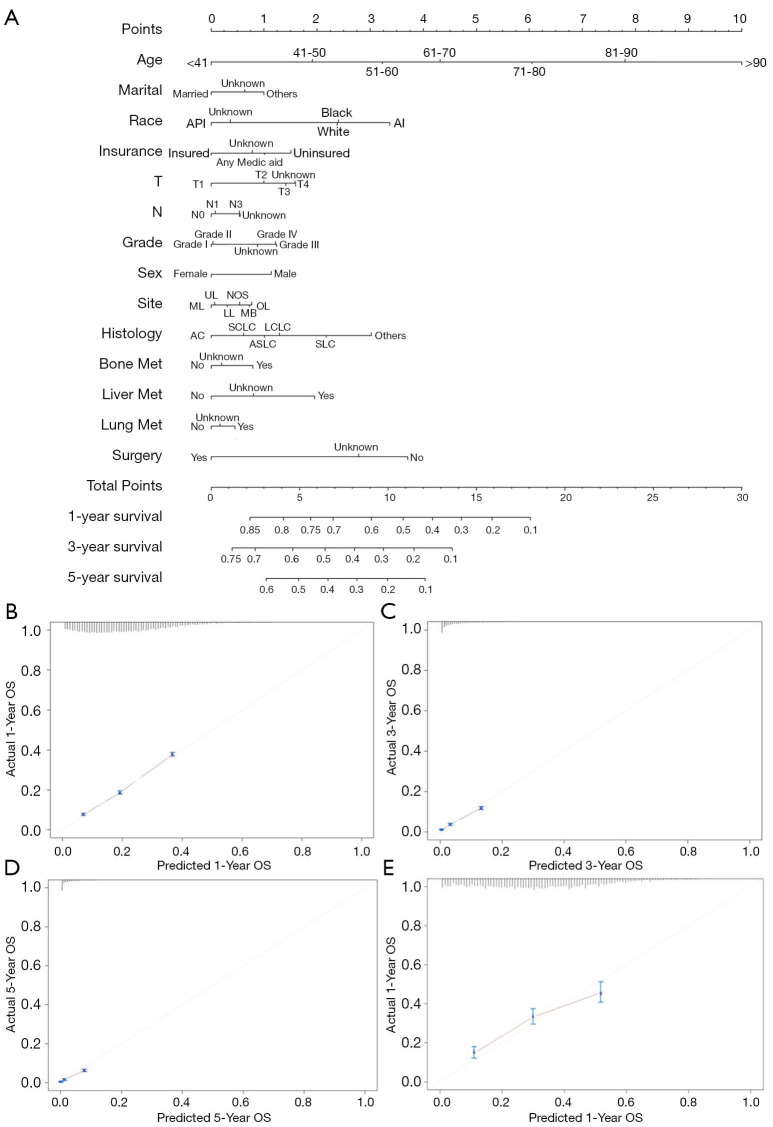
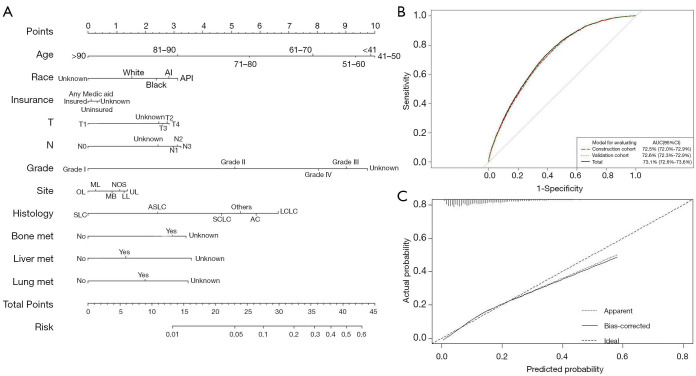
A total of 266,522 LC cases diagnosed between 2010 and 2016 were selected from the Surveillance, Epidemiology, and End Results (SEER) Program cohort. Risk factors for developing BM and prognosis were calculated by univariable and multivariable logistic and Cox regression analysis, respectively, and nomograms were constructed based on risk factors. Nomogram performance was evaluated with receiver operating characteristics (ROC) curve, or C-index and calibration curve.
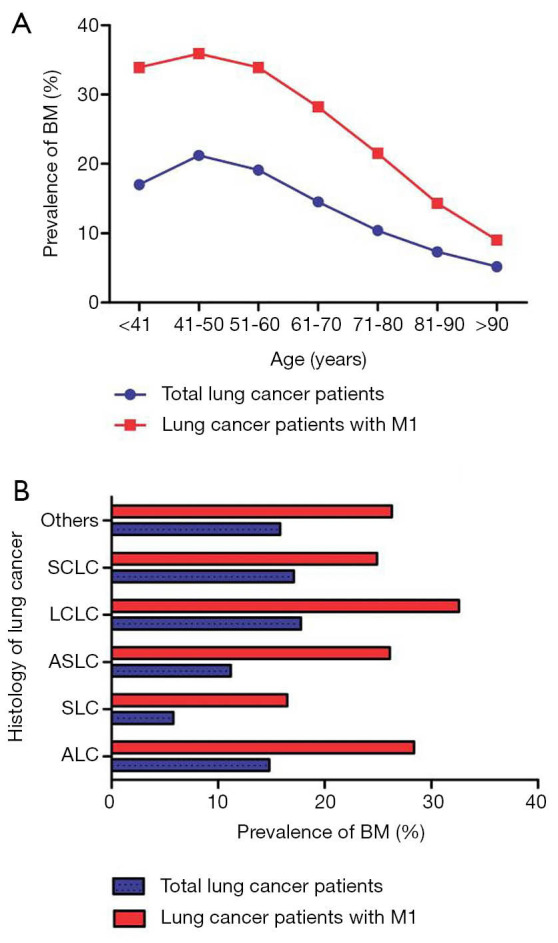
The prevalence of BM was 13.33%. Associated factors for developing BM include: advanced age; Asian or Pacific Islander race; uninsured status; primary tumor site; higher T stage; higher N stage; poorly differentiated grade; the presence of lung, liver, and bone metastases; and adenocarcinoma histology. Median overall survival (OS) was 4 months; associated prognosis factors were similar to risk factors plus female gender, unmarried status, and surgery. The calibration curve showed good agreement between predicted and actual probability, and the AUC/C-index was 73.1% (95% CI: 72.6-73.6%) and 0.88 (95% CI: 0.87-0.89) for risk and prognosis predictive models, respectively.
BM was highly developed in LC patients, and homogeneous and heterogeneous factors were found between risk and prognosis for BM. The nomogram showed good performance in predicting BM development and prognosis.
脑转移(BM)在肺癌(LC)患者中导致高发病率和死亡率。本研究旨在使用一个大型LC队列开发预测BM发生和预后的模型。
从监测、流行病学和最终结果(SEER)计划队列中选取2010年至2016年期间诊断的266,522例LC病例。分别通过单变量和多变量逻辑回归及Cox回归分析计算发生BM和预后的危险因素,并基于危险因素构建列线图。列线图性能通过受试者工作特征(ROC)曲线、C指数和校准曲线进行评估。
BM的患病率为13.33%。发生BM的相关因素包括:高龄;亚洲或太平洋岛民种族;未参保状态;原发肿瘤部位;更高的T分期;更高的N分期;低分化分级;存在肺、肝和骨转移;以及腺癌组织学类型。中位总生存期(OS)为4个月;相关预后因素与危险因素相似,外加女性性别、未婚状态和手术。校准曲线显示预测概率与实际概率之间具有良好的一致性,风险和预后预测模型的AUC/C指数分别为73.1%(95%CI:72.6 - 73.6%)和0.88(95%CI:0.87 - 0.89)。
LC患者中BM的发生率很高,并且在BM的风险和预后之间发现了同质和异质因素。列线图在预测BM发生和预后方面表现良好。