Department of Thoracic Surgery, Tianjin Chest Hospital, Tianjin, 300222, China.
Department of Thoracic Surgery, Peking University Shenzhen Hospital, Shenzhen, 518035, China.
BMC Cancer. 2021 Sep 26;21(1):1057. doi: 10.1186/s12885-021-08802-8.
Brain metastases were rare in esophageal cancer patients. Using the Surveillance, Epidemiology, and End Results (SEER) database, the present study investigated the incidence, risk and prognostic factors of brain metastases in esophageal cancer patients.
Retrieving esophageal cancer patients diagnosed between 2010 and 2018 from the SEER database, univariable and multivariable logistic and cox regression models were used to investigate the risk factors for brain metastases development and prognosis, respectively. The brain metastases predicting nomogram was constructed, evaluated and validated. The overall survival (OS) of patients with brain metastases was analyzed by Kaplan-Meier method.
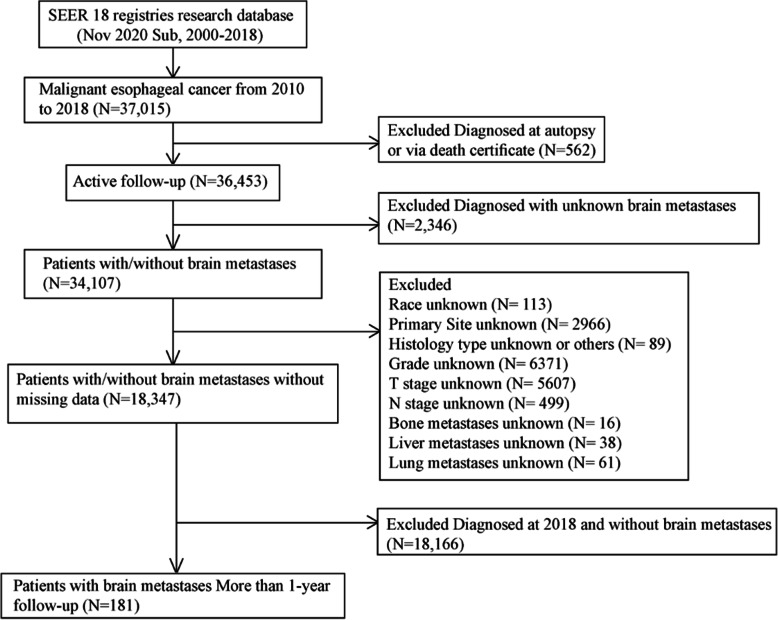
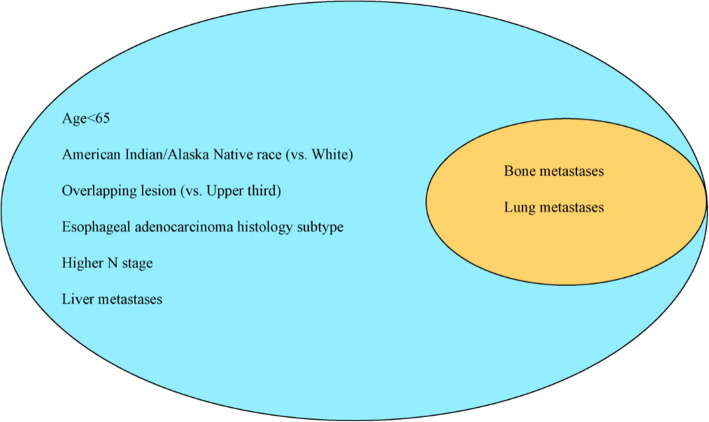
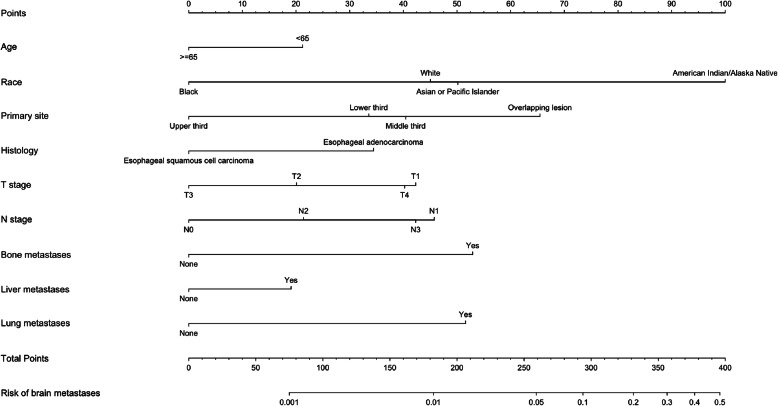
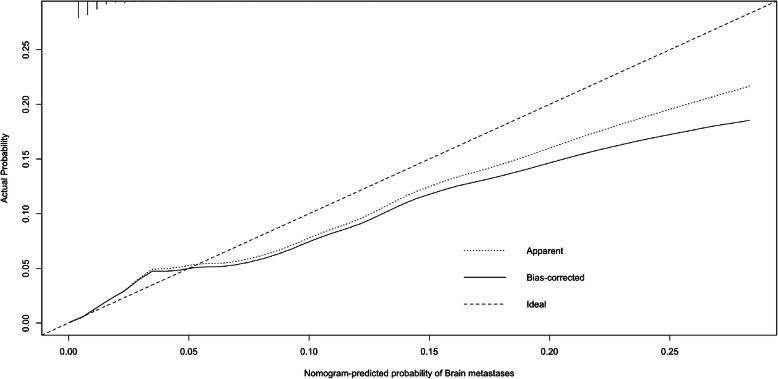
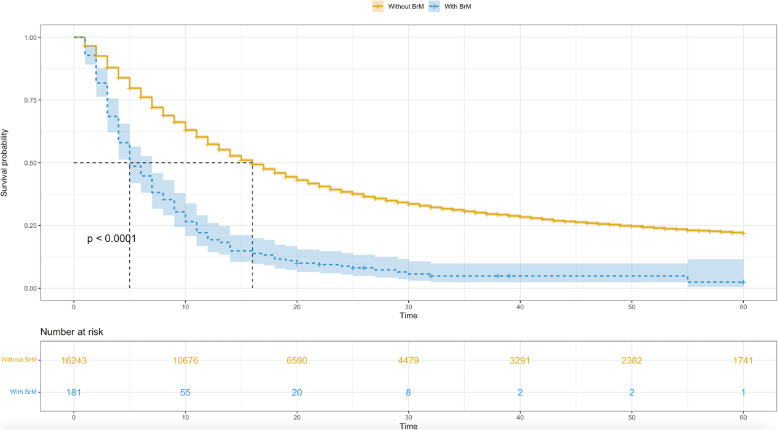
A total of 34,107 eligible esophageal cancer patients were included and 618 of them were diagnosed with brain metastases (1.8%). The median survival of the brain metastatic esophageal cancer patients was 5 (95% CI: 5-7) months. The presence of bone metastases and lung metastases were the homogeneously associated factors for the development and prognosis of brain metastases in esophageal cancer patients. Patients younger than 65 years, American Indian/Alaska Native race (vs. White), overlapping lesion (vs. Upper third), esophageal adenocarcinoma histology subtype, higher N stage, and liver metastases were positively associated with brain metastases occurrence. The calibration curve, ROC curve, and C-index exhibited good performance of the nomogram for predicting brain metastases.
Homogeneous and heterogeneous factors were found for the development and prognosis of brain metastases in esophageal cancer patients. The nomogram had good calibration and discrimination for predicting brain metastases.
脑转移在食管癌患者中较为罕见。本研究利用监测、流行病学和最终结果(SEER)数据库,调查了食管癌患者脑转移的发生率、风险和预后因素。
从 SEER 数据库中检索 2010 年至 2018 年间诊断为食管癌的患者,分别使用单变量和多变量逻辑回归和 Cox 回归模型来研究脑转移发展和预后的危险因素。构建、评估和验证脑转移预测列线图。采用 Kaplan-Meier 方法分析脑转移患者的总生存率(OS)。
共纳入 34107 例符合条件的食管癌患者,其中 618 例被诊断为脑转移(1.8%)。脑转移食管癌患者的中位生存时间为 5 个月(95%CI:5-7)。骨转移和肺转移的存在是食管癌患者脑转移发展和预后的同质相关因素。年龄小于 65 岁、美国印第安人/阿拉斯加原住民(非白人)、重叠病变(非上三分之一)、食管腺癌组织学亚型、较高的 N 分期和肝转移与脑转移的发生呈正相关。列线图的校准曲线、ROC 曲线和 C 指数显示出良好的脑转移预测性能。
发现了食管癌患者脑转移发展和预后的同质和异质因素。该列线图在预测脑转移方面具有良好的校准和区分度。