Cai Hai, Ke Zhi-Bin, Dong Ru-Nan, Chen Hang, Lin Fei, Zheng Wen-Cai, Chen Shao-Hao, Zhu Jun-Ming, Chen Shao-Ming, Zheng Qing-Shui, Wei Yong, Xue Xue-Yi, Xu Ning
Department of Urology, Urology Research Institute, the First Affiliated Hospital, Fujian Medical University, Fuzhou, China.
Department of Nuclear Medicine, First Affiliated Hospital of Fujian Medical University, Fuzhou, China.
Transl Cancer Res. 2021 Oct;10(10):4347-4354. doi: 10.21037/tcr-21-765.
The prognosis of homeobox A9 (HOXA9) methylation have been assessed in a variety of cancers; nevertheless, the results remain undetermined due to discrete outcome and the limitations of small sample size. Therefore, we conducted a meta-analysis to explore the effect of HOXA9 methylation on the prognostic outcomes of patients with solid tumors.
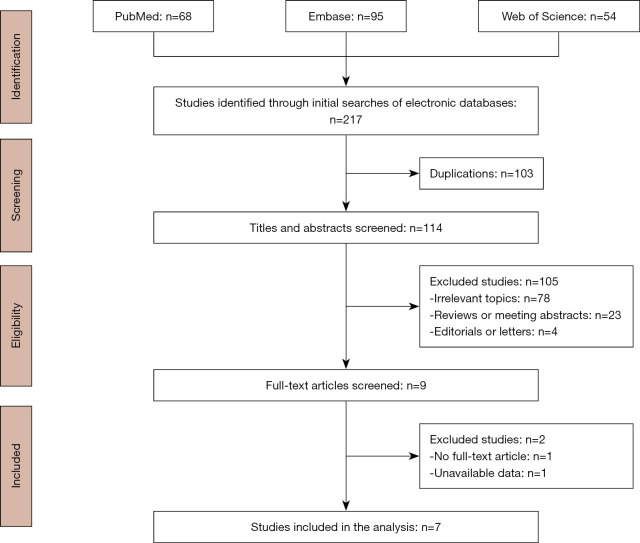
Qualified studies were verified by searching PubMed, Excerpta Medica Database and Web of Science until September, 2020. Clinicopathological factors and hazard ratio (HR) of 95% confidence interval (95% CI) were selected. Subgroup analysis including carcinoma category, analysis method and sample size were adopted.
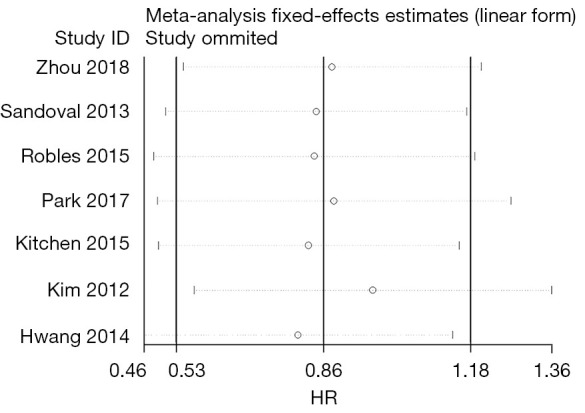
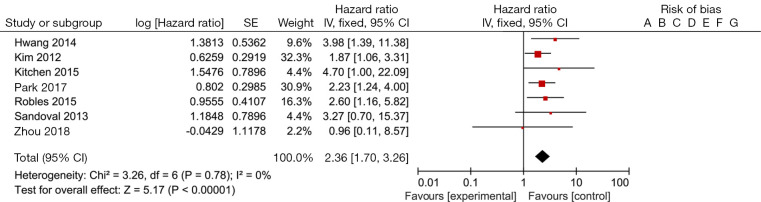
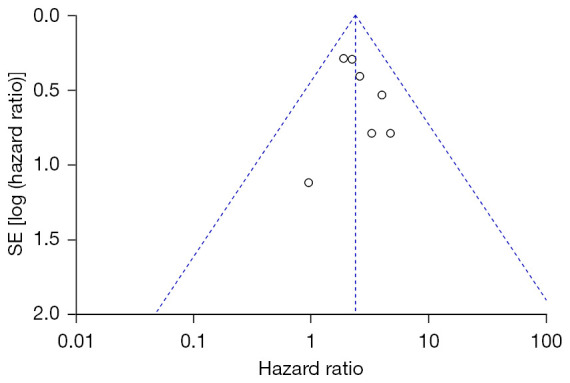
In the meta-analysis 1,031 patients with solid carcinoma from 7 eligible investigations were involved. Among human cancer we discovered that the high HOXA9 methylation level was negative correlative with overall survival (OS) (HR =2.36; 95% CI: 1.70-3.26). In the subgroup analysis, we found HOXA9 methylation over-expression had statistical significance with poorer OS in lung cancer patients (HR =3.08, 95% CI: 1.70-5.55, P=0.002) and non-lung cancer (HR =2.10, 95% CI: 1.42-3.10, P=0.0002). Similar result was found in sample size. Greater than or equal to 100 (HR =2.31, 95% CI: 1.54-3.45, P<0.0001) and less than 100 (HR =2.45, 95% CI: 1.42-4.23, P=0.001).
HOXA9 methylation has a significantly estimable biomarker of predicting poor prognosis and a potential target for therapy in solid malignant carcinoma from our meta-analysis.
已在多种癌症中评估了同源盒A9(HOXA9)甲基化的预后;然而,由于结果不一以及样本量小的局限性,结果仍未确定。因此,我们进行了一项荟萃分析,以探讨HOXA9甲基化对实体瘤患者预后结果的影响。
通过检索PubMed、医学文摘数据库和科学网,直至2020年9月,对合格研究进行验证。选择临床病理因素和95%置信区间(95%CI)的风险比(HR)。采用包括癌症类别、分析方法和样本量在内的亚组分析。
在荟萃分析中,纳入了来自7项符合条件研究的1031例实体癌患者。在人类癌症中,我们发现高HOXA9甲基化水平与总生存期(OS)呈负相关(HR =2.36;95%CI:1.70 - 3.26)。在亚组分析中,我们发现HOXA9甲基化过表达在肺癌患者(HR =3.08,95%CI:1.70 - 5.55,P =0.002)和非肺癌患者(HR =2.10,95%CI:1.42 - 3.10,P =0.0002)中与较差的OS具有统计学意义。在样本量方面也发现了类似结果。样本量大于或等于100(HR =2.31,95%CI:1.54 - 3.45,P <0.0001)和小于100(HR =2.45,95%CI:1.42 - 4.23,P =0.001)。
从我们的荟萃分析来看,HOXA9甲基化是预测实体恶性肿瘤预后不良的一个具有显著评估价值的生物标志物,也是实体恶性肿瘤治疗的一个潜在靶点。