Proskurina Anastasia S, Ruzanova Vera S, Ostanin Alexandr A, Chernykh Elena R, Bogachev Sergey S
Institute of Cytology and Genetics, Siberian Branch of the Russian Academy of Sciences, Novosibirsk, Russia.
Novosibirsk State University, Novosibirsk, Russia.
Transl Cancer Res. 2021 Nov;10(11):4958-4972. doi: 10.21037/tcr-21-919.
We describe experimental and theoretical premises of a powerful cancer therapy based on the combination of three approaches. These include (I) vaccination (intratumoral injections of CpG oligonucleotides and anti-OX40 antibody); (II) chronometric or metronomic low-dose cyclophosphamide (CMLD CP)-based chemotherapy; (III) cancer stem cell-eradicating therapy referred to as (from the Sanskrit ["source"] + ["to kill"]).
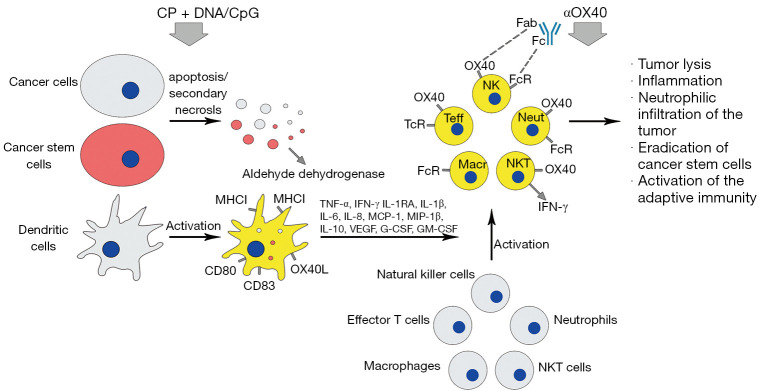
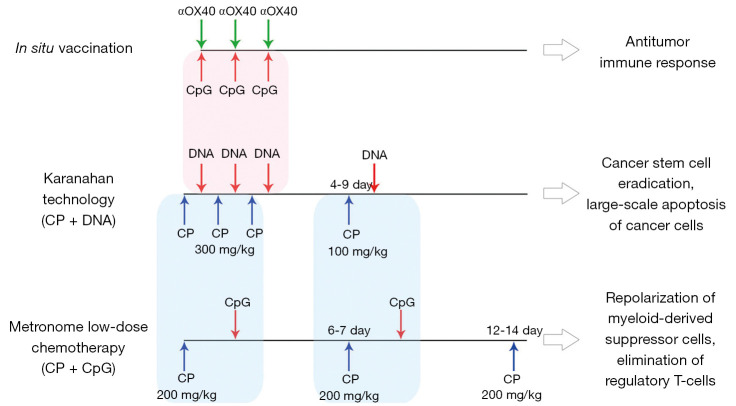
In murine models, the first two approaches are particularly potent in targeting immunogenic tumors for destruction. vaccination activates a fully fledged anticancer immune response via an intricate network of ligand-receptor-cytokine interactions. CMLD CP-based chemotherapy primarily targets the suppressive tumor microenvironment and activates tumor-infiltrating effectors. In contrast, technology, being aimed at replicative machinery of tumor cells (both stem-like and committed), does not depend on tumor immunogenicity. With this technology, mice engrafted with ascites and/or solid tumors can be successfully cured. There is a significant degree of mechanistic and therapeutic overlap between these three approaches. For instance, the similarities shared between vaccination and technology include the therapeutic procedure, the cell target [antigen-presenting cells (APC) and dendritic cells (DC)], and the use of DNA-based preparations (CpG and DNAmix). Features shared between CMLD CP-based chemotherapy and technology are the timing and the dose of the cytostatic drug administration, which lead to tumor regression.
The following keywords were used to search PubMed for the latest research reporting successful eradication of transplantable cancers in animal models that relied on approaches distinct from those used in the technology: and others.
We hypothesize, therefore, that very potent anticancer activity can be achieved once these three therapeutic modalities are combined into a single approach. This multimodal approach is theoretically curative for any type of cancer that depends on the presence of tumor-inducing cancer stem cells, provided that the active therapeutic components are efficiently delivered into the tumor and the specific biological features of a given patient's tumor are properly addressed. We expect this multimodal approach to be primarily applicable to late-stage or terminal cancer patients who have exhausted all treatment options as well as patients with inoperable tumors.
我们描述了一种基于三种方法联合的强大癌症治疗的实验和理论前提。这些方法包括:(I)疫苗接种(瘤内注射CpG寡核苷酸和抗OX40抗体);(II)基于计时或节律性低剂量环磷酰胺(CMLD CP)的化疗;(III)消除癌症干细胞的疗法,称为(源自梵语[“源”]+[“杀死”])。
在小鼠模型中,前两种方法在靶向免疫原性肿瘤进行破坏方面特别有效。疫苗接种通过复杂的配体-受体-细胞因子相互作用网络激活全面的抗癌免疫反应。基于CMLD CP的化疗主要针对抑制性肿瘤微环境并激活肿瘤浸润效应细胞。相比之下,技术旨在针对肿瘤细胞(包括干细胞样和定向细胞)的复制机制,但不依赖于肿瘤免疫原性。使用这种技术,接种腹水和/或实体瘤的小鼠可以成功治愈。这三种方法之间存在显著程度的机制和治疗重叠。例如,疫苗接种和技术之间的相似之处包括治疗程序、细胞靶点[抗原呈递细胞(APC)和树突状细胞(DC)]以及基于DNA的制剂(CpG和DNAmix)的使用。基于CMLD CP的化疗和技术之间的共同特征是细胞抑制药物给药的时间和剂量,这会导致肿瘤消退。
使用以下关键词在PubMed中搜索最新研究,这些研究报告了在动物模型中成功根除可移植癌症,且所依赖的方法不同于技术中使用的方法:以及其他。
因此,我们假设,一旦将这三种治疗方式组合成一种单一方法,就可以实现非常强大的抗癌活性。这种多模式方法理论上可治愈任何依赖肿瘤诱导癌症干细胞存在的癌症类型,前提是活性治疗成分能够有效地递送至肿瘤中,并且能够正确处理特定患者肿瘤的特定生物学特征。我们预计这种多模式方法主要适用于已用尽所有治疗选择的晚期或终末期癌症患者以及患有无法手术切除肿瘤的患者。