Sun Yixin, Zhang Quan, Yao Lanlin, Wang Shuai, Zhang Zhiming
Department of Breast Surgery, The First Affiliated Hospital of Xiamen University, School of Medicine, Xiamen University, Xiamen, China.
School of Medicine, Xiamen University, Xiamen, China.
Transl Cancer Res. 2020 Oct;9(10):5882-5892. doi: 10.21037/tcr-20-805.
Head and neck squamous cell carcinoma (HNSC) remains an important public health problem, with classic risk factors being smoking and excessive alcohol consumption and usually has a poor prognosis. Therefore, it is important to explore the underlying mechanisms of tumorigenesis and screen the genes and pathways identified from such studies and their role in pathogenesis. The purpose of this study was to identify genes or signal pathways associated with the development of HNSC.
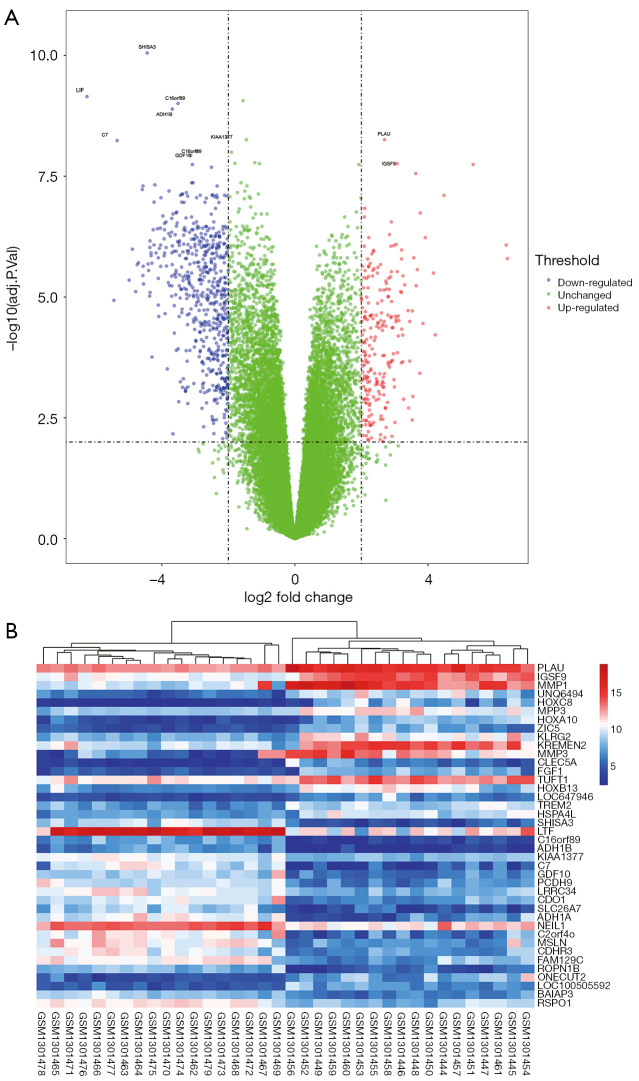
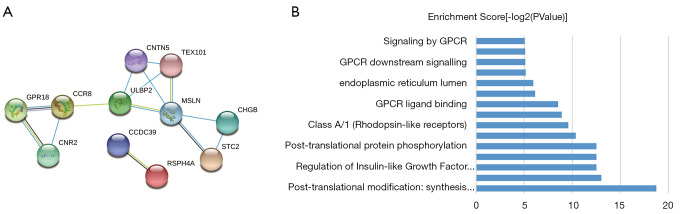
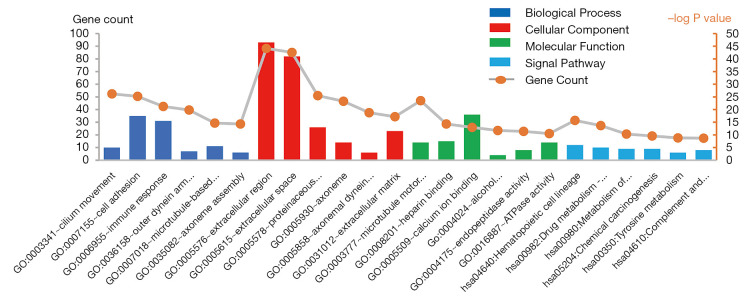
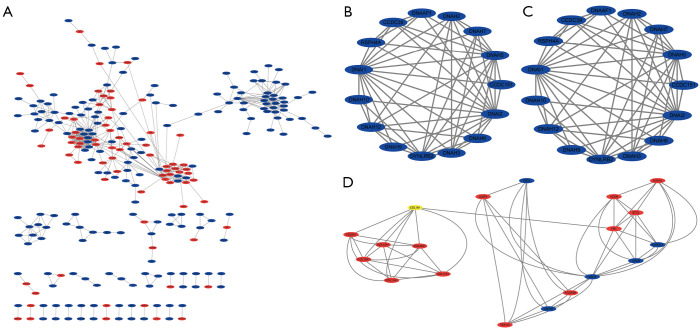
In this study, we downloaded gene expression profiles of GSE53819 from the Gene Expression Omnibus (GEO) database, including 18 HNSC tissues and 18 normal tissues. The differentially expressed genes (DEGs) were identified using the Linear Models for Microarray Data R package. Adjusted P values <0.01 and |log2 fold change (FC)| ≥2 was regarded as the filter condition. Gene ontology (GO) and Kyoto Encyclopedia of Genes and Genomes (KEGG) analysis of these DEGs were performed on the Database for Annotation, Visualization, and Integrated Discovery (DAVID) online website. Protein-protein interaction (PPI) network was built to visualize the interactions between these DEGs using the STRING online website. Finally, hub genes were identified by The Cancer Genome Atlas (TCGA) database.
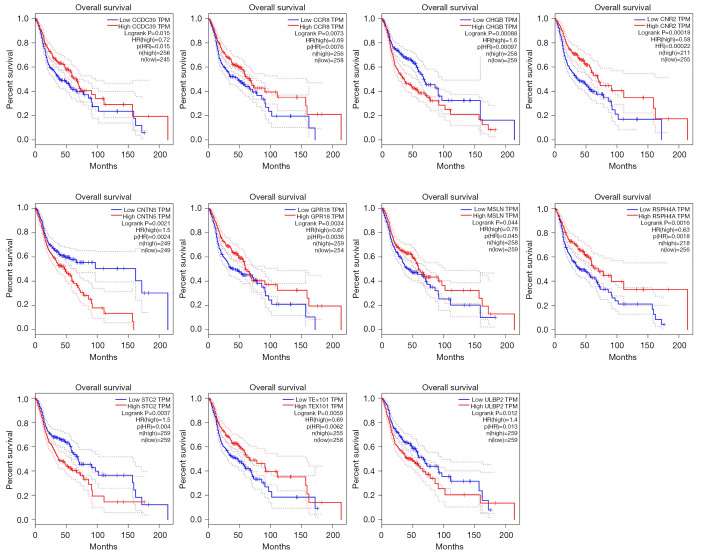
A total of 604 DEGs consisting of 159 upregulated genes and 445 downregulated genes were selected. From these DEGs, prognostic related genes could serve as potential biomarkers for the molecular diagnosis and therapeutic intervention of HNSC were identified. Including the known genes, , , , , , and . And the novel genes, , , , , and were strongly implicated in HNSC.
In summary, we indicated genes associated with prognostic in patients, which improve our understanding of HNSC and could be used as new therapeutic targets for HNSC.
头颈部鳞状细胞癌(HNSC)仍然是一个重要的公共卫生问题,其经典风险因素为吸烟和过量饮酒,且预后通常较差。因此,探索肿瘤发生的潜在机制,筛选此类研究中确定的基因和通路及其在发病机制中的作用非常重要。本研究的目的是鉴定与HNSC发生发展相关的基因或信号通路。
在本研究中,我们从基因表达综合数据库(GEO)下载了GSE53819的基因表达谱,包括18例HNSC组织和18例正常组织。使用微阵列数据线性模型R包鉴定差异表达基因(DEG)。调整后的P值<0.01且|log2倍数变化(FC)|≥2被视为筛选条件。在注释、可视化和综合发现数据库(DAVID)在线网站上对这些DEG进行基因本体(GO)和京都基因与基因组百科全书(KEGG)分析。使用STRING在线网站构建蛋白质-蛋白质相互作用(PPI)网络以可视化这些DEG之间的相互作用。最后,通过癌症基因组图谱(TCGA)数据库鉴定枢纽基因。
共筛选出604个DEG,其中包括159个上调基因和445个下调基因。从这些DEG中,鉴定出与预后相关的基因,这些基因可作为HNSC分子诊断和治疗干预的潜在生物标志物。包括已知基因, , , , , , 和 。以及新基因, , , , , 和 与HNSC密切相关。
总之,我们指出了与患者预后相关的基因,这增进了我们对HNSC的理解,并可作为HNSC的新治疗靶点。