Liu Hao, Zhang Congjun
Department of Oncology, The First Affiliated Hospital of Anhui Medical University, Hefei, China.
Transl Cancer Res. 2020 Nov;9(11):7183-7195. doi: 10.21037/tcr-20-322A.
Hepatocellular carcinoma (HCC) is one of the most life-threatening malignancies worldwide due to the lack of significant improvement in therapeutic methods. This study aimed to unravel the effects of paeonol, the main active component of , on survivin, a key molecule in tumorigenesis, and elucidate the mechanisms by which paeonol exerts antineoplastic effects in human HCC cells.
Immunohistochemistry (IHC) was used to study the expression levels of survivin and cyclooxygenase-2 (COX-2) in 57 human HCC tissue samples. Human HCC cell lines (HepG2 and SMMC-7721) were treated with prostaglandin E2 (PGE2). Subsequently, the cells were treated with paeonol and NS-398, and the expression levels of survivin, COX-2, and PGE2 were evaluated by Western blotting and enzyme-linked immunosorbent assay (ELISA), respectively. Fluorescence-activated cell sorting (FACS) and terminal deoxynucleotidyl transferase dUTP nick end labeling (TUNEL) staining were performed to analyze cell proliferation and apoptosis.
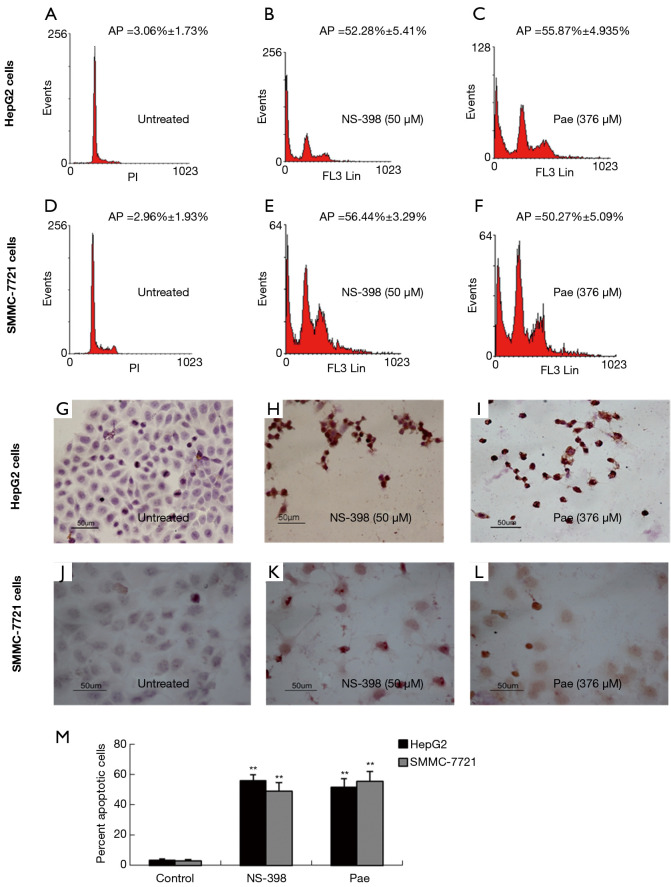
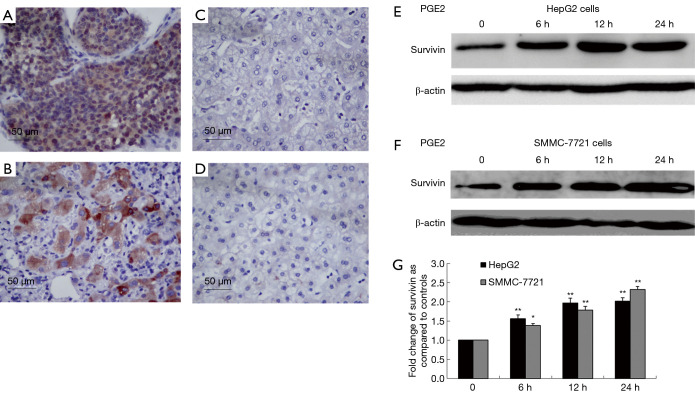
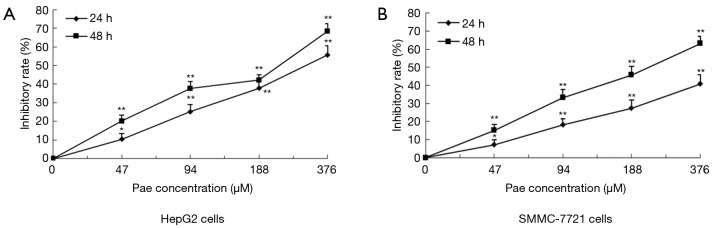
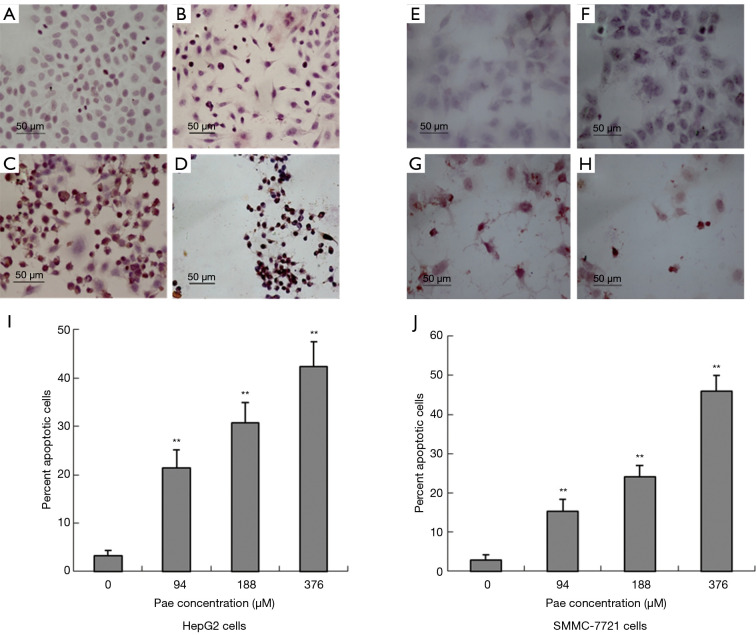
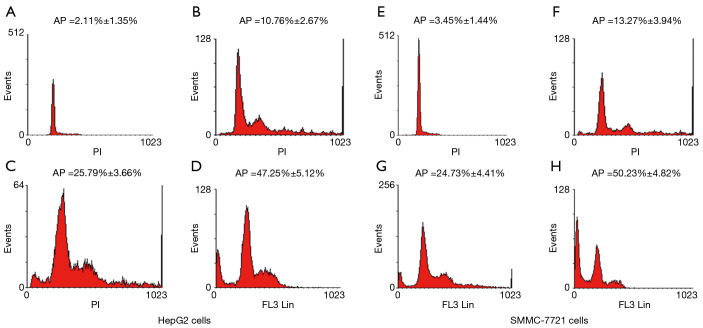
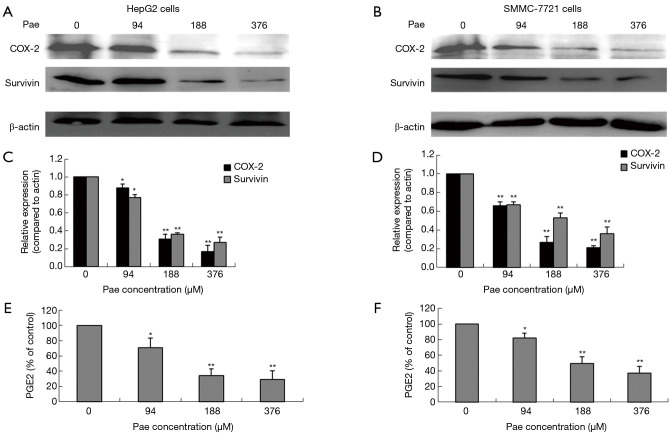
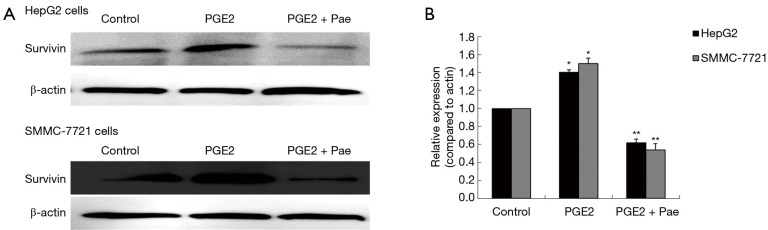
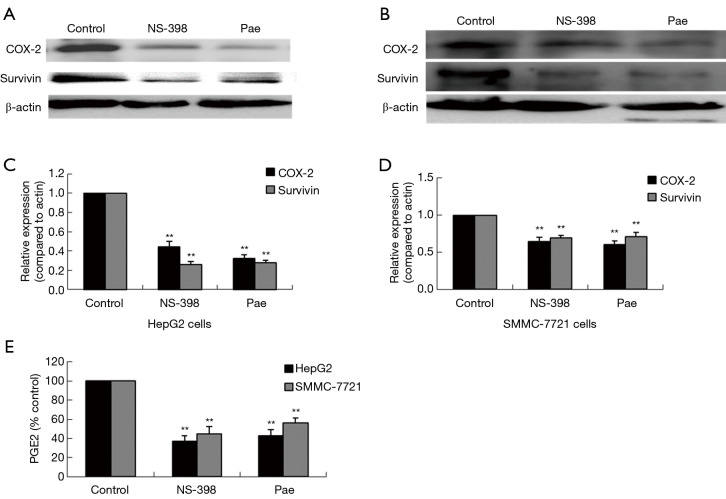
Survivin was expressed in 47 of 57 human HCC tissue samples, as observed by IHC, and its expression was correlated with COX-2 activity. Furthermore, Western blotting showed that the expression of survivin was increased in HepG2 and SMMC-7721 cells treated with PGE2, the biosynthesis of which is mainly regulated by COX-2. Interestingly, FACS and TUNEL staining demonstrated that paeonol significantly inhibited the proliferation of HepG2 and SMMC-7721 cells and induced apoptosis, concomitant with the downregulation of survivin. The levels of COX-2 and PGE2 were also reduced by paeonol, as confirmed by Western blotting and ELISA, respectively. To determine the mechanism by which paeonol inhibited survivin in HCC cells the effects of COX-2 expression on surviving were studied. Treatment with the COX-2 selective inhibitor NS398 effectively decreased the levels of PGE2 and survivin, inducing apoptosis in a manner similar to that of paeonol. Survivin expression was increased by PGE2 treatment but was blocked by paeonol, which suggests that paeonol inhibits survivin by inhibiting the COX-2/PGE2 signaling pathway.
To the best of our knowledge, this is the first study to demonstrate that paeonol can exert antitumor effects on HCC cells by targeting survivin via the COX-2/PGE2 signaling pathway. Paeonol could therefore be considered as a potential therapeutic candidate for HCC.
由于治疗方法缺乏显著改进,肝细胞癌(HCC)是全球最具生命威胁的恶性肿瘤之一。本研究旨在揭示丹皮酚(芍药苷的主要活性成分)对生存素(肿瘤发生中的关键分子)的影响,并阐明丹皮酚在人肝癌细胞中发挥抗肿瘤作用的机制。
采用免疫组织化学(IHC)研究57例人肝癌组织样本中生存素和环氧合酶-2(COX-2)的表达水平。用人肝癌细胞系(HepG2和SMMC-7721)与前列腺素E2(PGE2)处理。随后,用丹皮酚和NS-398处理细胞,分别通过蛋白质印迹法和酶联免疫吸附测定(ELISA)评估生存素、COX-2和PGE2的表达水平。进行荧光激活细胞分选(FACS)和末端脱氧核苷酸转移酶dUTP缺口末端标记(TUNEL)染色以分析细胞增殖和凋亡。
通过免疫组织化学观察,57例人肝癌组织样本中有47例表达生存素,其表达与COX-2活性相关。此外,蛋白质印迹法显示,用PGE2处理的HepG2和SMMC-7721细胞中生存素表达增加,其生物合成主要受COX-2调节。有趣的是,FACS和TUNEL染色表明,丹皮酚显著抑制HepG2和SMMC-7721细胞的增殖并诱导凋亡,同时生存素下调。蛋白质印迹法和ELISA分别证实,丹皮酚还降低了COX-2和PGE2的水平。为了确定丹皮酚在肝癌细胞中抑制生存素的机制,研究了COX-2表达对生存素的影响。用COX-2选择性抑制剂NS398处理可有效降低PGE2和生存素水平,以类似于丹皮酚的方式诱导凋亡。PGE2处理可增加生存素表达,但被丹皮酚阻断,这表明丹皮酚通过抑制COX-2/PGE2信号通路抑制生存素。
据我们所知,这是第一项证明丹皮酚可通过COX-2/PGE2信号通路靶向生存素对肝癌细胞发挥抗肿瘤作用的研究。因此,丹皮酚可被视为肝癌的潜在治疗候选药物。