University of California San Francisco, Division of Endocrinology and Metabolism, San Francisco, CA, USA.
University of California San Francisco, Department of Epidemiology and Biostatistics, San Francisco, CA, USA.
J Bone Miner Res. 2022 May;37(5):876-884. doi: 10.1002/jbmr.4519. Epub 2022 Feb 27.
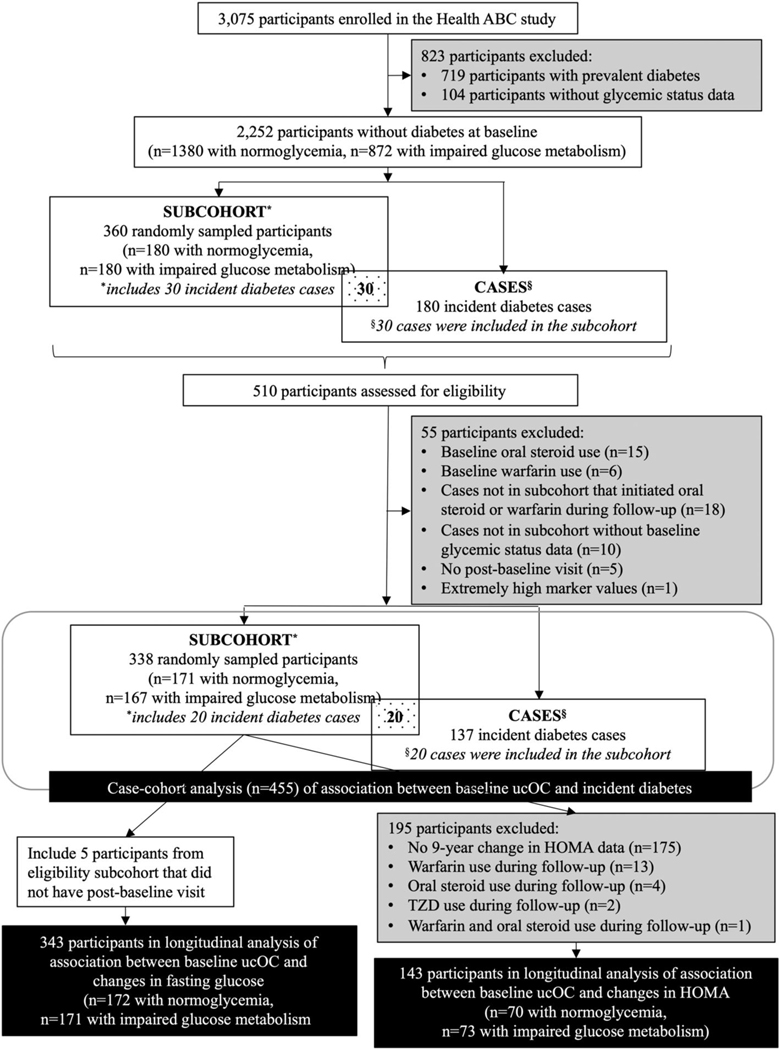
Mouse models suggest that undercarboxylated osteocalcin (ucOC), produced by the skeleton, protects against type 2 diabetes development, whereas human studies have been inconclusive. We aimed to determine if ucOC or total OC is associated with incident type 2 diabetes or changes in fasting glucose, insulin resistance (HOMA-IR), or beta-cell function (HOMA-Beta). A subcohort (n = 338; 50% women; 36% black) was identified from participants without diabetes at baseline in the Health, Aging, and Body Composition Study. Cases of incident type 2 diabetes (n = 137) were defined as self-report at an annual follow-up visit, use of diabetes medication, or elevated fasting glucose during 8 years of follow-up. ucOC and total OC were measured in baseline serum. Using a case-cohort design, the association between biomarkers and incident type 2 diabetes was assessed using robust weighted Cox regression. In the subcohort, linear regression models analyzed the associations between biomarkers and changes in fasting glucose, HOMA-IR, and HOMA-Beta over 9 years. Higher levels of ucOC were not statistically associated with increased risk of incident type 2 diabetes (adjusted hazard ratio = 1.06 [95% confidence interval, 0.84-1.34] per 1 standard deviation [SD] increase in ucOC). Results for %ucOC and total OC were similar. Adjusted associations of ucOC, %ucOC, and total OC with changes in fasting glucose, HOMA-IR, and HOMA-Beta were modest and not statistically significant. We did not find evidence of an association of baseline undercarboxylated or total osteocalcin with risk of incident type 2 diabetes or with changes in glucose metabolism in older adults. © 2022 American Society for Bone and Mineral Research (ASBMR).
小鼠模型表明,骨骼产生的非羧化骨钙素(ucOC)可预防 2 型糖尿病的发生,而人体研究尚无定论。我们旨在确定 ucOC 或总 OC 是否与 2 型糖尿病的发生或空腹血糖、胰岛素抵抗(HOMA-IR)或β细胞功能(HOMA-Beta)的变化有关。在健康、衰老和身体成分研究中,从基线时无糖尿病的参与者中确定了一个亚队列(n=338;女性占 50%;黑人占 36%)。2 型糖尿病的发病病例(n=137)定义为在每年的随访中自我报告、使用糖尿病药物或在 8 年的随访期间空腹血糖升高。在基线血清中测量了 ucOC 和总 OC。使用病例-队列设计,使用稳健加权 Cox 回归评估生物标志物与 2 型糖尿病发病之间的关联。在亚队列中,线性回归模型分析了生物标志物与 9 年内空腹血糖、HOMA-IR 和 HOMA-Beta 变化之间的关联。ucOC 水平升高与 2 型糖尿病发病风险增加无关(调整后的危险比[HR]=1.06 [95%置信区间,0.84-1.34],ucOC 每增加 1 个标准差[SD])。%ucOC 和总 OC 的结果相似。ucOC、%ucOC 和总 OC 与空腹血糖、HOMA-IR 和 HOMA-Beta 变化的调整关联适度且无统计学意义。我们没有发现基线非羧化或总骨钙素与老年人 2 型糖尿病发病风险或葡萄糖代谢变化之间存在关联的证据。© 2022 美国骨骼与矿物质研究协会(ASBMR)。