Department of Biomedical Sciences, Seoul National University Graduate School, Seoul, Korea.
Department of Preventive Medicine, Seoul National University College of Medicine, Seoul, Korea.
PLoS One. 2022 Feb 4;17(2):e0260826. doi: 10.1371/journal.pone.0260826. eCollection 2022.
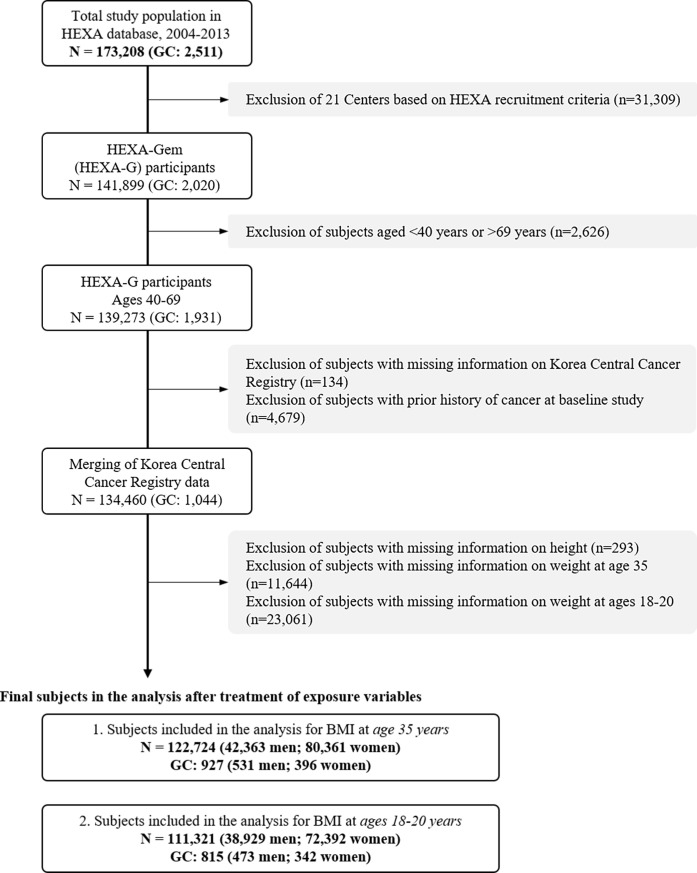
Emerging evidence has indicated a possible link between obesity in early life with subsequent cancer risks, but its association with gastric cancer remains unknown. This study aimed to investigate the association of obesity at ages 18-20 and 35 with the later risk of gastric cancer among the Korean population. Included were 122,724 individuals who participated in the large-scale prospective cohort study, the Health Examinees-Gem (HEXA-G) study, during 2004-2017. Multivariable Cox proportional hazards models were used to estimate hazard ratios (HR) and 95% confidence intervals (CI) for gastric cancer risk associated with body mass index (BMI) at ages 18-20 and 35 years. During a mean follow-up period of 8.6±2.1 years, a total 927 gastric cancer cases (531 men and 396 women) were identified. When compared to normal BMI (18.5-23.0 kg/m2), obesity (BMI ≥30 kg/m2) at age 35 was significantly associated with increased risk of gastric cancer later in life among total participants (HR 1.94, 95% CI 1.26-2.97, p 0.01). When analyzed separately by sex, obesity at 35 years of age was significantly associated with increased risk of gastric cancer among both men (HR 1.79, 95% CI 1.02-3.13, p 0.05) and women (HR 2.35, 95% CI 1.21-4.60, p 0.02). No significant associations were found for obesity at late adolescence in both men and women. Our findings suggest that obesity in early adulthood may be associated with an increased risk of gastric cancer. The results may aid in understanding the etiology of GC in a population with a divergent trend of gastric cancer.
新的证据表明,生命早期的肥胖与随后的癌症风险之间可能存在联系,但与胃癌的关联尚不清楚。本研究旨在调查韩国人群中 18-20 岁和 35 岁时的肥胖与胃癌后期风险之间的关系。共纳入了 122724 名参加大规模前瞻性队列研究健康体检者-基因组学(HEXA-G)研究的个体,研究时间为 2004 年至 2017 年。使用多变量 Cox 比例风险模型来估计与 18-20 岁和 35 岁时的体重指数(BMI)相关的胃癌风险的风险比(HR)和 95%置信区间(CI)。在平均 8.6±2.1 年的随访期间,共发现 927 例胃癌病例(531 例男性和 396 例女性)。与正常 BMI(18.5-23.0kg/m2)相比,35 岁时肥胖(BMI≥30kg/m2)与总参与者中胃癌的发生风险增加显著相关(HR 1.94,95%CI 1.26-2.97,p<0.01)。按性别分别分析时,35 岁时的肥胖与男性(HR 1.79,95%CI 1.02-3.13,p=0.05)和女性(HR 2.35,95%CI 1.21-4.60,p=0.02)的胃癌风险增加显著相关。在男性和女性中,青春期晚期的肥胖与胃癌均无显著相关性。我们的研究结果表明,成年早期的肥胖可能与胃癌风险增加有关。这些结果可能有助于了解具有不同胃癌趋势的人群中 GC 的病因。