Department of Biology, Emory University, Atlanta, GA 30322;
National Institute for Medical Research Mwanza Center, Mwanza, Tanzania.
Proc Natl Acad Sci U S A. 2022 Feb 8;119(6). doi: 10.1073/pnas.2116512119.
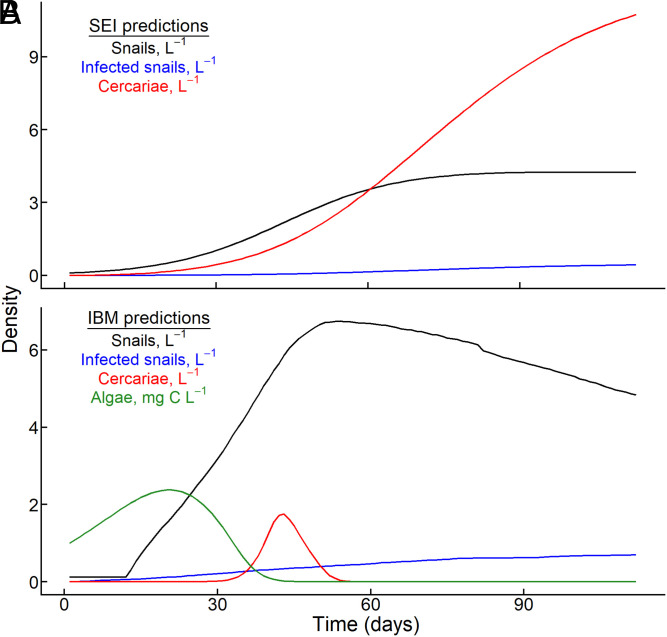
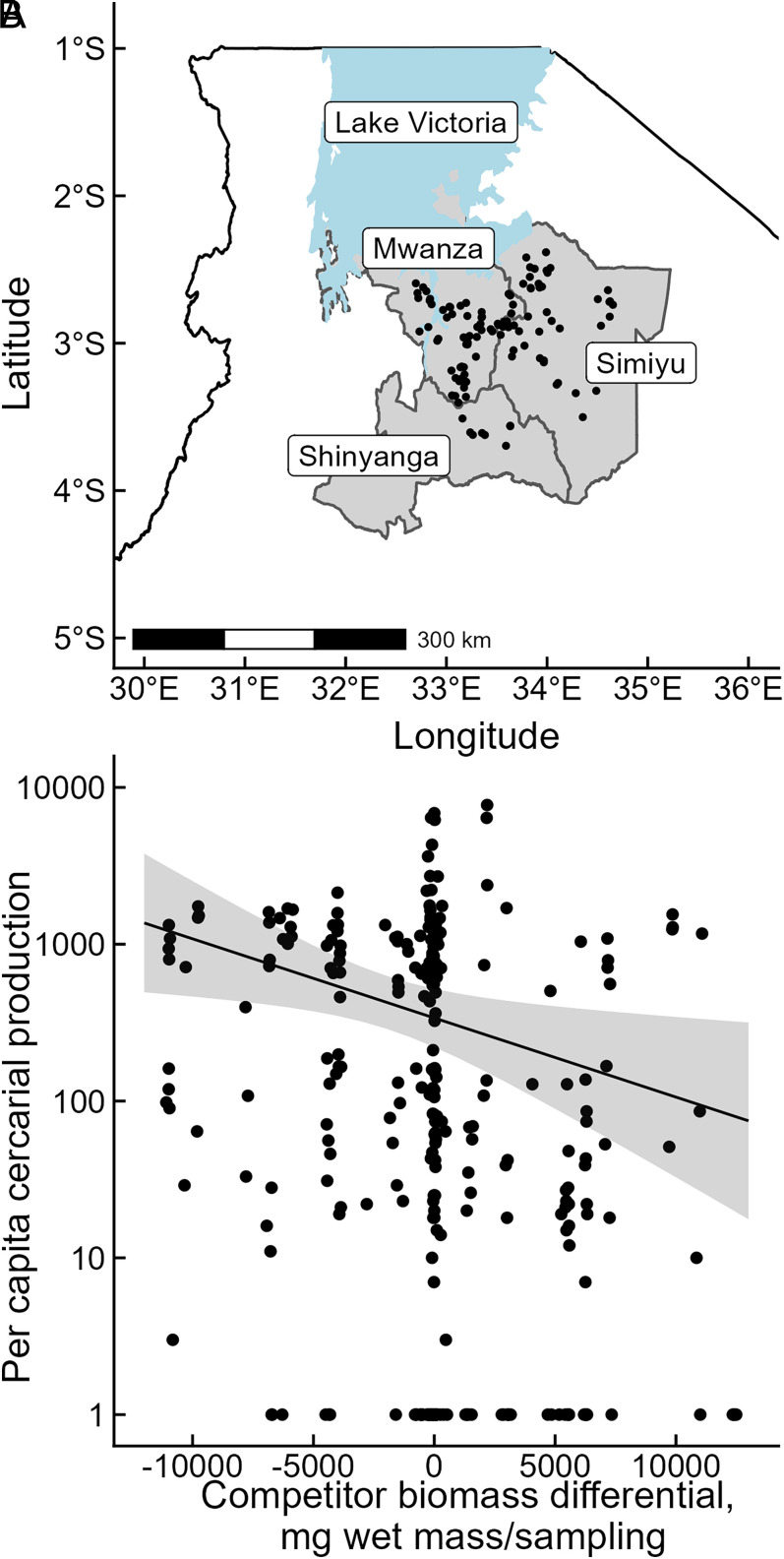
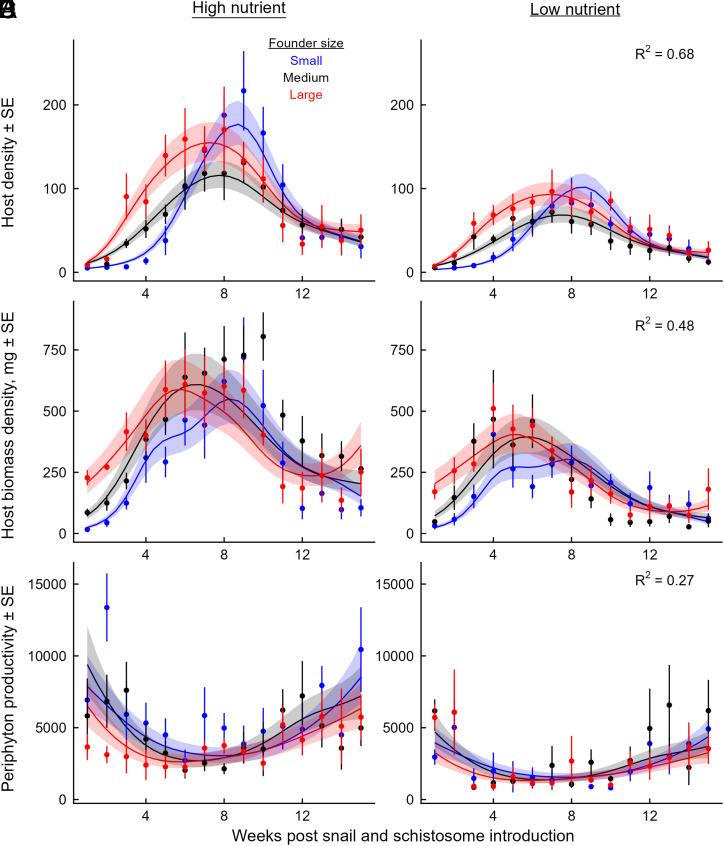
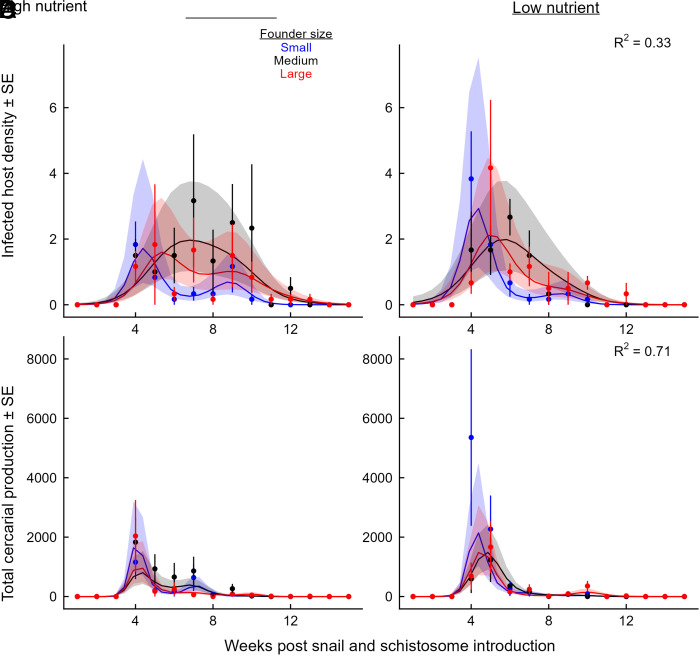
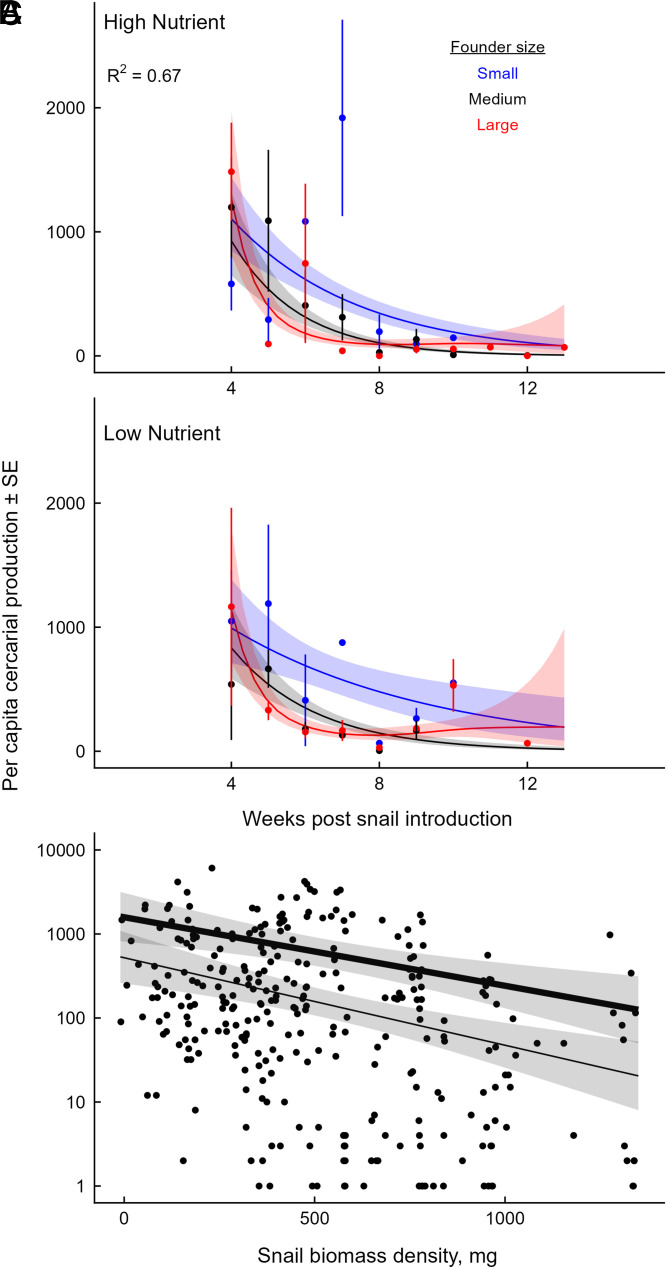
Predicting and disrupting transmission of human parasites from wildlife hosts or vectors remains challenging because ecological interactions can influence their epidemiological traits. Human schistosomes, parasitic flatworms that cycle between freshwater snails and humans, typify this challenge. Human exposure risk, given water contact, is driven by the production of free-living cercariae by snail populations. Conventional epidemiological models and management focus on the density of infected snails under the assumption that all snails are equally infectious. However, individual-level experiments contradict this assumption, showing increased production of schistosome cercariae with greater access to food resources. We built bioenergetics theory to predict how resource competition among snails drives the temporal dynamics of transmission potential to humans and tested these predictions with experimental epidemics and demonstrated consistency with field observations. This resource-explicit approach predicted an intense pulse of transmission potential when snail populations grow from low densities, i.e., when per capita access to resources is greatest, due to the resource-dependence of cercarial production. The experiment confirmed this prediction, identifying a strong effect of infected host size and the biomass of competitors on per capita cercarial production. A field survey of 109 waterbodies also found that per capita cercarial production decreased as competitor biomass increased. Further quantification of snail densities, sizes, cercarial production, and resources in diverse transmission sites is needed to assess the epidemiological importance of resource competition and support snail-based disruption of schistosome transmission. More broadly, this work illustrates how resource competition can sever the correspondence between infectious host density and transmission potential.
预测和阻断野生动物宿主或媒介传播的人类寄生虫仍然具有挑战性,因为生态相互作用会影响其流行病学特征。人类血吸虫是一种寄生性扁形虫,在淡水蜗牛和人类之间循环,是这种挑战的典型代表。鉴于与水的接触,人类的暴露风险取决于蜗牛种群产生自由生活的尾蚴。传统的流行病学模型和管理方法集中在受感染蜗牛的密度上,假设所有蜗牛的传染性都是相等的。然而,个体水平的实验反驳了这一假设,表明在获得更多食物资源的情况下,血吸虫尾蚴的产生会增加。我们构建了生物能量学理论来预测蜗牛之间的资源竞争如何驱动向人类传播潜力的时间动态,并通过实验性流行病学检验了这些预测,并与现场观察结果一致。这种资源明确的方法预测了当蜗牛种群从低密度增长时,即当人均资源获取量最大时,传播潜力会出现强烈的脉冲,这是由于尾蚴产生的资源依赖性。该实验证实了这一预测,发现感染宿主大小和竞争者生物量对人均尾蚴产生有强烈影响。对 109 个水体的实地调查还发现,人均尾蚴产生随着竞争者生物量的增加而减少。需要在不同的传播地点进一步量化蜗牛密度、大小、尾蚴产生和资源,以评估资源竞争的流行病学重要性,并支持基于蜗牛的血吸虫传播中断。更广泛地说,这项工作说明了资源竞争如何破坏感染宿主密度与传播潜力之间的对应关系。