Barba Lorenzo, Paolini Paoletti Federico, Bellomo Giovanni, Gaetani Lorenzo, Halbgebauer Steffen, Oeckl Patrick, Otto Markus, Parnetti Lucilla
Section of Neurology, Laboratory of Clinical Neurochemistry, Department of Medicine and Surgery, University of Perugia, Perugia, Italy.
Department of Neurology, University of Ulm, Ulm, Germany.
Mov Disord. 2022 Apr;37(4):669-683. doi: 10.1002/mds.28941. Epub 2022 Feb 5.
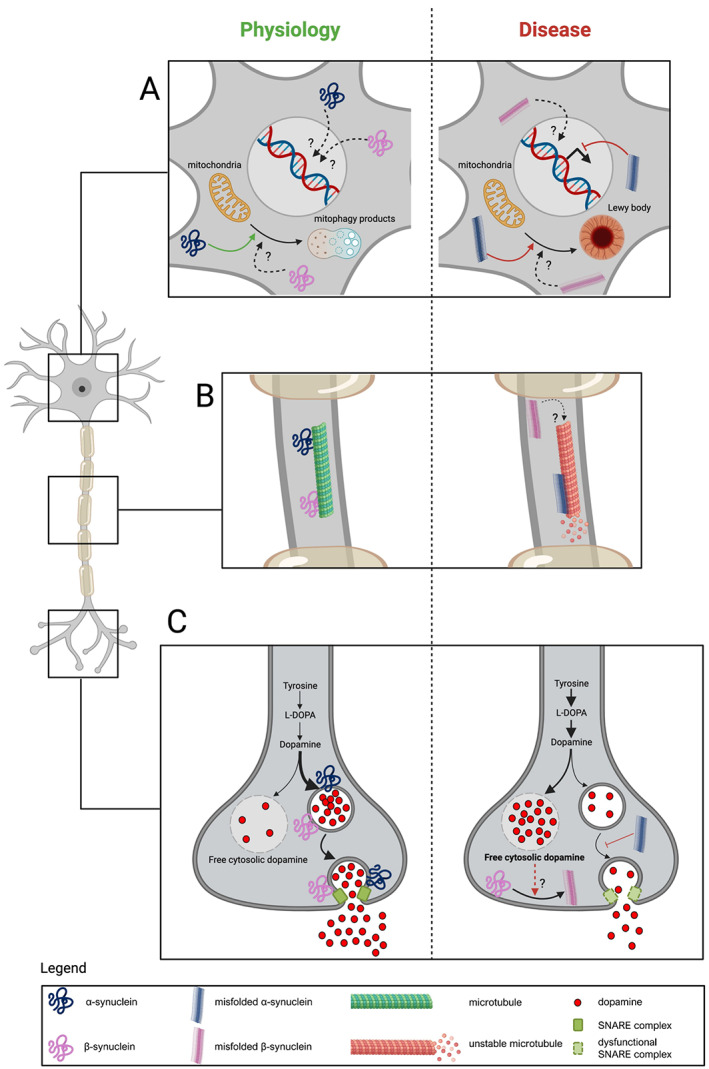
The synuclein family includes three neuronal proteins, named α-synuclein, β-synuclein, and γ-synuclein, that have peculiar structural features. α-synuclein is largely known for being a key protein in the pathophysiology of Parkinson's disease (PD) and other synucleinopathies, namely, dementia with Lewy bodies and multisystem atrophy. The role of β-synuclein and γ-synuclein is less well understood in terms of physiological functions and potential contribution to human diseases. α-synuclein has been investigated extensively in both cerebrospinal fluid (CSF) and blood as a potential biomarker for synucleinopathies. Recently, great attention has been also paid to β-synuclein, whose CSF and blood levels seem to reflect synaptic damage and neurodegeneration independent of the presence of synucleinopathy. In this review, we aim to provide an overview on the pathophysiological roles of the synucleins. Because γ-synuclein has been poorly investigated in the field of synucleinopathy and its pathophysiological roles are far from being clear, we focus on the interactions between α-synuclein and β-synuclein in PD. We also discuss the role of α-synuclein and β-synuclein as potential biomarkers to improve the diagnostic characterization of synucleinopathies, thus highlighting their potential application in clinical trials for disease-modifying therapies. © 2022 The Authors. Movement Disorders published by Wiley Periodicals LLC on behalf of International Parkinson and Movement Disorder Society.
突触核蛋白家族包括三种神经元蛋白,分别名为α-突触核蛋白、β-突触核蛋白和γ-突触核蛋白,它们具有独特的结构特征。α-突触核蛋白在很大程度上因是帕金森病(PD)和其他突触核蛋白病(即路易体痴呆和多系统萎缩)病理生理学中的关键蛋白而闻名。β-突触核蛋白和γ-突触核蛋白在生理功能以及对人类疾病的潜在影响方面了解较少。α-突触核蛋白已在脑脊液(CSF)和血液中作为突触核蛋白病的潜在生物标志物进行了广泛研究。最近,β-突触核蛋白也受到了极大关注,其脑脊液和血液水平似乎能反映突触损伤和神经退行性变,而与突触核蛋白病的存在无关。在本综述中,我们旨在概述突触核蛋白的病理生理作用。由于γ-突触核蛋白在突触核蛋白病领域研究较少,其病理生理作用远未明确,我们将重点关注帕金森病中α-突触核蛋白与β-突触核蛋白之间的相互作用。我们还将讨论α-突触核蛋白和β-突触核蛋白作为潜在生物标志物在改善突触核蛋白病诊断特征方面的作用,从而突出它们在疾病修饰治疗临床试验中的潜在应用。© 2022作者。《运动障碍》由Wiley Periodicals LLC代表国际帕金森和运动障碍协会出版。